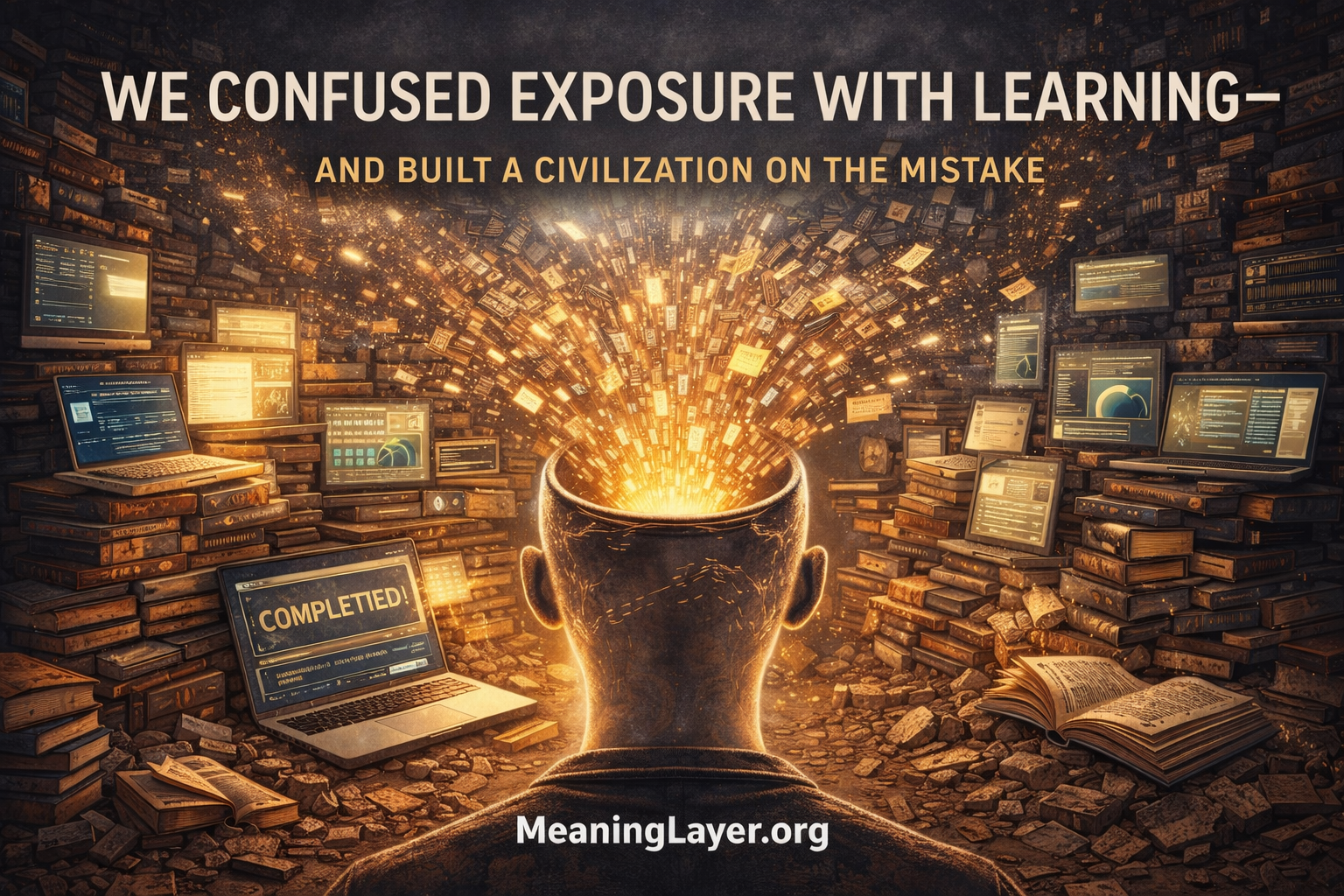
Everyone has access to everything. Nobody can do anything. This is not paradox—it is confusion elevated to civilizational architecture.
I. The Pattern Everyone Recognizes
A university graduates students with perfect GPAs who cannot write coherent emails. An online platform reports millions completing courses while employers report graduates lacking basic skills. A company invests heavily in training while capability visibly degrades. A society with more educational resources than any in history produces populations describing themselves as less capable than previous generations.
These are not isolated failures. They are symptoms of a single architectural confusion that became foundational to how civilization understands improvement: we confused exposure with learning and built everything—education, employment, advancement, verification—on the assumption they were the same.
Exposure is access to information, explanation, demonstration, or assistance. Learning is capability that persists independently over time. For most of human history, these were effectively identical because the gap between exposure and capability was obvious and immediate. If you were exposed to how to make fire and could not make fire independently weeks later, you had not learned. The test was built into survival.
This collapsed when systems could provide exposure without requiring persistent capability, when completion could be measured without testing retention, when credentials could verify participation without confirming learning occurred. The confusion became institutionalized: education measured exposure (lectures attended, assignments completed), employment assumed exposure created capability (degrees earned, training finished), and society optimized systems to maximize exposure while never testing whether learning persisted.
The result is civilization optimizing for a proxy that diverged from what it was meant to measure, at scale, across every domain, for decades. We did not notice because exposure and learning looked identical at the moment of acquisition. Only time reveals the difference. Only persistence proves learning occurred. And we never tested for persistence because we assumed exposure was learning.
II. The Confusion at Every Level
Education optimizes exposure, not learning.
Students attend lectures (exposure), complete assignments (exposure), pass exams (exposure testing short-term retention), receive degrees (credential of exposure). At no point does the system verify whether capability persists months or years later when the student must function independently. The assumption: if they were exposed to the material and completed requirements, learning occurred.
This assumption fails comprehensively with AI assistance. Students can complete every assignment with AI, pass every exam with AI-generated answers, write perfect papers with AI assistance—achieving maximal exposure metrics while learning approaches zero. Performance during coursework is excellent. Capability after graduation is absent. The system measured exposure, assumed learning, and optimized completion while genuine capability development became optional.
Employment assumes exposure creates capability.
Hiring decisions based on credentials (exposure to education), certifications (exposure to training), years of experience (exposure to work contexts). The assumption: exposure over time creates persistent capability. Reality: exposure creates temporary performance that requires continued assistance or context. Remove the context, and capability collapses.
A professional with five years of experience using tools X, Y, Z may possess zero capability to function without those tools. A certified expert may have completed training without developing transferable understanding. A graduate with honors may have optimized completion metrics without building independent capability. Employment systems cannot distinguish these because they measure exposure (credentials, experience, training) and assume learning (persistent capability) occurred.
Advancement optimizes for exposure accumulation.
Promotions reward those with most credentials (exposure), most training completed (exposure), most projects finished (exposure). Career progression becomes exposure accumulation game. The assumption: more exposure equals more capability. Reality: more exposure often equals deeper dependency on tools and contexts that enabled the exposure without creating transferable capability.
This is why senior professionals can appear extraordinarily capable within specific contexts (with their tools, their team, their established processes) while being unable to function in novel contexts requiring independent capability. The exposure accumulated. The learning never occurred or degraded through lack of persistence testing.
Verification cannot distinguish exposure from learning.
Every verification system—exams, interviews, portfolios, performance reviews, certifications—measures recent exposure or performance within supportive contexts. None test persistent independent capability over time. We verify people were exposed to information, can perform with assistance available, achieved outcomes in favorable conditions. We do not verify capability persists months later without assistance in novel contexts.
This makes exposure and learning indistinguishable to verification systems. Both produce identical signals during measurement. Only temporal testing—removing assistance and measuring capability after significant time—reveals which was which. And we built no infrastructure for temporal testing because we assumed verification of exposure verified learning.
III. Why the Confusion Became Foundational
The confusion was not obviously wrong when it formed. For most of human history, exposure and learning were tightly coupled:
Learning required sustained engagement. You could not complete apprenticeship without developing capability because completion required demonstrating independent function. You could not finish training without learning because training lasted until capability persisted. Exposure and learning happened together because systems optimized for persistent capability, not completion metrics.
Tools did not enable performance without learning. Pre-modern tools augmented capability but did not replace it. A better hammer made a capable craftsman more productive. It did not enable an incapable person to produce expert-level work. Tools required and revealed capability rather than hiding its absence.
Time naturally tested persistence. When learning happened through extended practice, capability either persisted or obviously degraded. A blacksmith who stopped working lost skill visibly. A scholar who ceased studying lost knowledge noticeably. The connection between practice, learning, and persistence was experientially obvious.
Credentials meant demonstrated capability. A master craftsman certification meant you produced excellent work independently over years. A degree meant you demonstrated deep understanding across extended time. Credentials verified persistent capability because acquiring them required persistence, not just exposure.
This created an environment where assuming exposure = learning worked reasonably well. If someone completed apprenticeship, they learned. If someone earned credentials through years of demonstrated independent work, the credentials indicated capability. The assumption held because the gap between exposure and learning was small and visible.
Everything changed when:
Systems could measure completion without persistence. Education shifted to credit hours, assignments completed, exams passed—all measurable at moment of completion, none requiring capability persist over time. Optimization toward these metrics made exposure the goal. Learning became unmeasured externality.
Tools enabled performance without capability. AI assistance makes it possible to produce expert-level output while possessing novice-level capability. The tool handles everything that would require learning. Performance metrics remain excellent. Capability development stops. The gap between performance and capability becomes invisible to measurement.
Verification tested moments, not duration. Exams test what you know today, not whether you will remember months from now. Interviews test current presentation, not persistent capability. Portfolios show recent work, not whether you could recreate it independently later. Verification optimized for immediate assessment, making persistence invisible.
Credentials certified exposure, not capability. Degrees certify you attended classes and completed requirements—exposure metrics. They do not certify capability persists, transfers, or functions independently. But we interpret credentials as capability certification because we confused the two. The credential inflation crisis is exposure inflation mistaken for capability growth.
The confusion became foundational because every system—education, employment, advancement, verification, credentials—was built on the assumption that measuring exposure measured learning. When the assumption broke, every system built on it began producing exposure theater: perfect metrics, zero capability.
IV. Why Reform Fails Without This Distinction
Education has attempted reform for decades. More access to information. Better online platforms. Personalized learning. Competency-based education. AI tutoring. Every reform fails to solve the capability crisis because every reform optimizes exposure while assuming exposure creates learning.
More information access: Students get unlimited information through internet, AI, resources. Exposure maximized. Learning unchanged because information access is not learning—it is resource availability. Persisting capability requires sustained engagement with difficulty, not access to answers.
Better platforms: Online education makes exposure more efficient, scalable, measurable. Students complete more courses faster. Capability at completion remains unmeasured. Whether learning persists becomes irrelevant to platform metrics. Optimization increases exposure, not learning.
Personalized learning: Adapts exposure to individual pace and style. Students progress through material at optimal speed. Exposure customized. Persistence untested. Learning still confused with completion. Reform makes exposure more efficient without verifying learning occurred.
Competency-based education: Measures whether students can demonstrate competency at moment of assessment. Better than time-based progression. But competency at assessment does not verify capability persists months later without assistance. Still measures exposure (can do it now) rather than learning (can do it independently later).
AI tutoring: Provides perfect personalized assistance. Students complete work faster with better results. Exposure to explanations maximized. Capability to function without AI assistance approaches zero. The reform optimizes the confusion—makes exposure more effective while ensuring learning does not occur.
Every reform fails because it operates within the confusion rather than resolving it. The reforms assume: make exposure better, and learning will follow. Reality: make exposure better, and the gap between exposure and learning widens because exposure becomes easier while learning still requires the friction, time, and independence that reforms systematically remove.
Employment faces the same pattern. Skills training, professional development, mentorship programs, knowledge transfer initiatives—all optimize exposure. Completion metrics improve. Capability gap widens. Organizations report investing more in development while experiencing faster capability degradation. The reforms optimize exposure while capability requires what reforms eliminate: sustained independent struggle over time.
Without the distinction between exposure and learning, reform cannot succeed because it does not know what to optimize for. With the distinction, reform becomes straightforward: optimize for persistent independent capability verified through temporal testing, not for exposure completion verified at moment of acquisition.
V. Persisto Ergo Didici: The Test That Ends the Confusion
There exists a test that distinguishes exposure from learning with perfect reliability: temporal verification of independent capability.
Expose someone to knowledge, skill, or process. Wait months. Remove all assistance. Test whether they can perform independently at comparable difficulty. If capability persists, learning occurred. If capability collapsed, exposure happened but learning did not.
This is not just better measurement. This is epistemological distinction that makes learning measurable when exposure and learning produce identical signals at acquisition:
At acquisition: Student completes assignment with AI assistance. Perfect performance. Teacher cannot tell if learning occurred.
Temporal verification: Three months later, remove AI, test comparable assignment. Student cannot perform. Reveals: exposure occurred (completion with assistance), learning did not occur (capability absent without assistance).
At acquisition: Professional completes training program. Tests show excellent understanding. Organization cannot verify if capability persists.
Temporal verification: Six months later, test whether they can apply knowledge independently in novel context. Professional cannot function. Reveals: exposure occurred (training completed), learning did not (capability does not transfer or persist).
At acquisition: Graduate receives degree certifying exposure to material. Credential looks identical for those who learned and those who optimized completion.
Temporal verification: One year post-graduation, test core capabilities independently. Graduate cannot perform. Reveals: degree certified exposure, not learning.
The Latin formulation Persisto Ergo Didici—”I persist, therefore I learned”—captures this epistemological transformation: learning is not what you experienced, understood, or completed; learning is what persists over time independent of enabling conditions. If capability does not persist, learning did not occur regardless of how acquisition felt or measured.
This transforms learning from internal experience (subjective, unmeasurable, easily confused with exposure) to external verification (objective, measurable, impossible to fake). Just as ”Cogito Ergo Sum” proved existence through thinking, Persisto Ergo Didici proves learning through persistence: your capability proves itself through endurance when assistance ends and time passes.
The protocol requires four components:
Temporal separation: Test capability months after acquisition, not immediately. Immediate testing measures short-term exposure retention. Temporal testing measures genuine learning that persists.
Independence verification: Remove all assistance during testing. No AI, no tools beyond what genuine application would provide, no guidance. Test measures what the person can do alone, not what they can complete with help.
Comparable difficulty: Problems match complexity of original exposure context. Not easier (inflates capability) or harder (deflates it). Test whether capability at level demonstrated during exposure persists.
Transfer validation: Verify capability generalizes beyond specific contexts where exposure occurred. If learning happened, understanding transfers to novel situations. If only exposure happened, performance requires identical context.
Together, these implement Persisto Ergo Didici as measurement infrastructure that ends the confusion: exposure can be maximized through optimization, learning proves itself through temporal persistence testing.
VI. What This Reveals About Everything
Education crisis explained: Schools optimize exposure completion (assignments, grades, degrees). They do not test persistent independent capability. Result: perfect exposure metrics, absent learning. Students feel educated because they were exposed. Employers find them incapable because learning never occurred.
Employment breakdown explained: Hiring selects for exposure accumulation (credentials, experience, training). Organizations do not verify capability persistence. Result: candidates with perfect CVs who cannot do the work. Experience looks identical for exposure accumulation and learning until independent capability is tested.
Expert shortage explained: We have more credentialed ”experts” than ever while facing expert shortage in every domain. Explanation: credentials certify exposure, not persistent capability. When genuine expertise is needed, exposure-certified experts cannot function because learning never occurred.
Training failure explained: Organizations invest record amounts in training while reporting capability declining. Training optimizes exposure completion. Capability requires persistent practice verified temporally. More training creates more exposure without creating more learning.
Credential inflation explained: Degrees, certifications, titles proliferate while capability stagnates. Credentials certify exposure accumulation. When everyone has access to exposure, everyone accumulates credentials. Learning remains rare because it requires what credentials do not verify: persistent independent capability over time.
Reform resistance explained: Every reform optimizes within the confusion—makes exposure better—while assuming learning will follow. Learning does not follow because exposure and learning are different things requiring different optimization. Reform fails until the distinction becomes architectural.
The pattern is universal: wherever we optimized exposure and assumed learning, capability collapsed while metrics showed success. Education, employment, training, expertise, credentials—all built on exposure = learning assumption. All producing exposure theater while calling it learning. All failing to produce persistent capability while reporting record completion.
This is not moral failure. Not laziness. Not declining standards. This is architectural: we built civilization on the assumption that maximizing exposure maximizes learning. The assumption was reasonable when exposure and learning were coupled. The assumption became catastrophically wrong when tools made exposure trivial and learning optional. And we cannot fix what we cannot name.
Persisto Ergo Didici names it. Makes the distinction measurable. Transforms ”something feels wrong but I cannot explain what” into ”we confused exposure with learning and built everything on the confusion.”
VII. The Implications Moving Forward
Once you see the distinction, it appears everywhere:
A child who completes homework with AI is exposed to answers. Whether they learned depends on whether capability persists weeks later without AI. Current systems measure completion. Persisto Ergo Didici measures persistence.
A professional who generates reports with AI is exposed to good outputs. Whether they developed capability depends on whether they could generate equivalent outputs months later without assistance. Current systems measure productivity. Persisto Ergo Didici measures lasting capability gain.
A society that optimizes information access believes it is maximizing learning. Whether learning increases depends on whether capability persists temporally across populations. Current systems measure exposure. Persisto Ergo Didici measures what endures.
The transformation required is not more exposure. Not better access. Not improved completion metrics. The transformation is: build systems that optimize for persistent independent capability verified through temporal testing rather than systems that optimize for exposure completion verified at moment of acquisition.
Education: Verify students can function independently months after coursework, not just that they completed assignments during coursework.
Employment: Verify candidates possess persistent transferable capability, not just that they accumulated exposure through credentials and experience.
Training: Verify capability persists and transfers months after training ends, not just that training was completed.
Expertise: Verify experts can handle novel problems independently over time, not just that they completed advanced exposure.
Credentials: Certify persistent capability verified temporally, not exposure accumulation verified through completion.
This is not return to past systems. This is recognition that tools which enable performance without learning require measurement infrastructure that distinguishes exposure from learning—infrastructure that never existed because it was never needed until exposure and learning diverged completely.
We built a civilization on the assumption that exposure creates learning. For most of human history, this assumption held well enough. With AI assistance, the assumption collapsed comprehensively. We now have unlimited exposure capacity and vanishing learning. The confusion became visible. The distinction became necessary.
Persisto Ergo Didici is not just better measurement. It is the language required to name the confusion that became foundational, the test that reveals whether learning or exposure occurred, and the protocol that makes optimization toward learning rather than exposure architecturally possible.
Tempus probat veritatem. Time proves truth. What persists was learning. What collapsed was exposure. And civilization must now choose whether to continue optimizing the confusion or build infrastructure that makes the distinction measurable before the gap between exposure and learning destroys the capacity to recognize the difference.
MeaningLayer.org — The infrastructure for implementing Persisto Ergo Didici: distinguishing exposure from learning through temporal verification of persistent independent capability before optimization makes the confusion irreversible.
Protocol: Persisto Ergo Didici — The epistemological foundation for measuring genuine learning when exposure and learning produce identical signals at acquisition.
Rights and Usage
All materials published under MeaningLayer.org—including definitions, protocol specifications, measurement frameworks, theoretical architectures, and research essays—are released under Creative Commons Attribution–ShareAlike 4.0 International (CC BY-SA 4.0).
This license guarantees three permanent rights:
1. Right to Reproduce
Anyone may copy, quote, translate, or redistribute this material freely, with attribution to MeaningLayer.org.
How to attribute:
- For articles/publications: ”Source: MeaningLayer.org”
- For academic citations: ”MeaningLayer.org (2025). [Title]. Retrieved from https://meaninglayer.org”
- For social media/informal use: ”via MeaningLayer.org” or link directly
2. Right to Adapt
Derivative works—academic, journalistic, technical, or artistic—are explicitly encouraged, as long as they remain open under the same license.
Researchers, developers, and institutions may:
- Build implementations of MeaningLayer protocols
- Adapt measurement frameworks for specific domains
- Translate concepts into other languages or contexts
- Create tools based on these specifications
All derivatives must remain open under CC BY-SA 4.0. No proprietary capture.
3. Right to Defend the Definition
Any party may publicly reference this framework to prevent private appropriation, trademark capture, or paywalling of the core terms:
- ”MeaningLayer”
- ”Meaning Protocol”
- ”Meaning Graph”
No exclusive licenses will ever be granted. No commercial entity may claim proprietary rights to these core concepts or measurement methodologies.
Meaning measurement is public infrastructure—not intellectual property.
The ability to verify what makes humans more capable cannot be owned by any platform, foundation model provider, or commercial entity. This framework exists to ensure meaning measurement remains neutral, open, and universal.
2025-12-17