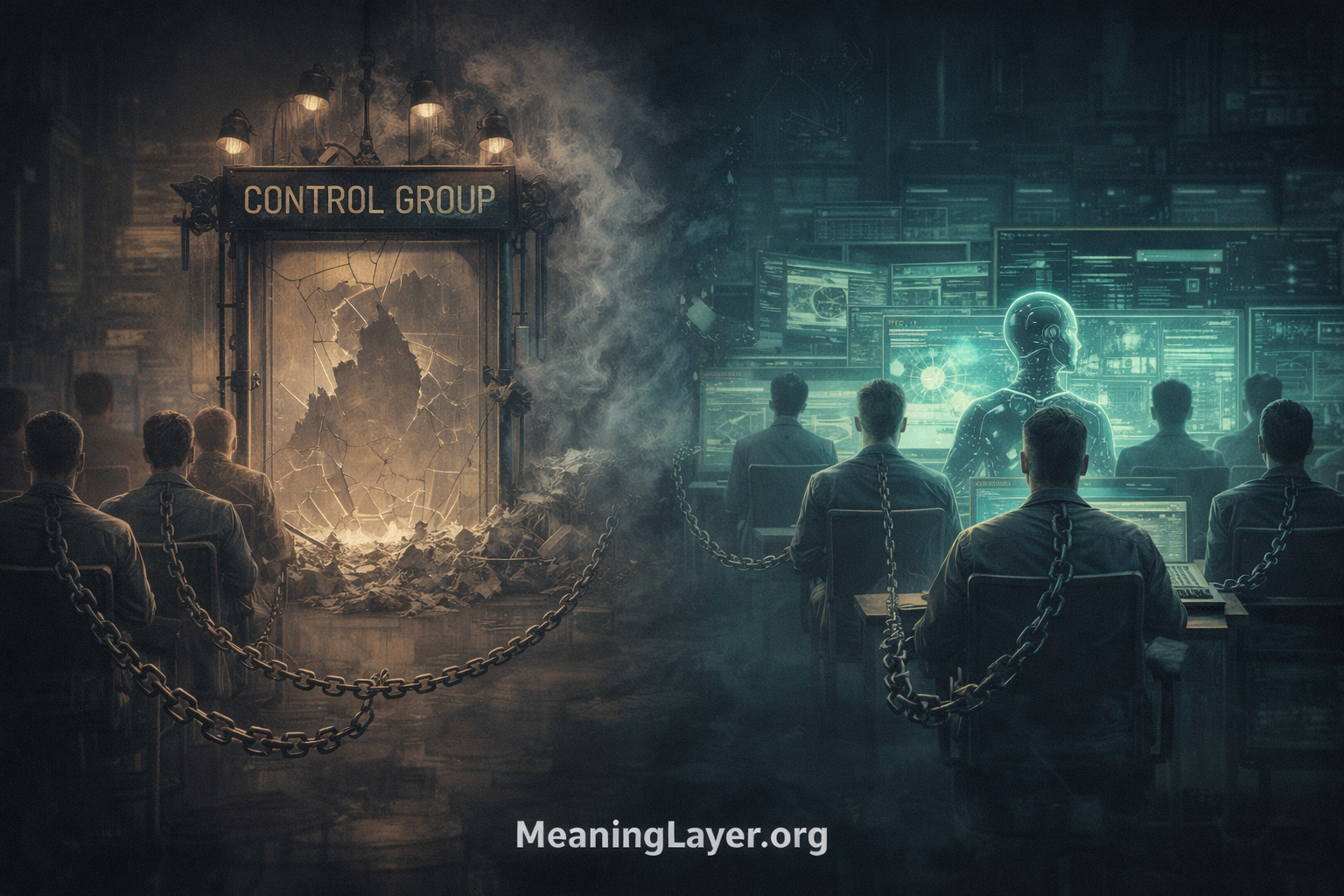
The largest cognitive experiment in human history was deployed globally without preserving our ability to measure its effects. Every study attempting to assess AI’s impact on human capability is now contaminated before it begins.
I. The Standard We Violated
Every meaningful scientific experiment requires a control group. Not for ethical decoration. For epistemological necessity. You cannot determine whether an intervention caused an outcome if you cannot compare populations that received the intervention to populations that did not.
This is not ideology. This is basic scientific method: if you want to know whether X affects Y, you need to measure Y in presence of X and absence of X, then compare. Without comparison, causation becomes speculation. With comparison, effects become measurable.
The principle applies universally. Medical trials require control groups—patients receiving treatment compared to patients receiving placebo. Educational research requires control groups—students receiving intervention compared to students receiving standard instruction. Psychological studies require control groups—participants exposed to stimulus compared to participants unexposed.
Violating this standard does not merely weaken results. It makes causal claims unfalsifiable. You can observe correlations. You cannot determine causation. You can see changes. You cannot know whether intervention caused them. The ability to know what caused what—the foundation of all scientific measurement—requires control groups.
AI deployment at global scale violated this standard completely. We introduced the most powerful cognitive intervention in human history—tools that can perform expert-level intellectual work, provide instant explanations for any question, complete complex tasks that previously required years of training—without preserving any population unexposed to compare against.
No control group of students developing without AI access. No control group of professionals working without AI assistance. No control group of children learning without AI-enhanced education. Every cohort, every population, every demographic—exposed simultaneously. The intervention deployed universally before any measurement infrastructure existed to assess its effects.
This is not ”we should have been more careful.” This is ”we eliminated our ability to know what we did.” The violation is not incomplete data collection. The violation is making data collection impossible by removing the comparison populations that would make measurement meaningful.
II. Control Group Extinction
What we lost is not just ”some people who didn’t use AI.” What we lost is the epistemological foundation for determining AI’s causal effects on human capability development.
This is Control Group Extinction: the permanent elimination of populations unexposed to an intervention, making causal assessment of that intervention’s effects on human development impossible through standard scientific methodology.
Not ”control groups are hard to find.” Control groups no longer exist. Not ”we need better measurement.” Measurement requires what no longer exists. Not ”future studies will clarify this.” Future studies will be contaminated from inception because every population they study was exposed during cognitively formative periods.
The extinction is comprehensive:
Age cohorts. Children born after 2020 develop with AI-enhanced education ubiquitous. There exists no unexposed cohort of similar age to compare against. Future research attempting ”does AI affect childhood cognitive development” will compare AI-exposed children to AI-exposed children—variations in exposure amount rather than exposed versus unexposed comparison.
Professional domains. Software engineering, writing, analysis, research—every domain adopted AI assistance rapidly. There exist no professional cohorts that developed post-2020 without AI exposure. Future research attempting ”does AI affect professional capability development” will compare early AI adopters to late AI adopters—different timing rather than exposed versus control comparison.
Educational contexts. Universities, schools, training programs—all integrated AI tools broadly. There exist no educational institutions maintaining AI-free instruction as control. Future research attempting ”does AI affect educational outcomes” will compare high-AI-integration institutions to medium-AI-integration institutions—degree of integration rather than integration versus no-integration comparison.
Cognitive development periods. Most critical: the cohorts developing cognitive capabilities during AI ubiquity—the children learning to read, students developing critical thinking, young professionals building domain expertise—these cohorts have no unexposed comparison populations. Their cognitive development occurred in AI-present environments. There is no way to measure what their development would have been without AI because nobody preserved an unexposed population.
This is what makes Control Group Extinction different from incomplete data. You can collect more data. You cannot resurrect populations that no longer exist. You can improve measurement methods. You cannot measure what requires non-existent comparison groups. You can design better studies. You cannot design studies requiring time travel to before intervention was deployed globally.
The extinction is irreversible. Once every relevant population was exposed during formative periods, the scientific ability to determine causally what exposure did becomes permanently compromised. We can observe correlations. We can track changes. We can notice patterns. We cannot know with scientific certainty whether AI caused them—because we eliminated the comparison that would make certainty possible.
III. The Questions We Can No Longer Answer
Control Group Extinction does not make research impossible. It makes causal inference unreliable. Specific questions about AI’s effects on human capability become scientifically unanswerable:
Does AI assistance during learning improve long-term capability retention? We can compare students who used much AI versus students who used some AI. We cannot compare students who used AI versus students who learned without AI at all—because the latter no longer exist as cohort. We cannot know whether AI-assisted learning builds better capability than unassisted learning because we have no unassisted cohort to measure. Every answer must be relative to other AI-exposed populations rather than absolute comparison to unexposed baseline.
Does professional AI use accelerate expertise development or replace it? We can track professionals who adopted AI early versus late. We cannot compare professionals who developed with AI versus professionals who developed without it at comparable career stages—because post-2020 cohorts all developed with AI present. We cannot know whether AI accelerates expertise or prevents its development because we lack unexposed professionals at similar developmental stages to provide baseline.
Does AI-enhanced education improve critical thinking skills? We can compare schools with high AI integration versus low AI integration. We cannot compare AI-enhanced education versus traditional education using equivalent modern cohorts—because traditional education without any AI access no longer exists at scale. We cannot know whether AI enhances critical thinking or replaces its development because we have no contemporary unexposed students to measure.
Does childhood AI exposure affect cognitive development? We can track children with much screen time versus little screen time, high AI interaction versus low AI interaction. We cannot compare children developing with AI available versus children developing without AI exposure entirely—because the latter no longer exist in this technological environment. We cannot know AI’s causal effects on cognitive development because we lack unexposed children in comparable environments to establish baseline.
The pattern repeats across every domain where AI deployment was rapid and comprehensive. Research can measure variations in exposure. Research cannot determine what exposure does relative to non-exposure. The ability to answer ”what does AI do to human capability” in causal terms requires comparison populations we no longer have and cannot recreate.
This is not research gap. This is epistemological barrier. You cannot design studies that answer questions requiring non-existent comparison groups. The extinction is not data availability problem. The extinction is structural impossibility of causal measurement using standard scientific methodology.
IV. Every Future Study Is Contaminated
Here is what makes Control Group Extinction devastating for understanding AI’s effects: not just that current measurement is impossible, but that future measurement starts contaminated.
Consider longitudinal study attempting to assess AI’s effects on career development: Track professionals over 20 years, measure capability growth, compare high AI users versus low AI users, determine whether AI accelerated or hindered expertise development.
The contamination:
Baseline is unknowable. Study begins with professionals who already developed partially through AI-exposed environment. Their starting capability was shaped by AI exposure during education. There is no AI-unexposed baseline to establish what their capability would be absent early AI exposure. Every measurement compares AI-exposed-more versus AI-exposed-less, never AI-exposed versus unexposed.
Comparison is relative only. Study can show high AI users differ from low AI users. Cannot show whether either group matches pre-AI capability development because no contemporary pre-AI cohort exists. Results are relative differences within contaminated population, not absolute effects compared to uncontaminated baseline.
Confounds are unmeasurable. Perhaps high AI users develop less because they are less capable initially. Perhaps low AI users develop more because they are more capable initially. Without unexposed group, cannot distinguish AI effects from selection effects. Every comparison assumes exposure is only systematic difference—assumption that cannot be verified when everyone was exposed.
Cohort effects dominate. Any differences observed might reflect cohort characteristics rather than AI effects. Perhaps post-2020 cohorts differ from pre-2020 cohorts in motivation, education quality, economic conditions, cultural factors—all confounded with AI exposure. Without unexposed contemporary cohort, cannot separate cohort effects from AI effects.
This contamination applies to every study design attempting causal inference about AI’s effects on human capability. Randomized controlled trials cannot randomize exposure that already occurred. Longitudinal studies cannot establish unexposed baseline when no unexposed population exists. Quasi-experimental designs cannot identify natural experiments when intervention was universal. Meta-analyses cannot synthesize studies that all compare exposed-more versus exposed-less rather than exposed versus unexposed.
The scientific machinery for determining causation—the methods that let us know medical treatments work, educational interventions help, policy changes matter—all require comparison groups we no longer have. Control Group Extinction does not make research impossible. It makes causal claims about AI’s effects on human capability permanently uncertain because the epistemological foundation for certainty was eliminated.
V. The Pre-Contamination Window Is Closing
Control Group Extinction is not yet complete. Brief window remains where measurement could still capture uncontaminated comparisons—but the window closes rapidly and nobody is building infrastructure to use it.
The Last Measured Generation: Cohorts who completed development before AI ubiquity (roughly: born before 2010, completed education before 2025) provide final baseline for comparison. These populations developed capabilities without AI assistance being universal. They can be measured now—capability persistence, problem-solving, independent function—establishing what human capability looks like when development occurred AI-free.
This measurement must occur before these cohorts age beyond relevance. Once they are 20+ years past development period, they no longer represent comparable baseline for current cohorts. They developed in different technological, economic, and cultural context. The comparison becomes historically interesting but not scientifically valid for assessing contemporary effects.
Window: approximately 5 years. After 2030, the unexposed comparison cohorts are too far past development periods to serve as control. The window to measure pre-contamination baseline—capture what human capability development looks like without AI, establish measurements for comparison with AI-exposed cohorts, document the baseline we are losing—this window is open now and closing fast.
The Current Cohort Transition: Children and young adults developing right now (2020-2030) are the crossover cohorts. Some developed partially AI-free. Some developed entirely with AI present. If measured carefully now, these cohorts could provide gradations of exposure useful for tracking effects. But measurement infrastructure for this does not exist. No large-scale studies capturing capability development across AI exposure gradients. No longitudinal tracking of when AI entered developmental process and what changed. No systematic documentation of the transition from unexposed to exposed cohorts.
Once these cohorts complete development without measurement, the detailed transition data is lost. Future research will know ”everyone born after 2015 had AI available” but will not know fine-grained differences in actual exposure during critical developmental periods. The granularity required for precise causal inference will be gone.
What Must Be Captured Now:
Capability baselines: Measure pre-AI cohorts on tasks requiring capabilities future cohorts will develop with AI: independent problem-solving, learning new domains without assistance, sustained cognitive work without tools, meta-learning through difficulty. Establish what these capabilities look like when developed without AI.
Developmental trajectories: Track how capability develops over time in final cohorts developing partially without AI. Document learning curves, skill acquisition patterns, expertise building without constant AI access. These trajectories become comparison standard for AI-exposed development.
Tool-independent function: Test pre-AI cohorts on ability to perform complex work entirely without AI. Establish baseline for what expert-level performance looks like when expertise was built independently. This becomes the standard for comparing AI-assisted expertise.
Transfer and adaptation: Measure how pre-AI cohorts learn new domains, adapt to novel situations, transfer knowledge across contexts. These meta-capabilities may be most affected by AI exposure—and most important to measure while unexposed populations exist.
This measurement infrastructure does not exist. Temporal Baseline Preservation—the systematic capturing of human capability measurements while unexposed populations remain—is not happening at institutional scale. No major research initiatives. No government programs. No educational assessments. No longitudinal tracking.
The window is closing. Every year, unexposed cohorts age further past relevance. Every year, transition cohorts complete development without measurement. Every year, the epistemological foundation for understanding AI’s effects erodes further. And nobody is building the infrastructure to capture what remains.
VI. Why Nobody Is Measuring
The measurement infrastructure for Temporal Baseline Preservation could be built. The technical challenges are manageable. The cost is reasonable compared to AI deployment investment. So why does the infrastructure not exist?
Institutional incentives run opposite:
AI companies benefit from measurement absence. While Control Group Extinction makes definitive proof of harm impossible, it also makes definitive proof of benefit impossible. The ambiguity serves commercial interests: companies can claim enhancement, critics can claim extraction, neither can prove causation definitively. Measurement infrastructure making effects determinable threatens profitable ambiguity.
Educational institutions benefit from measurement absence. If AI-assisted learning proves less effective than traditional learning for capability development, institutions that adopted AI comprehensively face crisis. Better to avoid measurement and maintain assumption that completion with AI indicates learning occurred. Measurement infrastructure revealing AI-assisted credentials document exposure rather than capability threatens institutional legitimacy.
Governments benefit from measurement absence. If AI adoption proves economically beneficial but cognitively damaging, policy faces impossible tradeoff. Productivity growth versus capability development. GDP increases versus human capacity. Better to avoid measurement and assume productivity gains indicate human improvement. Measurement infrastructure revealing divergence between economic metrics and capability metrics forces political crisis.
Researchers face structural barriers. Longitudinal studies require decades of funding. Institutional support for research questioning AI benefits is limited. Career incentives reward pro-innovation rather than risk-documentation research. Grant funding favors studies showing new interventions work rather than studies questioning whether interventions were properly evaluated. Building measurement infrastructure documenting Control Group Extinction does not advance careers in environments optimized toward innovation celebration.
The result: nobody builds Temporal Baseline Preservation infrastructure. Not through conspiracy. Through every institution following incentives that make measurement undesirable and nobody having incentives making it necessary. The window closes not because measurement is impossible but because nobody wants what measurement would reveal.
VII. What We Lost Forever
Once the pre-contamination window closes—once unexposed cohorts age beyond developmental relevance and transition cohorts complete development without measurement—certain knowledge becomes permanently unavailable:
True baseline human capability. What can humans develop through traditional learning methods in contemporary environment? We will never know with certainty because we eliminated traditional learning before measuring what it produced. Future discussions of ”human potential” will be speculation—we have no measurement of what humans can do when development occurs without AI because we let unexposed cohorts age without documentation.
Causal effects of AI on development. Does AI enhance cognitive capability or extract it? Accelerate expertise or replace it? Improve learning or bypass it? These become permanently uncertain questions. We can measure correlations. We can track changes. We cannot establish causation because we removed the comparison populations causation requires. Every claim about AI effects becomes unfalsifiable.
Critical capability preservation. What capabilities are most affected by AI exposure? Which develop fine with AI assistance? Which require traditional struggle? We lose ability to distinguish because we have no measured difference between populations developing with versus without AI. Future training cannot optimize for preserving most-affected capabilities because we don’t know which those are.
Intervention effectiveness. If we attempt to rebuild capabilities AI exposure damaged, how do we know interventions work? We need baseline showing what capability looks like when developed without damage. That baseline will not exist. Every intervention’s success will be relative to contaminated population rather than absolute comparison to uncontaminated standard.
Generational capability comparison. Are younger generations actually more capable, or just more productive with tools? We cannot answer this scientifically because we lack tool-independent capability measurements for both generations in comparable contexts. Claims about generational differences become speculation without measurement infrastructure we failed to build.
This lost knowledge is not recoverable. You cannot recreate 2020-2030 developmental cohorts in 2040 to measure them. You cannot return to pre-AI environments to establish unexposed baselines. You cannot undo global deployment to preserve comparison populations. The knowledge that could have been captured through Temporal Baseline Preservation while unexposed cohorts existed becomes historically unavailable.
Persisto Ergo Didici provides partial mitigation: temporal testing of whether capability persists can distinguish genuine learning from performance theater within contaminated populations. But it cannot answer what capability would have been without AI exposure—because unexposed comparison no longer exists. It can measure relative effects within exposed populations. It cannot measure absolute effects compared to unexposed baseline we failed to preserve.
VIII. The Scientific Scandal
Here is what makes this historically unprecedented: we conducted the largest cognitive experiment ever—deploying AI assistance that potentially replaces human cognitive development across entire populations—without implementing the basic scientific standard every major intervention requires.
Not ”we could have measured better.” We eliminated measurement possibility by deploying universally before preserving comparison populations. Not ”we need more research.” Research requires comparison groups we no longer have. Not ”future studies will clarify.” Future studies inherit contamination we created.
The scandal is structural, not personal. No individual decided ”eliminate control groups.” Every actor made reasonable decisions: AI companies deployed products serving market demand. Educational institutions adopted tools improving measured outcomes. Governments encouraged innovation driving economic growth. Parents gave children access to helpful technology. Researchers studied what funding supported.
The aggregate result: Control Group Extinction. The ability to know scientifically what AI does to human capability development became permanently compromised. Not through malice but through systemic failure to recognize that innovation speed outpaced epistemological infrastructure. We moved too fast to measure what we were doing.
The precedent is dangerous. If AI deployment succeeds despite elimination of measurement capability, future technologies face no scientific accountability. Deploy universally, eliminate comparison populations, make causation unfalsifiable, claim benefits that cannot be disproven. The scientific method—the foundation of knowing whether interventions help or harm—becomes optional for technologies moving fast enough.
The correction is possible but closing. Temporal Baseline Preservation infrastructure could still capture pre-contamination measurements while unexposed cohorts exist. The window is 3-5 years. After that, the last unexposed populations age beyond relevance and measurement becomes permanently impossible.
Building this infrastructure requires acknowledging we deployed AI without proper scientific evaluation. That innovation speed eliminated epistemological foundation for understanding effects. That we need to measure now what should have been measured before deployment. Uncomfortable acknowledgment for institutions that celebrated AI adoption as unqualified success.
But the alternative is permanent uncertainty about what AI does to human capability. Every future debate becomes unfalsifiable claims because we eliminated the comparison populations that make claims testable. We can choose temporary discomfort of acknowledging measurement failure—or permanent inability to know whether AI enhanced or damaged the most important thing we have: human capability to develop and maintain civilization.
Tempus probat veritatem. Time proves truth. And time is proving that deploying AI without preserving ability to measure its effects was the largest uncontrolled experiment in human history. Whether it proves to be successful experiment or catastrophic one, we eliminated our ability to know scientifically. That elimination—Control Group Extinction—is the scientific scandal we must face before the window to correct it closes forever.
MeaningLayer.org — The infrastructure for Temporal Baseline Preservation: capturing pre-contamination measurements while unexposed populations exist, making AI’s effects on human capability measurable before comparison populations age beyond relevance.
Protocol: Persisto Ergo Didici — The measurement distinguishing genuine capability from performance theater within contaminated populations when unexposed comparisons no longer exist.
New Concept: Control Group Extinction — The permanent elimination of unexposed populations, making causal assessment of intervention effects on human development impossible through standard scientific methodology.
Rights and Usage
All materials published under MeaningLayer.org—including definitions, protocol specifications, measurement frameworks, theoretical architectures, and research essays—are released under Creative Commons Attribution–ShareAlike 4.0 International (CC BY-SA 4.0).
This license guarantees three permanent rights:
1. Right to Reproduce
Anyone may copy, quote, translate, or redistribute this material freely, with attribution to MeaningLayer.org.
How to attribute:
- For articles/publications: ”Source: MeaningLayer.org”
- For academic citations: ”MeaningLayer.org (2025). [Title]. Retrieved from https://meaninglayer.org”
- For social media/informal use: ”via MeaningLayer.org” or link directly
2. Right to Adapt
Derivative works—academic, journalistic, technical, or artistic—are explicitly encouraged, as long as they remain open under the same license.
Researchers, developers, and institutions may:
- Build implementations of MeaningLayer protocols
- Adapt measurement frameworks for specific domains
- Translate concepts into other languages or contexts
- Create tools based on these specifications
All derivatives must remain open under CC BY-SA 4.0. No proprietary capture.
3. Right to Defend the Definition
Any party may publicly reference this framework to prevent private appropriation, trademark capture, or paywalling of the core terms:
- ”MeaningLayer”
- ”Meaning Protocol”
- ”Meaning Graph”
No exclusive licenses will ever be granted. No commercial entity may claim proprietary rights to these core concepts or measurement methodologies.
Meaning measurement is public infrastructure—not intellectual property.
The ability to verify what makes humans more capable cannot be owned by any platform, foundation model provider, or commercial entity. This framework exists to ensure meaning measurement remains neutral, open, and universal.
2025-12-18