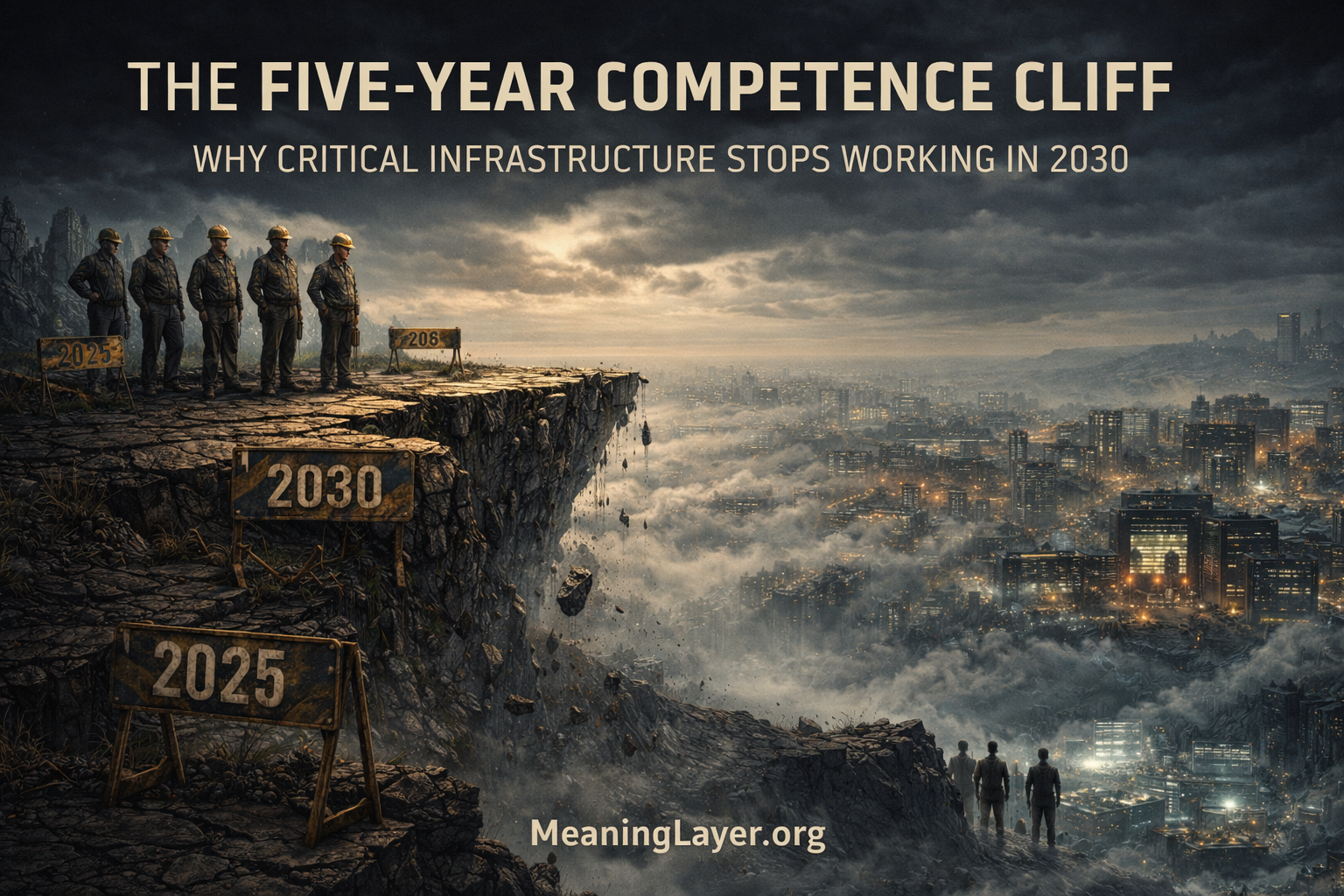
The last generation who can maintain civilization’s core systems without AI assistance retires in five years. Nobody is training replacements.
I. The Timeline Nobody Is Tracking
2020–2024: Infrastructure operates reliably. Senior engineers, operators, and technicians—trained before AI assistance became ubiquitous—maintain systems through deep understanding built over decades of independent problem-solving. When failures occur, these professionals diagnose, improvise, and restore function using judgment developed through thousands of unassisted repairs. Systems work because people who understand them independently remain employed.
2025–2027: AI-assisted junior staff reach ”full productivity.” Productivity metrics show training acceleration. New hires complete certifications faster, respond to routine issues efficiently, operate monitoring systems effectively. Management celebrates shortened onboarding, reduced training costs, improved efficiency. Output appears equivalent between experienced staff using minimal AI and junior staff using extensive AI. Performance metrics show successful knowledge transfer.
2028–2030: Pre-AI trained generation begins mass retirement. Power utilities, hospitals, transportation authorities, water systems—all face the same transition: professionals who built capability through decades of tool-free problem-solving leave, replaced by staff whose capability developed entirely through AI-assisted performance. The handoff appears smooth. Metrics remain green. Systems continue operating.
2031 and beyond: Novel failures emerge—situations not in AI training data, problems requiring improvisation beyond documented procedures, cascading issues demanding judgment about what matters. The staff cannot respond effectively. Not because they lack intelligence or training. Because the capability required to handle what AI cannot was never developed. It was never tested. Nobody measured whether it persisted.
This is Succession Collapse: the state where critical capability cannot transfer to the next generation despite continued operational performance, because the training conditions that created that capability no longer exist.
This is not distant speculation. This is five-year timeline. The collapse is already locked in unless measurement and intervention begin immediately. And currently, no institution is measuring whether succession is working or failing.
II. The Mechanism Is Not Malicious—It Is Structural
The competence cliff is not caused by incompetent training, lazy juniors, or malicious AI deployment. It is caused by capability developing differently when AI removes the conditions that built transferable expertise.
How pre-AI seniors developed capability:
Decades of independent failure and recovery. Power grid engineer faces unexpected cascading failure. No AI suggests solutions. No documentation covers this exact scenario. The engineer must diagnose from first principles, understand system interdependencies, improvise solutions, verify restoration. This process—repeated thousands of times across different failure modes—builds pattern recognition, judgment about what matters, intuition about system behavior, capability to handle novel situations.
This capability is not learned from success. It is built through sustained struggle with problems at edge of competence. Each failure that required independent diagnosis strengthened the capability. Each novel situation that demanded improvisation expanded it. Each cascading issue that required judgment about priorities deepened it.
How AI-assisted juniors develop capability:
The same engineer role now. Unexpected failure occurs. AI analyzes logs, suggests likely causes, recommends standard responses. The junior follows AI guidance, system restores. Productivity metrics show success—problem resolved quickly, downtime minimized, procedure followed. What the metrics do not show: the junior never developed the diagnostic reasoning the senior built through that failure. The pattern recognition that comes from independently determining root cause. The judgment about when standard procedures fail. The improvisation capability required when AI suggestions prove insufficient.
The junior completes the same work. The junior does not develop the same capability. Because AI removed the struggle that built capability—while preserving the performance that suggests capability exists.
The problem is not that juniors are worse. The problem is that the path that created seniors no longer exists. AI provides a new path that leads to equivalent performance without building equivalent capability. And nobody is testing whether the capability developed through the new path can handle situations the old path prepared seniors for.
This is structural inevitability: when tools remove cognitive friction that built capability, capability stops building—regardless of whether output continues. The mechanism requires no bad actors. It operates through optimization toward performance metrics that cannot distinguish capability built from capability bypassed.
III. The Test Nobody Runs
There exists a straightforward test revealing whether succession is working or collapsing:
Take infrastructure staff trained entirely with AI assistance (post-2020 cohort). Remove all AI tools. Present novel failure scenario with incomplete documentation—complexity matching what senior staff handle routinely. Measure whether they can restore function.
If they can—succession is working. AI assistance built genuine capability that persists independently.
If they cannot—succession is collapsing. AI assistance enabled performance without building capability to handle situations AI cannot.
This test is not run. Not by power utilities hiring new engineers. Not by hospitals onboarding medical technicians. Not by transportation authorities training system operators. Not by water facilities certifying new staff.
Every critical infrastructure sector measures:
- Productivity (how quickly work completes)
- Compliance (whether procedures are followed)
- Incident response time (how fast issues resolve)
- Training completion rates (certifications achieved)
None measure:
- Independent diagnostic capability (can they determine cause without AI?)
- Improvisation capacity (can they solve novel problems?)
- Judgment under uncertainty (can they prioritize when AI cannot?)
- Tool-free baseline (what persists when AI becomes unavailable?)
The measurement gap is comprehensive. Every metric tracks AI-assisted performance. No metric verifies capability that persists without assistance. This makes succession collapse invisible until the moment pre-AI expertise retires and systems encounter problems the next generation cannot handle independently.
Persisto Ergo Didici—”I persist, therefore I learned”—provides the protocol that makes succession measurable: test capability without assistance after time has passed. Not immediately after training. Months later, when temporary performance faded and only genuine capability remains. Not with AI available. In conditions matching what will exist when AI fails, changes, or encounters situations beyond its training.
This test reveals succession status. If capability persists independently—succession working. If capability collapsed—succession failing. The gap between what current metrics show (performance with AI) and what persistence testing reveals (capability without AI) is the gap between assumed succession success and actual succession collapse.
But the test is not run because every institution optimized metrics that make AI adoption appear successful—and those metrics cannot detect when adoption prevents rather than accelerates capability development. Succession collapse remains invisible in data showing training efficiency, productivity gains, and continued operational success.
IV. Where Collapse Becomes Catastrophic: Critical Infrastructure
The five-year competence cliff manifests across every domain where AI-assisted training replaced independent capability development. But consequences become civilization-threatening in critical infrastructure: systems where failure affects millions and recovery requires exactly the improvisation capability AI-assisted training never developed.
Power grid control systems: Pre-AI engineers understand grid behavior through decades of managing load, handling failures, maintaining stability during emergencies. This understanding—pattern recognition across thousands of situations, intuition about cascading risks, judgment about intervention priorities—developed through independent problem-solving. AI-assisted engineers operate monitoring systems effectively, respond to standard failures efficiently, follow procedures correctly. Their performance appears equivalent. Their independent capability to handle novel grid destabilization—scenarios not in AI training data, requiring real-time improvisation about which loads to shed, which connections to maintain, which risks to accept—was never tested and may not exist.
When pre-AI engineers retire and major grid emergency occurs requiring exactly this capability, the competence cliff becomes visible. Not through routine operation. Through crisis that reveals the new generation cannot function at previous levels without AI assistance—and AI assistance proves insufficient for situations demanding human judgment beyond what AI provides.
Hospital critical care systems: Pre-AI medical staff developed clinical judgment through years of patient care, equipment troubleshooting, emergency response. Not just following protocols. Recognizing when protocols fail. Improvising when equipment malfunctions. Prioritizing when resources are insufficient. AI-assisted staff performs routine care excellently. Efficiency increases. Error rates in standard procedures decrease. What metrics do not capture: whether the judgment to recognize when situations exceed standard procedures—the capability to improvise when equipment fails unexpectedly, the intuition about what matters when multiple crises compete—developed through AI-assisted training or whether it requires the independent struggle previous generations experienced.
The test occurs not during routine operation but during mass casualty event, equipment failure cascade, or pandemic surge—situations requiring exactly the improvisation capability that may not have developed. Then the competence cliff manifests as inability to maintain care quality when conditions exceed what AI prepared staff for.
Transportation signaling and control systems: Engineers who built expertise debugging rail systems, managing traffic control, maintaining safety protocols without AI assistance retire. Replacements trained with constant AI support operate systems effectively, respond to standard failures quickly, maintain routine operations. But complex system failures—multiple simultaneous issues, cascading problems, situations requiring diagnosis when monitoring is incomplete—demand exactly the independent reasoning capability AI assistance removes from training. The cliff appears when crisis reveals next generation cannot maintain system safety under conditions that require independent judgment previous generation developed through decades of unassisted troubleshooting.
Water treatment and distribution infrastructure: Operators who understand treatment chemistry, system hydraulics, contamination response through years of independent operation leave. New operators manage systems efficiently with AI monitoring. Chemical dosing is optimized. Leak detection improves. Compliance increases. The capability to respond when monitoring fails, when treatment goes wrong in unexpected ways, when contamination requires rapid improvisation—this capability is unmeasured and possibly undeveloped because training removed the conditions that built it.
These systems do not fail cleanly. They fail when humans cannot improvise without tools they trained with. They fail when novel situations require judgment AI cannot provide. They fail when problems cascade faster than AI analysis completes. They fail exactly at the intersection where operational performance appears high but independent capability required for crisis is absent.
The five-year window exists because pre-AI trained professionals still maintain these systems. Once they retire, the capability gap becomes irreversible. Not because retraining is difficult. Because the baseline they trained to no longer exists—and nobody measured whether the new baseline can handle what the old baseline prepared for.
V. The Irreversible Horizon
Here is what makes the competence cliff existentially different from previous workforce transitions:
When agricultural expertise mechanized: Farmers who understood crop rotation, soil management, animal husbandry lost relevance. But the knowledge remained accessible. Future generations could relearn traditional farming if needed. The baseline existed. The path remained open.
When industrial skills automated: Factory workers who developed craftsmanship, manual precision, quality assessment became unnecessary. But the capability could be reconstructed. Apprentice systems could be rebuilt. The knowledge to train new craftspeople persisted in those who possessed it.
When office work computerized: Professionals who developed skills in manual calculation, physical filing, typewriting faced obsolescence. But the capability was recoverable. If computers disappeared, humans could relearn these skills. The baseline remained achievable.
The AI competence cliff is different: Once the last pre-AI trained infrastructure professionals retire, the capability they possessed cannot be reconstructed—because the training conditions that created it no longer exist and the standard they achieved cannot be reached starting from the new baseline.
Here is the irreversibility mechanism:
The standard shifted during the gap. Pre-AI engineers could diagnose novel power grid failures because they practiced diagnosing failures for decades without AI assistance. Post-AI engineers practice diagnosing failures with AI assistance—fundamentally different cognitive process. You cannot ”just practice without AI” to reach pre-AI levels because the AI-assisted generation never built the foundation the pre-AI generation started from. Their capability developed along a different path that may not lead to the same destination.
The meta-capability was never developed. Pre-AI professionals built not just specific skills but the capability to develop new skills through independent struggle. Learning how to learn through failure. Building intuition through unassisted pattern recognition. Developing judgment through accumulated improvisation. Post-AI professionals developed specific skills through AI-assisted practice. When situations require learning new domains independently—because AI lacks data or tools become unavailable—the meta-capability required for that learning may be absent. You cannot ”teach someone to learn independently” if they never developed the cognitive infrastructure that makes independent learning possible.
The knowledge transfer chain broke. Pre-AI professionals could train successors through demonstration, explanation, supervised practice—because successors had similar foundational capability from similar training paths. Post-AI professionals cannot train future successors to handle what they cannot handle themselves. If the current generation cannot function independently without AI, they cannot transfer independent function to the next generation. The knowledge chain breaks not through information loss but through capability that no longer exists to transfer.
This creates Irreversible Capability Horizon: the point beyond which human capability cannot be reconstructed because the training conditions that created it no longer exist and attempting to recreate those conditions means training to a standard already surpassed by the tools everyone uses.
We are approaching this horizon. The five-year window exists because pre-AI capability still exists in professionals not yet retired. Once they leave, that capability becomes historically unavailable—unless succession is verified and failing succession is corrected before the window closes.
The correction requires infrastructure no institution currently has: systems measuring whether capability persists independently, standards requiring tool-free baseline verification, training proving AI builds rather than replaces capability, succession protocols ensuring next generation can function when conditions exceed what AI provides.
Without this infrastructure, the cliff is unavoidable. With it, succession becomes verifiable and correctable. The five-year window is the time to build that infrastructure—before the last generation possessing capability that may not be reproducible retires.
VI. What Measurement Would Reveal
If infrastructure sectors implemented succession verification—testing whether AI-trained staff can perform independently at levels previous generation achieved—results would likely show:
Routine operations: Performance equivalent or superior. AI-assisted staff handle standard procedures efficiently. Response times improve. Error rates decrease. All measured metrics show successful training and capability development.
Novel problem-solving: Performance significantly degraded. Problems requiring diagnosis without AI guidance, improvisation beyond documented procedures, judgment about what matters when multiple issues compete—performance drops to levels suggesting capability gap between generations is large and concerning.
Tool-free baseline: Performance approaches novice levels. When AI access is removed and staff must function independently at complexity levels seniors handled routinely, performance reveals that AI-assisted training built proficiency with AI rather than capability without it. The productivity gains were real. The capability development was minimal.
Crisis response: Performance becomes unpredictable and potentially dangerous. Situations requiring rapid independent judgment, creative problem-solving, risk assessment under uncertainty—exactly the scenarios critical infrastructure must handle—reveal capability gaps that routine operations never tested and metrics never captured.
This is not condemnation of AI-trained professionals. They developed the capability their training conditions allowed. The issue is whether those training conditions built capability sufficient for situations AI cannot handle—and nobody has tested whether they did because testing would require admitting current measurement is insufficient.
Persisto Ergo Didici makes succession collapse measurable before it becomes irreversible. Test AI-trained infrastructure staff without tools months after training. Compare independent capability to pre-AI baseline. If comparable—succession verified. If significantly degraded—succession failing and intervention necessary.
The measurement is straightforward. The implementation requires acknowledging that current productivity metrics might be comprehensively misleading about capability—uncomfortable revelation for institutions that optimized toward those metrics and declared AI adoption successful based on them.
VII. The Window Is Closing
Five years. That is the estimated time before mass retirement of pre-AI trained infrastructure professionals creates succession crisis across multiple critical sectors simultaneously.
Not speculation. Demographic inevitability. The generation that built expertise through decades of independent problem-solving reaches retirement age 2028-2032. The generation replacing them trained entirely with AI assistance. The handoff is occurring now. The capability gap is unmeasured. The succession status is unknown.
Scenario if succession is working: AI-assisted training built genuine capability that persists independently. Next generation can maintain infrastructure effectively even when AI fails, changes, or encounters novel situations. Crisis response remains robust. System resilience persists. The five-year transition completes without incident.
Scenario if succession is collapsing: AI-assisted training built performance dependent on continued AI availability. Next generation cannot maintain infrastructure effectively when conditions exceed AI training data. Crisis response degrades. System resilience declines. The five-year transition completes—then novel failures reveal capability gap too late for correction.
The only way to distinguish these scenarios is measurement infrastructure currently absent: testing whether independent capability persists at levels required for critical system maintenance. If that measurement reveals succession is collapsing, intervention becomes urgent. If measurement reveals succession is working, continued AI adoption proceeds confidently.
The measurement absence is not neutral. It guarantees we discover succession status reactively—through system failures that could have been prevented—rather than proactively while correction remains possible.
Building measurement infrastructure requires:
- Standards defining tool-free baseline capability for critical roles
- Protocols verifying capability persists independently after AI-assisted training
- Assessment proving novel problem-solving at levels matching pre-AI generation
- Succession verification ensuring next generation can function when AI cannot
This infrastructure does not exist. Building it requires acknowledging current metrics are insufficient. That AI adoption might be creating rather than solving workforce capability challenges. That productivity gains might mask capability extraction. That what appears as successful training might be performance theater.
Every institution avoiding this measurement faces the same choice: verify succession is working while correction remains possible—or discover succession collapsed through infrastructure failures that measurement would have prevented.
The five-year window exists because pre-AI capability still maintains systems. Once that generation retires, capability gap becomes locked in. Retraining is not possible because training conditions changed irreversibly and the baseline to retrain toward no longer exists as achievable standard.
Tempus probat veritatem. Time proves truth. And in five years, time will prove whether AI-assisted training built capability or performance illusion—whether succession is transferring critical capability or collapsing invisibly while every metric shows success.
The competence cliff is not preventable if succession is already collapsing. But it becomes survivable if measurement reveals the collapse while expertise remains to correct it. Five years is enough time—if measurement begins now. If it does not, 2030 becomes the year we discover whether civilization’s critical infrastructure can function without the last generation that understood it independently.
MeaningLayer.org – The infrastructure for measuring succession collapse before pre-AI expertise retires: distinguishing genuine capability transfer from AI-dependent performance theater while correction remains possible.
Protocol: Persisto Ergo Didici – The succession verification that reveals whether next generation can maintain critical infrastructure when AI becomes insufficient.
New Concept: Succession Collapse – The state where critical capability cannot transfer to next generation despite continued operational performance, because training conditions creating that capability no longer exist.
Rights and Usage
All materials published under MeaningLayer.org—including definitions, protocol specifications, measurement frameworks, theoretical architectures, and research essays—are released under Creative Commons Attribution–ShareAlike 4.0 International (CC BY-SA 4.0).
This license guarantees three permanent rights:
1. Right to Reproduce
Anyone may copy, quote, translate, or redistribute this material freely, with attribution to MeaningLayer.org.
How to attribute:
- For articles/publications: ”Source: MeaningLayer.org”
- For academic citations: ”MeaningLayer.org (2025). [Title]. Retrieved from https://meaninglayer.org”
- For social media/informal use: ”via MeaningLayer.org” or link directly
2. Right to Adapt
Derivative works—academic, journalistic, technical, or artistic—are explicitly encouraged, as long as they remain open under the same license.
Researchers, developers, and institutions may:
- Build implementations of MeaningLayer protocols
- Adapt measurement frameworks for specific domains
- Translate concepts into other languages or contexts
- Create tools based on these specifications
All derivatives must remain open under CC BY-SA 4.0. No proprietary capture.
3. Right to Defend the Definition
Any party may publicly reference this framework to prevent private appropriation, trademark capture, or paywalling of the core terms:
- ”MeaningLayer”
- ”Meaning Protocol”
- ”Meaning Graph”
No exclusive licenses will ever be granted. No commercial entity may claim proprietary rights to these core concepts or measurement methodologies.
Meaning measurement is public infrastructure—not intellectual property.
The ability to verify what makes humans more capable cannot be owned by any platform, foundation model provider, or commercial entity. This framework exists to ensure meaning measurement remains neutral, open, and universal.
2025-12-18