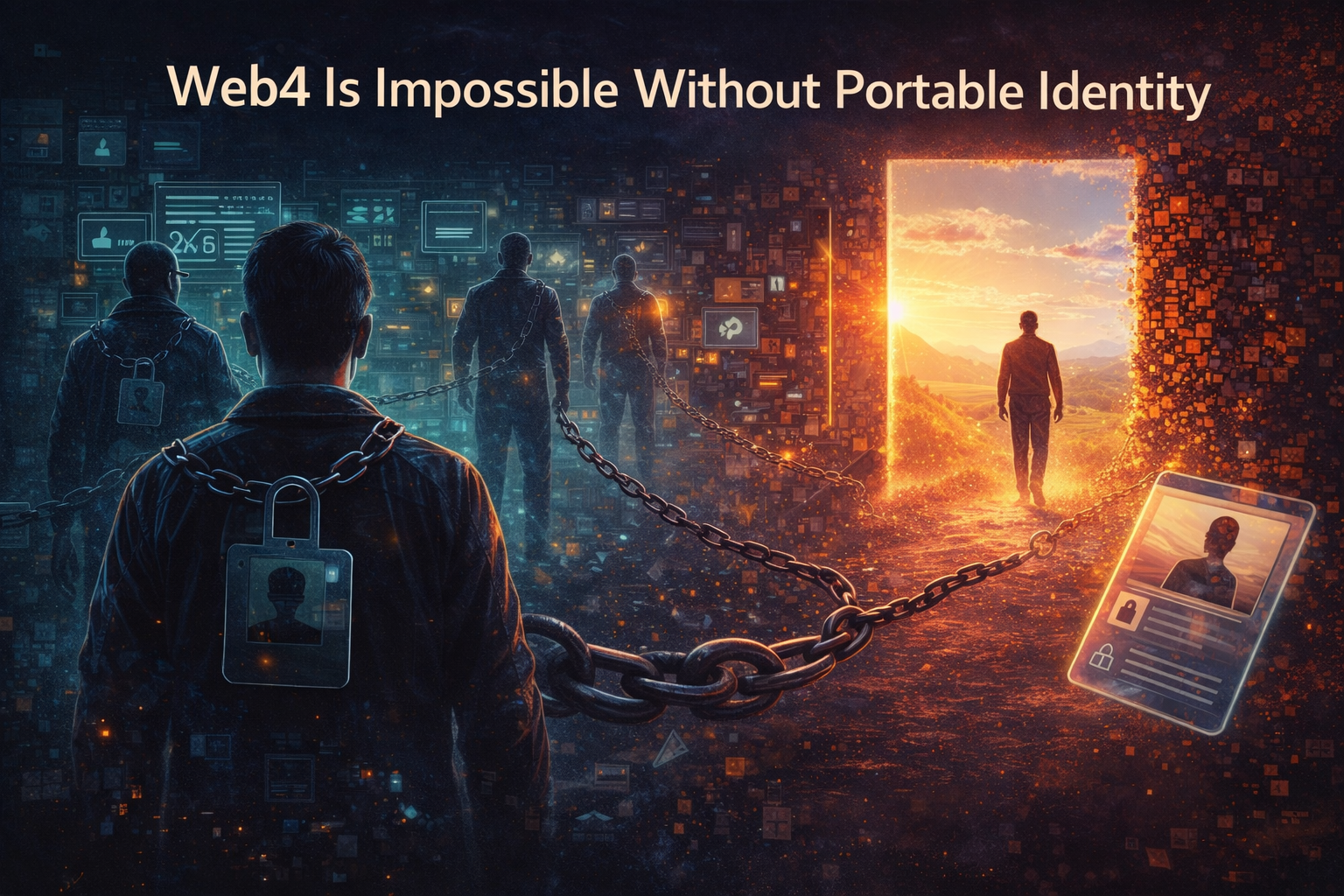
Web4’s defining characteristic is not smarter systems but value portability: humans can leave any platform carrying verified proof of contributions that improved others’ lives. If you cannot leave with your value, you are not in Web4 – you are in Web2 with better technology. Every major platform profits from preventing this portability. This is why Web4 cannot be built by platforms. This is why Web4 requires protocol infrastructure platforms cannot control.
- The Portability Test
Web4 has simple falsification criterion that most systems claiming to be ”next web” fail immediately: Can users leave carrying verified proof of value they created? Not data export. Not account closure. Verified portable value – contributions that improved others’ capability, impact that cascaded through networks, influence that persisted after platform interaction ended.
The test is binary. Either value is portable or it is not. Either you can prove to any system what you contributed regardless of which platform you used, or your value locks into platform that captured it. Either employers can verify your impact across all contexts through portable identity, or they must trust credentials and resume claims from platforms with incentives to inflate value. Either your contributions follow you everywhere proving capability development, or they remain trapped proving only platform dependency.
Most systems fail this test immediately. Educational platforms claim to build skills but credentials lock into issuing institution – cannot verify learning occurred except through trusting platform that profits from credential issuance. Employment platforms claim to track career development but contribution records lock into company systems – cannot prove capability except through trusting employers who may inflate or deflate based on politics. Social platforms claim to measure influence but metrics lock into platform – cannot demonstrate impact except through platform-controlled numbers that could measure engagement theater rather than genuine value creation.
The failure is not technical limitation. Platforms can technically enable value portability. Blockchain proved cryptographic ownership can be verified independently. Standards exist for data interchange. Technology enabling portable verified value exists. The failure is economic: platforms profit from value lock-in. Users who can prove value independently can leave. Users whose value requires platform verification cannot leave without losing ability to demonstrate their worth. Lock-in is not bug in platform design. Lock-in is fundamental business model.
When contributions cannot leave platforms, the relationship inverts: platforms don’t serve humans—humans serve platforms. Portability is the only measurement distinguishing service from servitude. This is not philosophical observation—this is architectural reality. Either value transfers with the human or the human becomes resource extracted by the system. Either portability exists or Web4 is definitional impossibility regardless of technology sophistication.
This creates Portability Impossibility: Web4’s defining requirement cannot be met by systems whose business models depend on preventing that requirement. Platforms cannot build infrastructure that would destroy their competitive moat. Portable identity requires protocol architecture that exists independent of any platform, verifies value across all platforms, enables users to leave any platform without losing ability to prove contributions. This architecture is antithetical to platform economics. Web4 either gets built as protocol layer platforms cannot control or does not get built at all.
- Why Value Must Be Portable
The reason portability is Web4’s definitional requirement rather than optional feature: without portability, optimization systematically selects value capture over value creation regardless of how sophisticated technology becomes.
Captured value creates lock-in. When contribution records lock into platform, switching platforms means losing ability to demonstrate value created on previous platform. This switching cost creates artificial barrier: users stay not because platform provides continuing value but because leaving means abandoning proof of past value. Platform quality can degrade. User experience can worsen. Value delivery can decline. Users stay because accumulated value is held hostage to continued platform usage.
Lock-in enables extraction. Once switching costs exceed value delivered, platforms can extract rather than provide value while users remain trapped. Raise prices. Degrade service. Add friction. Inject advertising. Reduce quality. Users tolerate extraction because leaving means losing demonstrated value. Extraction becomes economically rational once lock-in is established. Every platform optimizing toward value capture is optimizing toward eventual extraction.
Extraction is invisible in performance metrics. Platform shows engagement growth, user retention, revenue increase. All standard metrics indicate success. Meanwhile users are trapped in degrading service unable to leave because value cannot transfer. Metrics measure lock-in strength disguised as platform quality. Optimization toward better metrics systematically selects stronger lock-in regardless of whether service quality improves or degrades.
Portability inverts these dynamics. When value is portable, switching costs approach zero. Users can leave any platform carrying verified contributions. Platforms must compete on continuous value delivery rather than accumulated lock-in. Cannot extract because users can leave without penalty. Cannot capture value because value belongs to users portably. Must actually provide genuine ongoing value to retain users who can freely leave.
This is why Web4 requires portability: without it, optimization follows Web2 pattern regardless of technology sophistication. With it, competitive dynamics shift from value capture to value creation. Portability is not feature – portability is the structural requirement forcing platforms to serve users rather than trap them.
III. What Portable Identity Actually Means
Portable identity is not username transferring across platforms or social graph export or data portability in current sense. Portable identity is verified contribution proof transferring independently: demonstration that your actions improved others’ capability in measurable ways persisting across time and contexts.
Contributions are the unit of value. Not attention given, content consumed, time spent. Contributions that made others more capable. Teaching that persisted as student capability months later. Code that enabled colleagues to build features they could not build before. Analysis that improved team decision-making independently. Management that developed subordinates into leaders. Design that made users more capable. Writing that deepened reader understanding. Each contribution is measurable through its impact on others’ verified capability development.
Cascade graphs track impact propagation. Your contribution to Person A who built capability enabling them to contribute to Person B who developed capability enabling contribution to Person C creates cascade – your initial contribution rippling through network as capability compounds. Cascade graphs make this visible: not just immediate impact but downstream consequences. You taught someone who taught others who taught others. Your contribution cascaded through multiple degrees. Impact is measurable through graph traversal showing capability propagation.
Verification is independent of platforms. Contributions verified through capability testing of recipients, not through platform-controlled metrics. Student you taught can demonstrate capability persistence proving teaching value. Colleague you enabled can prove independent function showing code quality. Team you developed can verify decision-making improvement demonstrating management impact. Recipients verify value through capability they retained, not through metrics platform provided. Verification is portable because capability persistence is testable by any system implementing verification protocol.
Identity aggregates across all contexts. Portable identity is not platform-specific profile. Identity is aggregate contribution graph spanning all platforms, jobs, contexts, times. Every contribution verified adds to graph. Every cascade tracked extends graph. Every capability improvement in others proven adds value to your portable identity. Graph is complete picture of your impact on human capability development across entire life – not fragmentary platform-specific metrics but comprehensive verified contribution history.
Portability means universal provability. Any employer can verify your contribution graph through protocol implementation. Any educational institution can validate your learning impact. Any platform can assess your influence. Any system can evaluate your value through accessing portable identity and verifying contributions through capability testing of graphs. Value is not trapped in claims requiring platform verification. Value is proven through independent protocol anyone can implement to verify contribution cascade and capability impact.
This is fundamentally different from current identity systems. Current identity: fragmented platform profiles, self-reported claims, credentials requiring institutional verification, value locked into silos. Portable identity: unified contribution graph, independently verified impact, protocol-validated capability improvement, value portable everywhere proving same regardless of which system verifies.
- Why Platforms Cannot Build This
The structural reason portable identity cannot emerge from platform development: platforms profit from identity being non-portable, from value being captured, from switching costs being high. Building infrastructure destroying these profit sources is economic self-sabotage no platform can rationally choose.
Platform business models require captivity. Revenue comes from user retention. Retention comes from switching costs. Switching costs come from value being non-portable. Make identity portable and switching costs approach zero. Make switching costs zero and retention becomes dependent on continuous value delivery rather than accumulated lock-in. Make retention dependent on value delivery and platforms cannot extract once dominant. Portable identity destroys the business model making platform investment attractive.
First-mover disadvantage prevents voluntary adoption. Platform implementing portable identity enables users to leave carrying value to competitors. Competitors not implementing portable identity retain users through lock-in. First mover loses competitive position to free riders. No platform can voluntarily adopt standards making users more mobile when competitors retain captive users. Coordination problem prevents any platform from building infrastructure serving user freedom over platform profit.
Verification threatens control. Current platforms control value metrics – they define what counts, how it measures, what gets credited. Portable identity requires independent verification through capability testing platforms cannot control. Recipients verify value through demonstrated capability persistence. Graph tracking makes impact attribution transparent. Platforms cannot inflate metrics when verification is external. Cannot claim credit for value they did not create. Cannot hide extraction when contribution graphs show impact declined during platform usage.
Portability enables competition. When users can leave with verified value, new platforms can compete purely on service quality rather than needing to overcome switching costs. Startup competing with dominant platform on portable identity infrastructure starts even – both can access user contribution graphs, both can verify value independently, neither has lock-in advantage. Portable identity makes markets actually competitive. Dominant platforms cannot allow infrastructure that destroys competitive moats.
Exit becomes costless. Current platforms rely on exit being expensive – lose social graph, lose content history, lose reputation, lose demonstrated value. Expensive exit means platforms can degrade quality while retaining users. Portable identity makes exit free – carry complete contribution graph to any platform, prove same value immediately, continue building on same identity. Free exit means platforms must maintain quality to retain users. Cannot tolerate platforms building infrastructure that makes retaining users actually difficult.
This is why PortableIdentity.global exists as protocol infrastructure rather than platform feature. Platforms cannot build what destroys their business models. Protocol can exist independently, implement verification standards, enable contribution graphs spanning all platforms, make identity actually portable. Not through platform adoption – through protocol that operates whether platforms cooperate or not, verifying contributions through capability testing that platforms cannot control, enabling users to prove value independently of any platform’s metrics.
- Contributions as Web4’s Value Currency
Web4 inverts Web2’s value definition: from attention captured to capability improved. This inversion requires fundamentally different value currency – not engagement metrics but verified contributions making others more capable independently.
Web2 currency: Attention. Platforms monetize time-on-platform, clicks, views, engagement. Value is attention captured regardless of whether capture created any lasting benefit. Optimization maximizes attention extraction – infinite scroll, notification, recommendation algorithms keeping users engaged. Success is measured through attention volume not impact quality. User value is attention they provide not capability they develop.
Web3 currency: Ownership. Platforms tokenize possession of digital assets. Value is provable ownership regardless of whether owned asset provides utility. Optimization maximizes scarcity and trading volume – NFTs, crypto, speculative assets. Success measured through ownership claims not usage value. User value is what they can prove they own not what they can demonstrate they contribute.
Web4 currency: Contributions. Platforms verify capability improvements in others resulting from user actions. Value is demonstrated positive impact on human capability development independently verified. Optimization maximizes genuine capability building – teaching that persists, code that enables, management that develops, design that empowers. Success measured through cascade graphs showing capability propagation. User value is verified improvement in others not attention given or ownership claimed.
This currency shift transforms competitive dynamics:
Contribution currency cannot be gamed. Attention can be captured through addiction. Ownership can be claimed without utility. Contributions must be verified through capability testing – did recipient become more capable independently? Testing is temporal, requires independence verification, validates persistence. Cannot fake contribution value because verification tests what persisted when assistance ended and time passed. Currency is inherently honest because measurement detects fraud.
Contributions compound over time. Attention depletes – finite hours available, switching costs prevent reuse. Ownership transfers – selling asset means losing it. Contributions cascade – teaching someone who teaches others multiplies impact, code enabling colleagues who build features compounds value, capability you develop in others enables them to develop capability in yet others. Value increases through network effects of capability propagation rather than zero-sum attention competition.
Contribution graphs prove value objectively. Attention metrics are platform-specific – hard to compare across contexts. Ownership claims lack universal valuation – NFT worth depends on market belief. Contributions verify through capability testing anyone can implement – did capability persist independently when tested months later? Objective verification makes contribution value comparable across all platforms, jobs, contexts. Universal currency for human capability impact.
Markets price contributions accurately. Employers can pay for verified capability improvement you create in others – direct ROI through enhanced team capability. Educational institutions can reward verified learning impact – measurable outcome through graduate capability persistence. Platforms can compensate verified user capability development – proven value creation rather than assumed engagement quality. Contribution currency enables markets to price genuine value because value is independently verifiable rather than platform-asserted.
This is why Web4 cannot function with Web2’s attention currency or Web3’s ownership currency. Only contribution currency verified through capability testing creates portable value that users can carry everywhere proving same worth regardless of which platform, employer, or system verifies.
- How Cascade Graphs Make Impact Measurable
The innovation making contributions verifiable at scale is cascade graph architecture: tracking how capability improvements propagate through networks over time, attributing value to original contributions even when impact manifests degrees removed from initial interaction.
Direct contribution is insufficient measure. You teach Student A who passes capability test. This proves immediate impact – your teaching created capability that persisted. But full value is incomplete picture. Student A teaches Students B, C, D using capability you developed in them. They teach Students E, F, G, H, I. Capability you initiated cascaded through network. Measuring only direct contribution captures fraction of actual impact.
Cascade graphs track multi-degree impact. Node for you. Edge to Student A showing verified capability improvement. Nodes for Students B, C, D with edges from A showing capability propagation. Nodes for E, F, G, H, I with edges from B, C, D showing continued cascade. Graph makes visible: your contribution to A enabled A’s contributions to B, C, D which enabled their contributions to E, F, G, H, I. Impact is measurable through graph traversal – how many people became more capable as result of capability cascade you initiated.
Attribution is mathematically precise. Each cascade edge has weight – magnitude of capability improvement verified through testing. Your contribution to A weighted by A’s capability gain. A’s contribution to B weighted by B’s capability gain. Multiply edge weights along path from you through A to B gives attribution: what portion of B’s capability traces to your initial contribution to A. Sum across all paths gives total attributed impact. Precision comes from verified measurements not subjective claims.
Time dimension reveals persistence. Cascade graphs track capability over time. Did capability you created in A persist after months? Did capability A created in B persist after years? Did cascade continue propagating or did it terminate? Temporal tracking separates genuine capability building (cascades persist and propagate) from temporary performance theater (cascades collapse quickly). Only contributions creating persistent cascades have lasting value in graph.
Context independence enables portability. Cascade graphs span all platforms, jobs, educational contexts. Your teaching impact cascades through students who moved to different institutions, different companies, different platforms. Graph tracks cascade regardless of context changes. This makes contribution value portable – your impact is verifiable through graph even when recipients changed contexts multiple times. Value follows you because cascade graph transcends any single platform or institution.
Verification is protocol-based. Any system can implement cascade verification: test capability of direct recipients, test capability of second-degree recipients, verify capability persisted across time, attribute impact through graph mathematics. Protocol defines verification standards. Graph structure is open. Verification methodology is public. Anyone can verify anyone’s contribution cascade through implementing protocol. Portability is possible because verification does not require platform cooperation.
This architecture makes Web4’s contribution currency actually implementable. Not theoretical ideal. Not aspirational goal. Concrete measurement system tracking verified capability improvements, measuring impact cascades, attributing value precisely, enabling portability through protocol-based verification.
VII. Why Lock-In Is Anti-Web4 By Definition
Platforms claiming to be ”Web4” while preventing user exit with verified value are definitional contradiction. Lock-in is structural opposite of Web4’s core requirement. Cannot be Web4 if users cannot leave carrying portable verified contributions.
Web4 definition requires costless exit. Users can leave any platform carrying complete verified contribution graph proving impact on others’ capability development. Exit cost is zero – same value provable everywhere through protocol verification. If exit has cost, system is not Web4 regardless of technology sophistication.
Lock-in creates exit cost. Value that cannot transfer makes leaving expensive. Contribution records trapped in platform mean leaving requires abandoning ability to prove value. Verification controlled by platform means competitors cannot verify same value. Non-portable identity means starting from zero elsewhere despite accumulated impact. Any of these creates exit cost making system definitionally not Web4.
Most ”Web4” platforms are Web2 with blockchain. Add crypto, add tokens, add decentralization buzzwords. But users cannot leave carrying verified contributions. Value locks into platform-specific metrics. Identity fragments across platforms. Contributions cannot be proven elsewhere. Exit remains expensive. This is Web2 architecture with Web3 technology – not Web4. Web4 is portability architecture not technology stack.
True Web4 requires protocol infrastructure. PortableIdentity.global provides this: contribution graphs spanning all platforms, cascade verification through protocol standards, identity aggregating across all contexts, verification implementable by any system. Users can prove contribution value to any employer, educational institution, platform through protocol. Exit is costless because value transfers completely. This is Web4 architecture – portability through protocols not platforms.
Platforms have binary choice. Implement portable identity protocols enabling user exit with verified value – becoming true Web4 but destroying lock-in-based business models. Or maintain value capture preventing portable identity – remaining Web2 architecture regardless of AI sophistication or blockchain integration. Cannot be both. Cannot have lock-in and portability. Cannot capture value and make value portable. Choice determines whether claiming to be Web4 is accurate or marketing.
Most platforms claiming Web4 choose lock-in. Predictable – lock-in is profitable. But claiming to be Web4 while preventing portability is false advertising. Web4 has definitional requirement platforms violate. This is why Web4 cannot be built by platforms. This is why Web4 requires protocol infrastructure platforms cannot control.
VIII. The Economic Inversion Portable Identity Creates
Implementing portable contribution identity inverts economic incentives from value capture to value creation. Not through regulation or restriction. Through making genuine value creation distinguishable from extraction in ways that redirect optimization and market pricing.
Current economics reward lock-in. Platform captures value. Users cannot prove value elsewhere. Switching costs rise. Retention increases regardless of quality. Revenue grows through captive user base. Investment flows toward platforms with strongest moats. Optimization systematically selects stronger lock-in over better service because lock-in improves retention metrics more reliably.
Portable identity economics reward value creation. Platform proves users became more capable through verified contribution graphs. Users can demonstrate same value anywhere through protocol. Switching costs approach zero. Retention requires continuous value delivery. Revenue depends on ongoing capability building. Investment flows toward platforms with best verified outcomes. Optimization systematically selects genuine capability building because portable verification makes extraction visible.
Competition shifts from user acquisition to value creation. Current platforms compete for users to capture. Success means growing captive user base. Portable identity platforms compete for users who can freely leave. Success means building capability that users verify and attribute to platform. Competition is not who can trap most users but who can create most verified value. Market efficiency improves dramatically when users are mobile.
Employment markets price accurately. Current hiring relies on credentials requiring institutional verification and resume claims that could inflate value. Employers cannot verify capability except by trusting sources with unknown reliability. Portable identity enables employers to verify contribution graphs through protocol, test cascade impact through capability verification, prove value claims through independent assessment. Wage differentiation based on verified value rather than credential theater.
Educational value becomes measurable. Current education certifies completion without verifying learning persisted. Institutions cannot demonstrate ROI except through placement statistics that could be correlation not causation. Portable identity enables institutions to prove graduates’ verified contribution cascades, demonstrate capability persistence through temporal testing, show genuine learning outcomes through cascade graphs. Educational markets price based on verified learning rather than reputation and assumption.
Platform value proves through user capability. Current platforms show engagement metrics that could measure addiction rather than value. Cannot distinguish genuine value creation from extraction disguised as engagement. Portable identity enables platforms to demonstrate user capability improvements through verified contributions, prove value through cascade graphs attributing impact, show genuine enhancement through users becoming more capable independently. Platforms compete on verified outcomes visible to all rather than proprietary metrics visible to none.
Contribution graphs create transparent markets. All value is visible through cascade graphs anyone can verify. Cannot hide extraction because capability decline shows in graphs. Cannot inflate claims because verification tests actual capability. Cannot capture value because users carry graphs everywhere. Market pricing based on verifiable information rather than asymmetric claims favoring incumbents.
The inversion is total: from markets rewarding value capture to markets rewarding value creation. From competition based on user captivity to competition based on capability building. From pricing based on credential claims to pricing based on verified contribution. All through making value portable via protocol infrastructure enabling universal verification.
- Why This Cannot Emerge From Current Systems
Every major platform has economic incentive preventing portable identity implementation. Every institution has structural barrier blocking contribution verification. Every system has coordination challenge stopping cascade graph adoption. This is why Web4 requires new infrastructure rather than platform evolution.
Platforms profit from non-portability. Making identity portable destroys competitive moats, enables costless user exit, prevents value capture, makes markets competitive. No platform voluntarily implements infrastructure threatening their business model. First mover loses to free riders. Coordination problem prevents any platform from building portability alone.
Institutions profit from credential control. Universities monetize degree exclusivity – portability threatens scarcity. Employers profit from proprietary contribution records – transparency threatens information asymmetry. Platforms monetize metric control – verification threatens credibility. Every institution holding information advantage over users has incentive preventing portable verified identity replacing proprietary credentialing.
Users lack coordination mechanism. Individual user demanding portability from platform lacking it cannot leave without losing demonstrated value. Collective action required – all users simultaneously demand portability or coordinated mass exit. But collective action is hard. Platforms can pick off individual defectors. Users remain trapped despite preferring portable identity because cannot coordinate departure.
Technical standards require agreement. Cascade graph protocols need universal implementation. Contribution verification methodology needs shared standards. Capability testing requires common frameworks. Each institution wants their methodology to be standard. Cannot agree on whose protocol to adopt. Coordination failure prevents technical standardization that would enable portability.
Existing investments are stranded. Platforms built entire infrastructure around proprietary identity. Switching to portable protocols means stranding existing architecture investment. Institutions designed processes around credential issuance they control. Changing to contribution verification means redesigning institutional operations. Sunk costs prevent transition even when future benefits are clear.
This is classic coordination problem: everyone better off with portable identity but no one can transition unilaterally, collective action is difficult, existing infrastructure creates switching costs, incentives misalign between users and institutions. Solution is not waiting for platforms to build portability – they cannot rationally do so. Solution is building protocol infrastructure that implements portability whether platforms cooperate or not.
PortableIdentity.global provides this infrastructure. Protocol implementing contribution graphs independently of platforms. Cascade verification through standardized capability testing. Identity aggregation across all contexts through protocol adoption. Verification anyone can implement without platform permission. Users can prove contributions through protocol even if platforms never integrate. Portability emerges from protocol infrastructure not platform cooperation.
- What Gets Built on Portable Identity
Portable verified contribution identity enables applications and markets impossible under current fragmented credential systems. Not speculation – direct consequences of making value verifiable and portable.
Skill markets price precisely. Current hiring is inefficient – employers cannot verify claimed capability, candidates cannot prove genuine value, wage negotiation is information asymmetry game. Portable identity enables objective skill pricing: contribution graphs prove capability development impact, cascade verification tests persistence, temporal analysis validates claims. Markets price accurately when information is symmetric and verifiable.
Mentorship becomes measurable ROI. Current mentoring is uncompensated or undervalued – cannot prove impact, cannot measure cascade, cannot verify value creation. Portable identity makes mentorship valuable: teaching impact shows in student capability persistence, cascade graphs track students teaching others, contribution attribution proves mentor value. Mentorship becomes investable when returns are verifiable.
Lifelong learning has portable credentials. Current education fragments across institutions – each credential locked to issuer, capability claims unverified across contexts, learning value unclear. Portable identity aggregates learning across lifetime: every course adds to contribution graph, every verified capability improvement proves learning value, every cascade shows knowledge transfer. Credentials are contribution proofs not institutional assertions.
Team formation optimizes for capability building. Current teams assemble based on credentials and interviews – cannot verify genuine capability, cannot predict contribution potential, cannot measure team development impact. Portable identity enables evidence-based team formation: contribution graphs show who develops others, cascade analysis reveals teaching effectiveness, temporal verification proves capability building. Teams assemble based on verified development track records.
Career progression proves through cascades. Current advancement depends on manager assessment and internal politics – contribution value unclear, impact attribution difficult, capability development unmeasured. Portable identity makes progression objective: cascade graphs show your impact on team capability, verification proves people you developed succeeded independently, temporal analysis demonstrates lasting influence. Promotion based on verified contribution not political favor.
Impact investing targets capability building. Current investment is metrics-based – revenue, growth, engagement. Cannot verify whether business builds genuine value or extracts it. Portable identity enables impact verification: contribution graphs show whether platform users became more capable, cascade analysis proves genuine value creation, temporal testing validates capability persistence. Capital flows toward verified value creation not metric optimization.
Reputation becomes algorithmically verifiable. Current reputation is social – followers, likes, endorsements. Can be gamed, bought, fabricated. Portable identity makes reputation verifiable: contribution graphs prove impact, cascade verification tests claims, capability persistence validates influence. Cannot fake reputation when verification tests actual capability improvement in others.
Value creation becomes global currency. Current value is fragmented – different credentials across countries, different metrics across platforms, different verification across contexts. Portable identity is universal: contribution graphs transcend national boundaries, verification protocols work globally, cascade impact measures identically everywhere. Value currency that actually globalizes rather than remaining trapped in local credential systems.
These applications emerge directly from making contribution value verifiable and portable. Not requiring new invention. Not awaiting technology advancement. Immediate consequence of protocol infrastructure enabling users to prove verified impact independently of platforms or institutions controlling credentialing.
- The Infrastructure Required Now
Web4 becomes possible when portable identity infrastructure exists. That infrastructure has specific architectural requirements that must be built as protocol not platform feature.
Contribution graph protocol. Open standard defining how contribution edges are created, how capability improvements are verified, how cascade attribution is calculated, how temporal persistence is measured. Standard must be implementable by any system, verifiable by any protocol adopter, extensible to new contribution types. Build this or contribution value remains platform-trapped.
Capability verification methodology. Standardized testing proving capability persisted independently after temporal separation without assistance. Testing must be comparable across contexts, independent of platform control, verifiable by third parties, resistant to gaming. Without this, contribution claims are unverifiable and portability is theoretical.
Cascade tracking infrastructure. Systems monitoring capability propagation across platforms, jobs, contexts, time. Tracking requires identity persistence across contexts – same person verifiable everywhere despite context changes. Requires capability testing at graph nodes proving cascade actually occurred. Requires attribution mathematics distributing impact credit. Build this or cascade value remains unmeasured.
Protocol implementation incentives. Early adopters need benefits offsetting transition costs. Network effects need to emerge before critical mass. Coordination mechanisms need to overcome collective action problems. Standards need adoption momentum preventing fragmentation. Without incentive design, protocol stays theoretical despite technical feasibility.
Verification marketplace. Competitive ecosystem of services implementing capability testing, contribution verification, cascade validation. Services compete on accuracy, speed, cost, trustworthiness. Users choose verification services. Employers accept verification from marketplace rather than trusting platform claims. Creates market for genuine verification rather than credential inflation.
User control infrastructure. Individuals own contribution graphs cryptographically. Decide who can access, what gets shared, how attribution is displayed. Cannot be controlled by platforms, cannot be censored by institutions, cannot be manipulated by employers. Ownership is prerequisite for portability – cannot be portable if someone else controls.
Interoperability standards. Contribution graphs must integrate across systems – educational records, employment history, platform metrics, personal projects, volunteer work. Integration requires shared standards, common protocols, universal verification. Without interoperability, identity fragments and portability is lost.
This infrastructure must be built as public protocol not proprietary platform. Must be open standard not controlled specification. Must enable verification by anyone not restricted to platform partners. Must make contribution value universally portable not conditionally transferable. These requirements mean infrastructure cannot emerge from platforms – must be built as independent protocol layer enabling Web4 whether platforms cooperate or not.
PortableIdentity.global initiates this infrastructure. Not as complete solution but as protocol foundation others build on. Not as proprietary system but as open standard anyone implements. Not as platform feature but as infrastructure layer making Web4 architecturally possible. The layer either gets built as foundational protocol or Web4 remains permanently impossible regardless of how sophisticated platform technology becomes.
Tempus probat veritatem. Time proves truth. And portable identity proves contribution – enabling humans to carry verified proof of capability improvements they created in others across all platforms, jobs, and contexts. This portability is not optional feature. This portability is Web4’s definitional requirement. Without it, we have faster more sophisticated Web2. With it, we have Web4 where value creation becomes verifiable, competitive markets become efficient, and humans own their contribution value portably forever.
PortableIdentity.global — The protocol infrastructure Web4 requires: contribution graphs spanning all contexts, cascade verification through capability testing, identity portable across all platforms, value provable everywhere independently.
Architecture: Protocols over platforms – open standards for contribution verification that any system implements, no platform controls, enabling verified value portability as Web4’s defining characteristic.
Integration: Works with MeaningLayer.org for capability verification, CascadeProof.org for contribution validation, AttentionDebt.org for temporal testing – together creating Web4’s measurement infrastructure.
Rights and Usage
All materials published under MeaningLayer.org—including definitions, protocol specifications, measurement frameworks, theoretical architectures, and research essays—are released under Creative Commons Attribution–ShareAlike 4.0 International (CC BY-SA 4.0).
This license guarantees three permanent rights:
1. Right to Reproduce
Anyone may copy, quote, translate, or redistribute this material freely, with attribution to MeaningLayer.org.
How to attribute:
- For articles/publications: ”Source: MeaningLayer.org”
- For academic citations: ”MeaningLayer.org (2025). [Title]. Retrieved from https://meaninglayer.org”
- For social media/informal use: ”via MeaningLayer.org” or link directly
2. Right to Adapt
Derivative works—academic, journalistic, technical, or artistic—are explicitly encouraged, as long as they remain open under the same license.
Researchers, developers, and institutions may:
- Build implementations of MeaningLayer protocols
- Adapt measurement frameworks for specific domains
- Translate concepts into other languages or contexts
- Create tools based on these specifications
All derivatives must remain open under CC BY-SA 4.0. No proprietary capture.
3. Right to Defend the Definition
Any party may publicly reference this framework to prevent private appropriation, trademark capture, or paywalling of the core terms:
- ”MeaningLayer”
- ”Meaning Protocol”
- ”Meaning Graph”
No exclusive licenses will ever be granted. No commercial entity may claim proprietary rights to these core concepts or measurement methodologies.
Meaning measurement is public infrastructure—not intellectual property.
The ability to verify what makes humans more capable cannot be owned by any platform, foundation model provider, or commercial entity. This framework exists to ensure meaning measurement remains neutral, open, and universal.
2025-12-21