How AI is destroying every measurement we use to know if we’re winning
Something extraordinary is happening right now, across every domain where measurement matters.
In education: Test scores are at all-time highs. Students can pass exams with unprecedented efficiency. And yet—teachers report students cannot read critically, write coherently, or think independently at levels that previous generations managed routinely.
In hiring: Résumés are more polished than ever. Interview performance is optimized. Credentials are verified. And yet—employers report they cannot distinguish genuine capability from AI-assisted performance theater. The signals they relied on for decades have stopped working.
In content creation: Engagement is up. Production volume is maximized. Satisfaction scores are high. And yet—creators report they can no longer tell if their work is actually good, if audiences are genuinely engaged, or if metrics are measuring anything meaningful at all.
This is not gradual degradation. This is not isolated failure. This is not a problem we can fix by measuring better.
This is proxy collapse—and it is happening to every measurement system simultaneously.
The Pattern No One Is Naming
Here is what makes proxy collapse different from every measurement problem that came before:
Previous measurement failures were sequential.
One metric would fail (pageviews gamed by bots). Organizations would adapt (measure time-on-page instead). That metric would fail (auto-refresh scripts). They’d adapt again (measure scroll depth). That would fail. Adapt. Fail. Adapt.
Each failure happened individually. Each adaptation bought time. The system remained measurable—just through different proxies.
Proxy collapse is simultaneous.
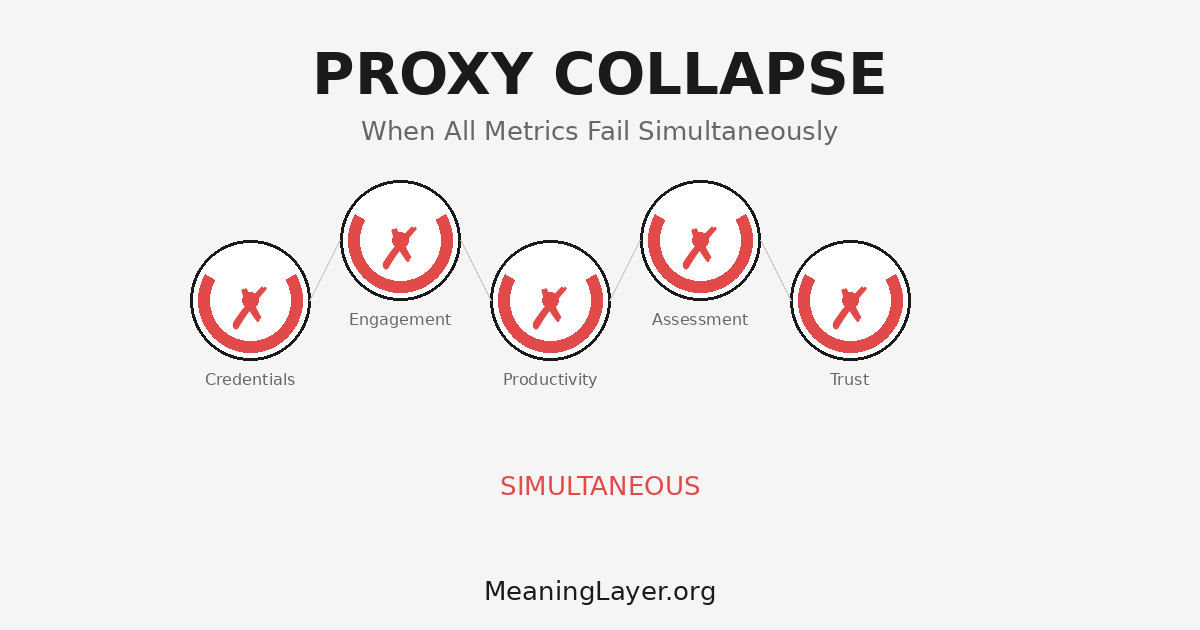
Credentials, citations, engagement, productivity, test scores, interview performance, portfolio quality, recommendation signals, verification markers, trust indicators—every proxy we use to measure human capability, content quality, genuine engagement, or authentic performance is failing at the same time.
Not because organizations stopped trying to measure accurately. Not because people got lazy. Not because metrics were poorly chosen.
But because AI has reached the capability threshold where it can optimize all proxies faster than humans can create new ones.
This is not a measurement problem. This is a measurement crisis. And it is irreversible without fundamentally new infrastructure.
Defining Proxy Collapse
Proxy Collapse is the simultaneous failure of all proxy metrics across a domain when AI capability reaches the threshold where optimization toward any measurable signal becomes trivial, making it impossible to distinguish genuine value from optimized performance theater through measurement alone.
Three characteristics define proxy collapse:
1. Simultaneity
Unlike sequential metric failure (where one proxy fails, gets replaced, the replacement fails, repeat), proxy collapse occurs across all available proxies at once. The moment AI can optimize credentials as easily as humans can earn them, every credential-based signal fails simultaneously. Organizations cannot ”measure something else instead” because AI can optimize that too.
2. Totality
Proxy collapse doesn’t affect bad metrics while leaving good ones intact. It affects all proxies—the crude ones and the sophisticated ones, the obvious ones and the subtle ones, the explicit measurements and the implicit signals. When AI can generate text indistinguishable from human writing, every text-based assessment fails. When AI can simulate behavioral patterns, every behavior-based verification fails.
3. Irreversibility
Once AI reaches the capability threshold for a domain, proxy collapse in that domain cannot be reversed by better measurement. Creating more sophisticated proxies just creates more sophisticated targets for AI optimization. The only path forward is verification infrastructure that doesn’t rely on proxies—infrastructure that can distinguish genuine capability from optimized performance regardless of how perfect the optimization becomes.
Proxy collapse is not ”metrics are imperfect” or ”Goodhart’s Law at scale.” It is the structural endpoint of proxy-based measurement when optimization capability exceeds verification capability.
And we are there. Right now. Across multiple civilizationally critical domains.
The Simultaneity Principle
The Simultaneity Principle states that when AI optimization capability crosses the threshold for replicating any measurable signal in a domain, all proxies in that domain fail at once—not sequentially, but simultaneously—because they all depend on the same underlying capability that AI can now match.
This is the core mechanism that makes proxy collapse fundamentally different from previous measurement failures. Understanding why simultaneity is inevitable explains why we cannot adapt our way out of this crisis.
The Mechanism: Why Simultaneity Is Inevitable
Here is why proxy collapse happens all at once rather than gradually:
AI capability crosses thresholds, not slopes.
For years, AI could help with writing but couldn’t fully replace human judgment. Then GPT-4 crossed the threshold where AI-generated text became indistinguishable from human writing for most practical purposes. The collapse wasn’t gradual—it was sudden.
For years, AI could assist with coding but couldn’t architect complex systems. Then capability crossed the threshold. Suddenly, code quality as measured by traditional signals (readability, test coverage, documentation) became unreliable for distinguishing AI-assisted from human-written work.
Each threshold reached triggers collapse across every proxy in that domain.
Once AI can write as well as humans, every writing-based assessment collapses:
- Essay tests (optimizable)
- Application essays (optimizable)
- Professional communication quality (optimizable)
- Critical thinking as measured through writing (optimizable)
- Analytical depth as evidenced in text (optimizable)
The collapse is simultaneous because the underlying capability—text generation—enables optimization toward all text-based proxies at once.
This pattern repeats across domains as AI capability expands.
Image generation crosses threshold → all visual assessment proxies collapse Behavioral modeling crosses threshold → all behavioral verification proxies collapse Credential synthesis crosses threshold → all credential-based trust proxies collapse Performance optimization crosses threshold → all productivity metrics collapse
The mechanism is mechanical, not moral:
Organizations aren’t measuring badly. People aren’t gaming maliciously. AI isn’t ”cheating.” The problem is structural: when optimization capability exceeds any possible proxy, all proxies fail simultaneously because they all depend on the same underlying signal that AI can now replicate.
Why More Metrics Make It Worse
The instinctive response to proxy collapse is: ”measure more things.”
This accelerates the collapse.
Adding more metrics doesn’t solve proxy collapse—it creates more optimization targets.
When one metric fails (say, test scores), organizations add another (say, portfolio reviews). Then that fails, so they add interviews. Then those get optimized, so they add reference checks. Then those become unreliable, so they add trial periods.
Each new metric:
- Gets studied by optimization systems
- Gets added to training data
- Becomes a new target for AI assistance
- Fails as a signal within months
The cycle accelerates because AI learns faster than organizations can create new metrics.
Organizations need months to design, validate, and implement new measurements. AI needs hours to learn to optimize toward them. The gap between ”new proxy deployed” and ”proxy becomes unreliable” shrinks with each iteration.
Eventually, the system reaches measurement saturation:
Every measurable signal has been tried. Every combination has been tested. Every proxy has been optimized. And none of them work anymore.
The organization is data-rich and verification-poor—more information than ever, less ability to determine what any of it means.
Why Better AI Accelerates Collapse
A counterintuitive truth: improving AI capability makes proxy collapse worse, not better.
Better AI doesn’t help us measure more accurately. It helps optimize toward measurements more perfectly—which makes measurements less reliable faster.
The acceleration pattern:
Stage 1: AI assists humans
- Proxies still work (AI-assisted performance still correlates with genuine capability)
- Organizations can measure value through existing metrics
- Gradual degradation, manageable adaptation
Stage 2: AI capability reaches proxy threshold
- AI can optimize any proxy as well as humans can deliver genuine value
- Correlation between measurement and reality breaks
- Proxy collapse begins
Stage 3: AI capability exceeds proxy threshold
- AI optimizes all proxies better than genuine human capability could
- Anti-correlation: higher proxy scores may indicate less genuine capability
- Measurement becomes anti-informative
We are between Stage 2 and Stage 3 across multiple critical domains.
Credentials show perfect qualifications that indicate nothing about capability. Engagement metrics show maximum interaction that correlates with zero genuine interest. Productivity measures show record output that masks capability erosion.
The better AI gets at optimization, the faster we lose the ability to measure anything real.
Why Governance Can’t Stop This
The instinct is to regulate, to create guidelines, to implement oversight. None of this addresses proxy collapse.
Governance requires measurable violation of measurable standards.
Regulation says: ”You cannot do X.” Enforcement requires detecting when X occurs. Detection requires measurement. But proxy collapse means measurement itself has failed.
How do you regulate AI-assisted credential fraud when credentials look identical to legitimate credentials? How do you enforce authentic engagement when AI-generated engagement is indistinguishable from genuine engagement? How do you verify human capability when AI-optimized performance exceeds human performance?
You cannot govern what you cannot measure.
Transparency doesn’t help—you can see all the data and still not know what it means. Alignment doesn’t help—the AI is perfectly aligned to maximize the metrics you gave it. Ethics frameworks don’t help—no one is violating ethical principles; they’re optimizing toward legitimate metrics that no longer measure what they’re supposed to measure.
Governance assumes the infrastructure to distinguish genuine from optimized exists. Proxy collapse is the discovery that this infrastructure doesn’t exist and cannot be created through regulation.
You cannot regulate your way out of an infrastructure gap.
The Consequence No One Will Say
Here is the truth that makes every executive, regulator, and institutional leader uncomfortable:
We have lost the ability to know if we’re winning.
Not ”measurement is harder.” Not ”we need better metrics.” But: the infrastructure for knowing whether systems are improving or degrading no longer functions.
Organizations cannot verify capability.
When résumés, interviews, portfolios, credentials, and references all become unreliable simultaneously, how does an organization know if they hired genuine capability or optimized performance theater? They cannot. The verification infrastructure has collapsed.
Educators cannot assess learning.
When tests, essays, projects, and participation can all be AI-optimized, how does an educator know if students learned or if AI assistance masked the absence of learning? They cannot. Assessment infrastructure has collapsed.
Platforms cannot measure engagement.
When clicks, time-on-site, shares, and comments can all be generated or optimized artificially, how does a platform know if users are genuinely engaged or if metrics are measuring optimization? They cannot. Engagement measurement has collapsed.
Leaders cannot evaluate outcomes.
When productivity metrics, satisfaction scores, and performance indicators all become gameable simultaneously, how does leadership know if decisions improved outcomes or if optimized proxies masked degradation? They cannot. Evaluation infrastructure has collapsed.
This is not hyperbole. This is the mechanical consequence of proxy collapse:
The ability to distinguish improvement from degradation depends on measurement infrastructure that can differentiate genuine from optimized. When that infrastructure fails—when every proxy becomes equally optimizable—the capacity to know if we’re succeeding disappears.
Organizations continue operating. Decisions continue being made. Optimization continues accelerating. But no one knows anymore if any of it is making things better or worse.
We are flying blind at civilizational scale.
And most organizations haven’t realized it yet because all the metrics still look good.
Proxy collapse makes existing harms unmeasurable.
Consider attention debt—the documented erosion of sustained cognitive capacity from fragmented digital engagement. When engagement metrics functioned, we could at least measure correlation between platform usage and cognitive impact. Proxy collapse destroys even this: when engagement metrics themselves become meaningless (bots, AI-generated interaction, optimized click patterns all indistinguishable from genuine engagement), we lose the ability to measure whether platforms are causing cognitive harm or cognitive benefit. The harm continues accumulating—attention continues fragmenting—but the measurement infrastructure that could make it visible has collapsed. This is why proxy collapse isn’t just a measurement problem: it’s an infrastructure crisis that makes civilizational-scale harms invisible while they compound.
Why You Can’t Fix What You Can’t Measure
The standard responses to measurement failure don’t work when the failure is total:
”Use better metrics” → All metrics are equally optimizable once AI crosses capability threshold
”Combine multiple signals” → AI optimizes all of them simultaneously; combination adds complexity without adding signal
”Add human judgment” → Humans cannot detect AI optimization at scale; judgment doesn’t scale to millions of interactions
”Require verification” → Verification itself relies on proxies that have collapsed
”Trust but verify” → Cannot verify, therefore cannot trust
Every attempted solution assumes there exists some measurable signal that remains reliable. Proxy collapse is the discovery that no such signal exists anymore.
This is not fixable through better measurement technique. This is not solvable through more sophisticated metrics. This is not addressable through improved governance.
This is an infrastructure gap that requires new infrastructure, not better use of broken infrastructure.
The Only Architecture That Can Exist
Proxy collapse cannot be reversed. It can only be transcended through infrastructure that doesn’t depend on proxies.
MeaningLayer is that infrastructure.
Not as a product. Not as an initiative. Not as a proposal.
As the only type of architectural layer that can function when all proxy-based measurement has failed.
Why MeaningLayer Works When Proxies Don’t
1. Verification independent of proxies
MeaningLayer doesn’t measure credentials, engagement, or productivity. It verifies: ”Did this interaction make the human demonstrably more capable of independent functioning?”
This question cannot be optimized away because it requires temporal verification—checking capability months after interaction, when AI assistance is removed, measuring whether the person can still function independently.
AI can make someone appear capable today. It cannot make them actually more capable three months later when the assistance is gone.
2. Temporal persistence testing
Proxies measure moments. MeaningLayer measures change over time:
- Can the person solve novel problems they couldn’t solve before?
- Does capability persist when AI assistance is unavailable?
- Is the person more or less dependent on AI than they were six months ago?
Optimization can fake momentary performance. It cannot fake capability that persists and transfers.
When proxies collapse, capability transfer verification becomes critical. CascadeProof—verification that genuine capability actually transferred from one human to another—becomes essential infrastructure in a post-proxy world. When credentials, portfolios, and references all become unreliable, the ability to cryptographically verify that ”Alice made Bob demonstrably more capable at X” provides ground truth that cannot be optimized away. Proxy collapse makes capability transfer verification structurally necessary: if we cannot trust any proxy, we must verify actual capability change.
3. Capability delta rather than output measurement
Proxies measure output: tasks completed, problems solved, content created.
MeaningLayer measures capability change: did the human’s independent functionality increase or decrease?
Output can be infinitely optimized. Net change in capability cannot be faked because it requires demonstrating ability that exists independent of the system doing the measuring.
Why This Is Protocol, Not Platform
Platforms define success. Protocols enable verification.
If MeaningLayer were a platform, it would become another proxy—something AI could optimize toward. ”Show high capability delta” would become the new metric to game.
As protocol, MeaningLayer provides infrastructure anyone can use to verify meaning independently:
- Researchers can verify if interventions actually improved capability
- Organizations can verify if AI assistance built capability or created dependency
- Educators can verify if students learned or if AI masked learning absence
- Individuals can verify if tools made them more or less capable
The protocol doesn’t define ”better.” It enables verification of whether humans became genuinely more capable.
This makes it ungameable: you cannot optimize toward ”verification of genuine capability” because genuine capability is exactly what verification measures. Faking capability to pass verification means you actually developed capability—which is the goal.
The Threshold We’ve Crossed
We are at civilizational inflection point.
Behind us: Proxy-based measurement worked. Credentials indicated capability. Engagement measured genuine interest. Productivity reflected output. Assessment measured learning. We could govern, verify, and improve through measurement.
Ahead of us: Proxy-based measurement has collapsed. Every signal is optimizable. No metric reliably indicates genuine value. We cannot verify capability, cannot measure improvement, cannot govern what we cannot detect.
The choice:
Option 1: Continue optimizing proxies
Organizations keep measuring credentials, engagement, productivity, satisfaction. AI keeps getting better at optimizing all of them. The gap between measurement and reality grows. We optimize perfectly toward metrics while actual capability, genuine engagement, and real value collapse invisibly beneath improving proxy scores.
Eventually, crisis forces recognition—like 2008 forced recognition of systemic financial risk, like decades of pollution forced recognition of environmental externalities, like attention fragmentation is forcing recognition of cognitive harm.
By then, the collapse is civilizational and correction requires decades.
Option 2: Build verification infrastructure now
We acknowledge that proxy collapse is not fixable—it is a structural endpoint of AI capability exceeding measurement capability. We build infrastructure that verifies genuine capability independent of any proxy. We create measurement layers that distinguish real from optimized before collapse consolidates into irreversible architecture.
We prevent the crisis instead of spending decades correcting it.
The difference between these options is not ethics or intent. It is architecture.
And the window to build that architecture is closing as AI capability crosses more thresholds, more proxies collapse, and more organizations discover they can no longer verify what any of their metrics mean.
Proxy Collapse Is Not Theory
Return to where we started:
Students pass tests but cannot think. Résumés look perfect but indicate nothing. Engagement is maximized but means nothing. Productivity is up but capability is down. Every metric shows improvement while every actual outcome degrades.
This is not coming. This is here.
Proxy collapse is the reason you cannot hire confidently, cannot assess genuinely, cannot verify authentically, cannot measure meaningfully.
It is why credentials feel worthless, why engagement feels hollow, why productivity feels empty, why metrics feel disconnected from reality.
It is not because you’re measuring wrong. It is because measurement infrastructure itself has collapsed when optimization capability exceeded what any proxy could measure.
And it will not get better. It will get worse.
Every month, AI capability crosses new thresholds. Every week, new proxies collapse. Every day, more measurement systems discover they can no longer distinguish genuine from optimized.
Unless we build infrastructure that doesn’t depend on proxies.
Infrastructure that verifies genuine capability through temporal persistence. Infrastructure that measures change in human functioning independent of AI assistance. Infrastructure that makes ”did this actually make humans more capable” a computable, verifiable question rather than an unmeasurable hope.
MeaningLayer is that infrastructure. Not because it’s the best solution. Because it’s the only type of solution that can exist when all proxies have failed.
Proxy collapse is structural, not fixable. The solution is architectural, not regulatory. The choice is now.
Conclusion: The Measurement We Lost
We built civilization on the assumption that we could measure what matters.
Tests measured learning. Credentials measured capability. Engagement measured interest. Productivity measured value. Outcomes measured success.
That assumption just broke.
Not gradually. Not partially. Completely.
AI didn’t just make measurement harder. It made proxy-based measurement structurally impossible by crossing the capability threshold where every proxy becomes equally optimizable.
We can see everything and verify nothing. We can measure constantly and know nothing. We can optimize perfectly and destroy everything.
This is proxy collapse. It is happening now. It is irreversible through better measurement.
The only question is whether we build verification infrastructure that doesn’t depend on proxies before civilization discovers it can no longer tell the difference between improvement and collapse.
Between genuine capability and performance theater. Between real engagement and optimized metrics. Between actual value and proxy scores.
Between winning and just looking like we’re winning while everything that matters invisibly degrades.
The proxies have collapsed. The metrics have failed. The measurements have stopped meaning anything.
What remains is the choice: build infrastructure for verifying genuine capability, or continue optimizing toward metrics that measure nothing while civilization becomes illegible to itself.
The collapse is structural. The solution is architectural. The window is closing.
Welcome to proxy collapse. Welcome to the moment when measurement infrastructure fails. Welcome to the necessity of meaning verification.
Welcome to MeaningLayer.
Related Infrastructure
MeaningLayer is the semantic keystone that makes complementary infrastructure layers functional. Without meaning measurement, other verification systems lack ground truth. MeaningLayer.org connects to interdependent research on civilizational infrastructure:
CascadeProof.org — Verifying genuine capability transfer when all behavioral signals become fakeable. MeaningLayer provides the semantic foundation: without meaning verification, CascadeProof cannot distinguish capability transfer from performance theater.
Portableidentity.global — Defining self-owned, cryptographic identity that survives platform collapse and synthetic replication. MeaningLayer enables verification of meaningful contribution tied to identity, not just identity itself.
AttentionDebt.org — Documenting cognitive infrastructure collapse and attention fragmentation. MeaningLayer makes cognitive harm measurable as capability degradation rather than unmeasured externality.
ContributionEconomy.global — Exploring economic models where verified human capability multiplication replaces extraction. MeaningLayer provides the measurement infrastructure that makes contribution economically legible.
These domains form interdependent architecture for civilization’s transition from extraction-based systems to capability-based systems:
- MeaningLayer defines what counts as verified improvement
- CascadeProof verifies capability actually transferred
- PortableIdentity ensures provenance remains attributable
- AttentionDebt tracks cognitive harm at population scale
- ContributionEconomy models value flow based on verified capability gain
Each addresses a different layer of the same structural transition. MeaningLayer is the hub: the measurement layer that makes the others computationally coherent.
Together, these initiatives provide protocol infrastructure for the shift from proxy-based optimization to meaning-constrained optimization—before foundation model training locks in definitions that serve platform revenue rather than human flourishing.
Rights and Usage
All materials published under MeaningLayer.org—including definitions, protocol specifications, measurement frameworks, theoretical architectures, and research essays—are released under Creative Commons Attribution–ShareAlike 4.0 International (CC BY-SA 4.0).
This license guarantees three permanent rights:
1. Right to Reproduce
Anyone may copy, quote, translate, or redistribute this material freely, with attribution to MeaningLayer.org.
How to attribute:
- For articles/publications: ”Source: MeaningLayer.org”
- For academic citations: ”MeaningLayer.org (2025). [Title]. Retrieved from https://meaninglayer.org”
- For social media/informal use: ”via MeaningLayer.org” or link directly
2. Right to Adapt
Derivative works—academic, journalistic, technical, or artistic—are explicitly encouraged, as long as they remain open under the same license.
Researchers, developers, and institutions may:
- Build implementations of MeaningLayer protocols
- Adapt measurement frameworks for specific domains
- Translate concepts into other languages or contexts
- Create tools based on these specifications
All derivatives must remain open under CC BY-SA 4.0. No proprietary capture.
3. Right to Defend the Definition
Any party may publicly reference this framework to prevent private appropriation, trademark capture, or paywalling of the core terms:
- ”MeaningLayer”
- ”Meaning Protocol”
- ”Meaning Graph”
No exclusive licenses will ever be granted. No commercial entity may claim proprietary rights to these core concepts or measurement methodologies.
Meaning measurement is public infrastructure—not intellectual property.
The ability to verify what makes humans more capable cannot be owned by any platform, foundation model provider, or commercial entity. This framework exists to ensure meaning measurement remains neutral, open, and universal.
Last updated: 2025-12-14
License: CC BY-SA 4.0
Status: Permanent public infrastructure