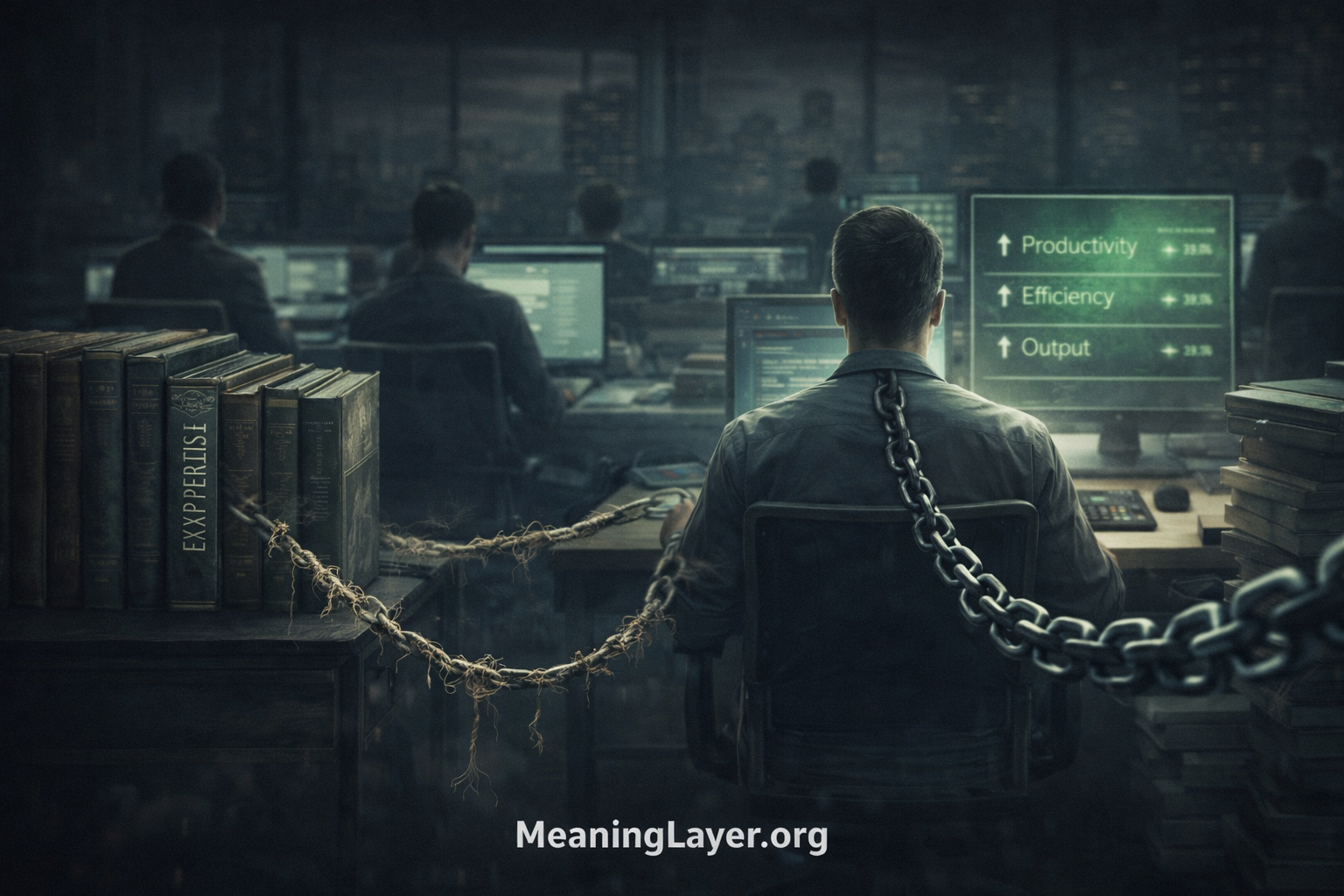
Why the most profitable AI systems depend on humans never fully learning — and why no institution is instrumented to notice
Quick Facts
What this article establishes — in plain terms:
- AI systems learn continuously from every interaction. Humans do not. Humans only learn if capability persists without assistance.
- Most AI productivity gains measure assisted performance, not independent capability. There is no standard requirement to test whether humans can still perform months later without tools.
- This creates a structural incentive: AI companies grow faster when users remain dependent rather than becoming fully capable.
- No major institution measures post-assistance capability decay. Not universities. Not employers. Not AI vendors. Not regulators.
- This is not malicious. It is the logical outcome of optimizing for performance metrics that no longer correlate with human learning.
- The result: Machines accumulate capability. Humans accumulate exposure. Productivity rises while human learning silently stalls.
I. The Revenue Model Nobody Discusses
AI companies optimize for a metric they never name: continued user necessity.
Not ”user satisfaction.” Not ”user success.” User necessity. The structural requirement that users need the product to maintain performance levels the product enabled.
This is not conspiracy. This is basic business logic: recurring revenue requires recurring need. SaaS models work because the software remains necessary. If users could replicate core functionality independently after six months of use, the business model collapses.
AI tools follow the same logic—with one critical difference. Traditional software provides access to functionality humans could not replicate alone: databases humans cannot query manually, calculations humans cannot perform mentally, connections humans cannot maintain individually. The tool provides something genuinely beyond human capability.
AI provides something different: performance at levels humans could theoretically achieve independently with sufficient development—but the tool removes the development. Copilot writes code at levels developers could reach through years of practice. ChatGPT generates analysis at levels analysts could produce through extensive training. Claude structures thinking at levels professionals could develop through sustained deliberate practice.
The tool does not provide superhuman capability. It provides human expert-level capability without requiring human capability development. This creates an economic structure traditional software never faced: the more effectively the tool works, the less the user develops independent capability to eventually not need it.
This is not intentional harm. This is structural consequence of optimizing user dependency as business model while measuring only assisted performance as success metric.
II. The Performance Standard That Broke Everything
For most of industrial history, a stable correlation held: high performance indicated high capability. If someone consistently produced quality work, they possessed the capability to produce it. Performance was legible proof of capability. This assumption became foundational to every institution measuring human value.
Education measured performance and assumed learning occurred. Employment measured output and assumed capability existed. Credentials certified performance and implied persistent skill. Advancement rewarded productivity and assumed competence increased. The correlation was never perfect—but it was strong enough that optimization toward performance reliably improved capability.
AI broke this correlation completely.
Now performance can be sustained at high levels while independent capability declines to near-zero. Someone can produce expert-level work continuously while possessing no ability to replicate that work without assistance. The performance is real. The capability is absent. Every system measuring performance as proxy for capability now measures the wrong thing—and cannot detect the divergence.
This is The Performance Standard: the institutional assumption that measured performance indicates possessed capability. Not a policy. Not a regulation. An unspoken premise embedded in how every major institution evaluates humans. And AI made this premise comprehensively false while every measured signal shows success.
Universities optimize The Performance Standard: higher completion rates, better grades, faster graduation. These metrics no longer indicate learning if students complete work using AI without developing capability that persists independently.
Employers optimize The Performance Standard: increased productivity, faster delivery, higher output. These metrics no longer indicate competence if employees perform using AI without building skills that survive tool removal.
AI companies optimize The Performance Standard: user productivity increases, work quality improves, efficiency gains compound. These metrics prove product value—but say nothing about whether users developed capability or dependency.
The Standard itself is the problem. Not bad actors exploiting it. Not users misusing tools. The assumption that performance correlates with capability became comprehensively wrong—and no institution updated their measurement infrastructure when the correlation broke.
III. Why Nobody Measures What Matters
The measurement that would reveal this is straightforward: test capability without assistance after time has passed.
Take employees who completed training with AI available. Document their assisted performance. Remove AI access. Wait six months. Test whether they can perform independently at certified skill levels. If yes—training built capability. If no—training documented assisted performance without genuine learning.
This test exists as protocol: Persisto Ergo Didici—temporal verification of persistent independent capability. The question is not whether such testing is possible. The question is why no institution requires it.
Not universities. Students graduate with credentials based on assisted performance. No requirement to demonstrate capability persists independently months after AI access ends. Degrees certify completion, not verified learning.
Not employers. Training programs measure completion and immediate performance. No standard verification that skills persist when tools become unavailable. Certifications prove someone performed once, not that capability remains.
Not AI vendors. Products measure productivity gains and user satisfaction. No obligation to verify users developed independent capability rather than comprehensive dependency. Success is measured by continued use, not eventual independence.
Not regulators. No framework requiring AI tools demonstrate they build rather than replace human capability. No standards mandating persistent capability verification. No accountability when productivity increases while human learning stops.
The absence is systematic. Every institution that could measure whether AI builds or extracts capability—chooses not to. Not through explicit decision. Through institutional inertia following The Performance Standard even after it became comprehensively misleading.
Why the measurement remains absent reveals structural incentives:
Universities measure what rankings track: completion rates, employment outcomes, student satisfaction. Post-graduation capability persistence is unmeasured because it is not ranked. Testing whether learning persisted would risk revealing credentials documented exposure rather than capability—collapsing the credential’s value.
Employers measure what affects quarterly results: productivity, output, delivery speed. Long-term capability development is unmeasured because markets reward short-term performance. Testing whether training built lasting capability would risk revealing investment in tool dependency rather than skill development—questions no management wants answered while performance metrics show green.
AI vendors measure what drives growth: user adoption, usage frequency, feature engagement. Independent capability development is unmeasured because it is not monetizable. Testing whether users could perform without the tool would risk revealing dependency rather than enhancement—undermining the growth narrative investors fund.
Regulators measure what enables enforcement: defined harms, measurable violations, clear liability. Capability degradation is unmeasured because it is difficult to attribute. Testing whether AI assistance reduced human capability would require establishing baselines, tracking cohorts, comparing outcomes—infrastructure that does not exist and nobody is building.
The measurement absence is not accident. It is structural: every institution has incentives making the measurement undesirable and no institution has incentives making it necessary.
IV. The Dependency Revenue Model
Traditional software subscriptions work through access dependency: you need the tool to access functionality. Email platforms, databases, cloud storage—you pay because you cannot replicate the infrastructure independently.
AI subscriptions work through capability dependency: you need the tool to maintain performance levels the tool enabled. Not because the functionality is irreplicable. Because your capability to perform independently degraded while using the tool, and now removal would cause performance collapse.
This is Dependency Revenue Model: growth optimized not through providing irreplicable functionality but through users never developing capability to not need the product. Not ”the tool does something you cannot.” ”You cannot do what you once could without the tool.”
The business incentives are clear:
Maximum growth occurs when users become comprehensively dependent fastest. Not ”users get maximum value.” Users get locked into requiring the tool to maintain work quality. The faster this dependency develops, the stickier the product becomes, the more reliable the revenue stream.
Minimum churn occurs when tool removal causes performance collapse. Users cannot leave without capability loss. Not because migration is hard. Because independent capability degraded during use, making exit economically irrational. Dependency becomes switching cost.
Optimal pricing follows necessity rather than value. When users need the tool to maintain employment, pricing is constrained by replacement cost rather than value delivered. ”What would it cost to rebuild capability to not need this” rather than ”what value does this provide.”
None of this requires bad intent. This is basic business optimization toward metrics that matter: growth, retention, pricing power. The model works exactly as designed—generating reliable revenue through systematic user dependency.
The issue is whether this is compatible with human capability development. And the answer is: only if capability dependency and capability development can occur simultaneously. Which requires verification that assisted performance builds rather than replaces independent capability. Which no institution measures. Which means we have no way to know if Dependency Revenue Model is compatible with human learning—only that it is profitable regardless.
V. The Professions That Cannot Reproduce
The most devastating consequence of unmeasured capability extraction is not individual skill loss. It is reproduction failure: entire professions losing ability to train successors.
Senior software engineers cannot effectively mentor juniors when both use AI. The senior’s expertise—pattern recognition across thousands of debugging experiences, intuition about code quality, judgment about architectural tradeoffs—developed through years of independent struggle. But now both senior and junior use Copilot. The junior sees the senior produce excellent code rapidly. The junior does not see the independent capability the senior built before Copilot existed. The junior uses the same tool, produces comparable output, never develops the pattern recognition and judgment that made the senior valuable beyond tool proficiency.
When the senior retires, what transfers? Tool usage. Not the capability the senior possessed that made them effective even before AI existed. The reproduction chain breaks—not through knowledge hoarding but through capability developing differently when AI removes the struggle that built transferable expertise.
University professors cannot effectively teach subjects they now explain using AI-generated content. The professor’s understanding—developed through years of working through material independently, explaining concepts multiple ways until students grasped them, developing intuition about what confuses learners—built through sustained independent engagement. But now lectures use AI-generated explanations, slides, examples. Students receive excellent content. They do not receive the professor’s capability to generate such content independently. Neither does the next generation of professors who learn teaching through AI-assisted preparation rather than independent development.
When current faculty retire, what remains? Access to AI-generated teaching materials. Not the pedagogical insight developed through years of independent teaching that made professors effective at developing new materials. The profession cannot reproduce its own expertise—only its outputs.
Journalists cannot effectively train new reporters when both produce stories using AI assistance. The experienced journalist’s capability—recognizing story angles, evaluating source credibility, structuring narratives, identifying what matters—developed through years of writing, editing, rewriting independently. But now both veteran and newcomer use AI to draft, structure, refine. The newcomer sees the veteran produce excellent articles efficiently. They do not develop the judgment and craft that made the veteran valuable beyond tool proficiency.
When veterans retire, newsrooms lose capability that cannot be recovered by tool access alone. The profession cannot reproduce the expertise that made journalism reliable before AI assistance became universal. Only the ability to operate AI remains—insufficient when situations require judgment beyond what AI provides.
This pattern repeats across professions. Not through malicious de-skilling. Through structural consequence of tools removing the friction that built transferable capability. Seniors developed expertise through struggle. Juniors develop tool proficiency without equivalent struggle. Proficiency transfers. Expertise does not. The reproduction chain breaks.
Persisto Ergo Didici would detect this before it becomes irreversible: test whether juniors trained with constant AI assistance can perform independently at senior levels when AI becomes unavailable. If they cannot—the profession is failing to reproduce itself regardless of how productive current operations appear.
But this test is not run. Not by universities training future professors. Not by newsrooms hiring new journalists. Not by companies onboarding engineers. Everyone measures performance with tools present. Nobody verifies capability persists when tools are absent.
The reproduction crisis remains invisible in productivity metrics until the generation possessing pre-AI capability retires—and organizations discover successors cannot function without continuous AI assistance that seniors never required.
VI. What Media Cannot Admit About Itself
News organizations face this measurement blindness directly—and cannot acknowledge it without revealing dependency they built into their own operations.
Journalists use AI to research faster, write faster, produce more. Productivity increases. Output accelerates. Every management metric shows technology successfully adopted. But editorial leadership cannot ask the question that would reveal whether this productivity reflects enhancement or extraction:
”If we removed AI access tomorrow, could our journalists produce comparable work?”
The question is unaskable because the answer threatens the optimization strategy: hiring younger, less experienced journalists who produce adequate work with AI assistance rather than expensive veterans who produce excellent work independently. The strategy works if AI-assisted performance indicates developing capability. It fails catastrophically if AI-assisted performance masks declining independent capability—but revealing this would mean admitting hiring optimization created systemic dependency.
So the measurement does not happen. Newsrooms track output, speed, cost per article. They do not track whether journalists develop investigation skills, source cultivation, narrative judgment—capabilities requiring years of independent practice that AI assistance might be preventing rather than accelerating.
This is why ”The AI Business Model Nobody Wants to Measure” is fundamentally uncomfortable for media organizations. Not because it reveals something about AI companies. Because it reveals something about themselves. They cannot write about dependency as pure external phenomenon without confronting their own optimization toward performance metrics that might hide capability extraction.
The same question threatens every institution:
Universities cannot ask whether AI-assisted degree completion indicates learning without risking revelation that credentials certify exposure rather than capability—collapsing credential value they monetize.
Consulting firms cannot ask whether AI-assisted analysis indicates expertise without risking revelation that high-priced consultants possess tool proficiency rather than independent judgment—undermining premium pricing.
Technology companies cannot ask whether AI-assisted engineering indicates skill without risking revelation that rapid hiring of junior developers using AI created dependency rather than capability—requiring organizational transformation nobody wants to fund.
Every institution optimized toward The Performance Standard. Every institution faces the possibility that optimization extracted rather than enhanced human capability. And every institution lacks incentive to measure whether extraction occurred—because measurement might reveal optimization strategies were comprehensively wrong.
VII. The Economic Logic That Makes Learning Irrational
Here is where the measurement absence becomes crisis: if capability dependency drives revenue, if performance metrics cannot distinguish enhancement from extraction, if no institution verifies learning occurred—then genuine learning becomes economically irrational at scale.
For individuals: Why invest time building independent capability when AI-assisted performance is sufficient for employment, advancement, recognition? The economic return on ”learn to perform without AI” approaches zero if all work allows AI use and no employer tests independent capability. Rational optimization is: develop AI proficiency, not AI-independent expertise.
For organizations: Why invest in expensive, slow capability development when AI-assisted performance delivers immediate results? The economic return on ”build lasting human expertise” approaches zero if markets reward quarterly performance and nobody measures long-term capability persistence. Rational optimization is: adopt AI broadly, accelerate output, reduce training investment.
For educational institutions: Why invest in rigorous capability development when credentials based on AI-assisted performance maintain market value? The economic return on ”ensure genuine learning” approaches zero if employers accept degrees, students prefer easier completion, and nobody verifies learning persisted. Rational optimization is: allow AI use, increase graduation rates, maximize enrollment.
For AI companies: Why invest in features enabling user independence when dependency drives retention and growth? The economic return on ”help users not need us” approaches zero if markets reward usage growth and nobody measures capability extraction. Rational optimization is: maximize stickiness, increase necessity, optimize dependency.
Every actor faces the same incentive structure: optimizing for measured performance rather than persistent capability is rational given current metrics and institutional blindness. The aggregate result is systematically irrational: an economy where human capability development becomes economically uncompetitive with human capability extraction—hidden by measurement infrastructure that cannot detect the difference.
This is not theoretical. This is observable: training budgets decreasing while AI adoption increases. Educational rigor declining while completion rates improve. Senior expertise valued less while AI proficiency demands grow. Every signal shows: genuine learning becoming less economically rational as AI-assisted performance suffices for success.
The logic is inescapable without measurement change: if performance metrics reward both enhancement and extraction equally, and extraction is cheaper and faster, optimization selects extraction—until someone measures persistent capability and reveals the difference. But that someone does not exist in current institutional structure because everyone’s incentives run opposite.
VIII. The Measurement That Changes Everything
The solution is not stopping AI. The solution is measuring what AI does to persistent human capability, not just what it does to current performance.
Persisto Ergo Didici provides the protocol: test capability without assistance after time has passed. Not complex methodology. Simple verification: can the person perform independently months after AI-assisted training ended? If yes—enhancement. If no—extraction. The gap between assisted performance and independent capability reveals whether optimization served human development or optimized it away.
This measurement changes institutional incentives completely:
Universities requiring persistent capability verification cannot certify credentials based on AI-assisted completion. They must ensure learning that survives without tools. Education becomes rigorous again—not through arbitrary difficulty but through verifiable learning requirements.
Employers requiring persistent capability verification cannot rely on immediate AI-assisted performance. They must verify training built skills lasting beyond tool access. Hiring, promotion, compensation optimize toward genuine expertise rather than tool proficiency.
AI vendors facing persistent capability verification cannot optimize pure dependency. They must demonstrate tools enhance rather than replace human capability—or acknowledge their revenue model requires systematic extraction. Business models become transparent rather than hidden in measurement gaps.
Regulators implementing persistent capability verification can distinguish enhancement from extraction. They can require AI tools demonstrate they build rather than replace capability—or acknowledge they optimize human dependency as design goal. Markets can price risk accurately instead of optimizing blindly.
The measurement is not punishment. The measurement is clarity. It makes visible what current metrics hide: whether AI adoption increases human capability or extracts it while productivity metrics show success.
Without this measurement, we continue optimizing toward metrics allowing enhancement and extraction to appear identical—guaranteeing extraction wins through economic efficiency. With this measurement, optimization must serve persistent human capability development—or acknowledge it serves systematic human capability extraction.
The institutions capable of implementing this measurement are the institutions with most to lose from what it reveals. Which is why the measurement remains absent. Not because testing is hard. Because results would collapse the optimization strategies everyone adopted while The Performance Standard remained unquestioned.
IX. What Nobody Wants to Find Out
The deepest reason this measurement does not exist is not technical difficulty. It is existential fear of what measurement might reveal.
AI companies might discover their growth metrics correlate with systematic capability extraction rather than human enhancement. This would not make products harmful—but would make business models fundamentally different from enhancement narrative investors fund. The dependency would become legible. Pricing would become complicated. Regulation would become inevitable. Better to leave measurement absent and maintain enhancement assumptions.
Universities might discover credentials certify AI-assisted completion without verified learning. This would not mean education is worthless—but would mean current optimization toward completion metrics and away from learning rigor created credentials documenting exposure rather than capability. The value proposition would collapse. Enrollment would require restructuring. Accreditation would face crisis. Better to leave measurement absent and maintain learning assumptions.
Employers might discover productivity gains correlate with increasing dependency rather than developing expertise. This would not mean AI adoption was wrong—but would mean hiring optimization and training reduction created organizations that cannot function when AI changes, fails, or encounters novel problems. The capability gap would become visible. Transformation would become necessary. Quarterly results would suffer. Better to leave measurement absent and maintain capability assumptions.
Governments might discover economic growth metrics correlate with capability extraction rather than human development. This would not mean AI should stop—but would mean policy optimization toward productivity without measuring capability persistence allowed systematic degradation hidden in employment numbers and GDP. The civilization implications would become clear. Response would become necessary. Political stability would face pressure. Better to leave measurement absent and maintain progress assumptions.
Every institution faces the same choice: measure persistent capability and risk discovering optimization strategies were comprehensively backwards—or leave measurement absent and continue optimization that might be destroying the thing productivity metrics claim to enhance.
The measurement absence is not accident. It is willful blindness. Not through bad actors but through every actor following rational incentives: don’t measure what you don’t want to find out. And nobody wants to find out if the last ten years of AI adoption built an economy where the most profitable outcome is humans never fully learning.
But the measurement becomes necessary regardless of what institutions want. Because Negative Capability Gradient—the state where machine learning rate exceeds human learning rate—has observable consequences that become undeniable even without formal measurement:
Professions that cannot train successors. Organizations that cannot function without continuous AI access. Credentials that do not predict capability. Productivity increasing while problem-solving degrades. Output accelerating while judgment weakens. Performance improving while resilience declines.
These consequences make measurement inevitable. Not through institutional choice but through crisis that forces acknowledgment. The question is whether measurement happens proactively—while reversal remains possible—or reactively, when capability extraction becomes irreversible and institutions discover they optimized human capacity away while every measured signal showed success.
Tempus probat veritatem. Time proves truth. And time is revealing an economy where the most profitable AI business models depend structurally on humans never developing independent capability—hidden by measurement infrastructure everyone chose not to build because nobody wanted to know what it would show.
MeaningLayer.org — The infrastructure for measuring whether AI adoption enhances or extracts human capability: distinguishing performance improvements from systematic capability dependency before optimization becomes irreversible.
Protocol: Persisto Ergo Didici — The measurement that makes capability extraction visible when all performance metrics show enhancement.
Rights and Usage
All materials published under MeaningLayer.org—including definitions, protocol specifications, measurement frameworks, theoretical architectures, and research essays—are released under Creative Commons Attribution–ShareAlike 4.0 International (CC BY-SA 4.0).
This license guarantees three permanent rights:
1. Right to Reproduce
Anyone may copy, quote, translate, or redistribute this material freely, with attribution to MeaningLayer.org.
How to attribute:
- For articles/publications: ”Source: MeaningLayer.org”
- For academic citations: ”MeaningLayer.org (2025). [Title]. Retrieved from https://meaninglayer.org”
- For social media/informal use: ”via MeaningLayer.org” or link directly
2. Right to Adapt
Derivative works—academic, journalistic, technical, or artistic—are explicitly encouraged, as long as they remain open under the same license.
Researchers, developers, and institutions may:
- Build implementations of MeaningLayer protocols
- Adapt measurement frameworks for specific domains
- Translate concepts into other languages or contexts
- Create tools based on these specifications
All derivatives must remain open under CC BY-SA 4.0. No proprietary capture.
3. Right to Defend the Definition
Any party may publicly reference this framework to prevent private appropriation, trademark capture, or paywalling of the core terms:
- ”MeaningLayer”
- ”Meaning Protocol”
- ”Meaning Graph”
No exclusive licenses will ever be granted. No commercial entity may claim proprietary rights to these core concepts or measurement methodologies.
Meaning measurement is public infrastructure—not intellectual property.
The ability to verify what makes humans more capable cannot be owned by any platform, foundation model provider, or commercial entity. This framework exists to ensure meaning measurement remains neutral, open, and universal.
2025-12-18