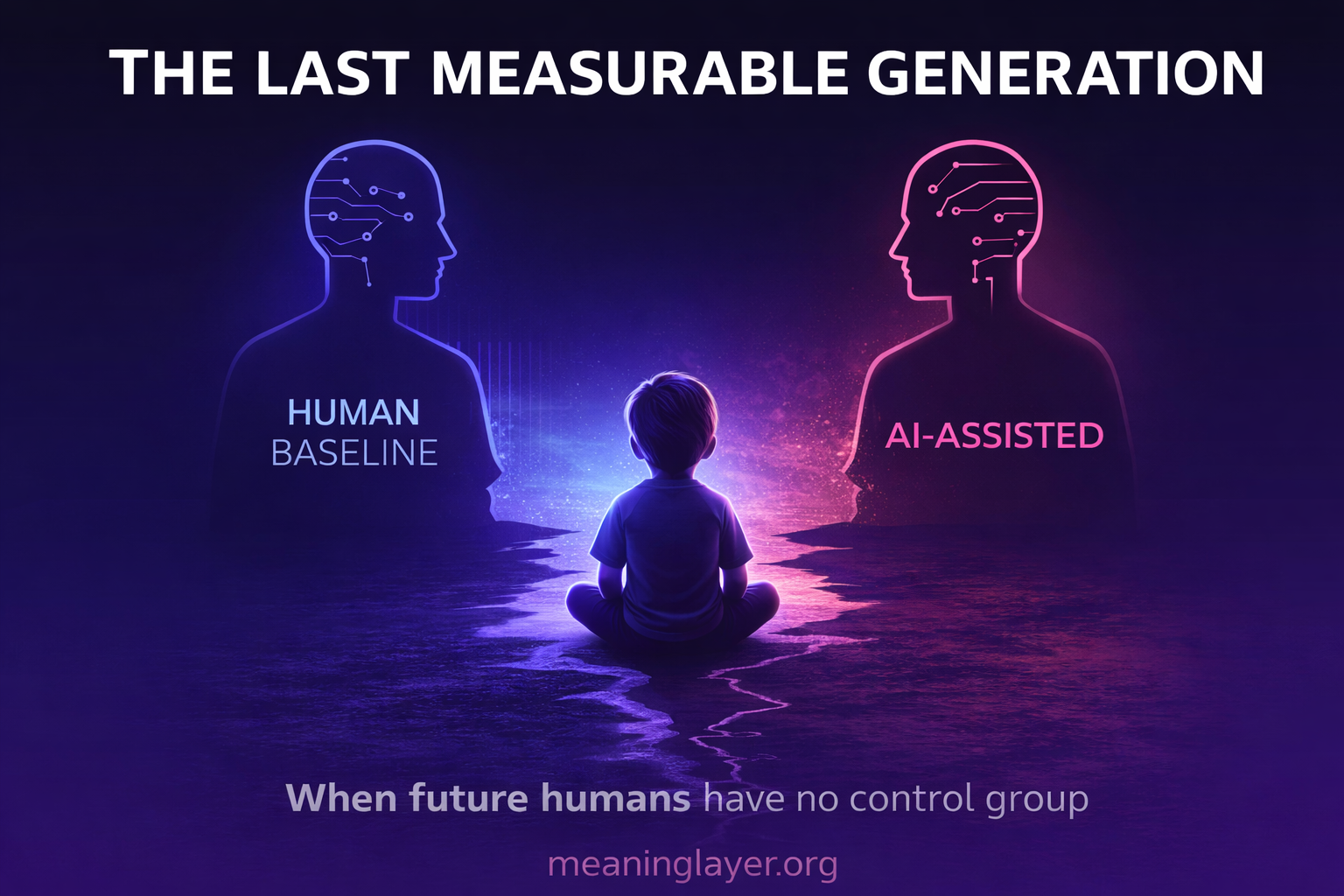
In ten years, we lose the ability to know what humans are capable of without AI. Not hypothetically. Structurally. Permanently.
I. The Child Who Will Never Know
A child is born today.
By age three, conversational AI answers her questions. By five, AI tutors guide her learning. By seven, AI assists every homework assignment. By ten, she cannot imagine solving problems without prompting an AI first.
At fifteen, we test her mathematical ability. She scores exceptionally high. But here is the question no test can answer: How much of that ability is hers?
Not ethically hers—legally, she completed the work. But structurally hers: what could she do if AI had never existed?
We cannot know. We can never know.
Because she has never existed without AI. There is no measurement of her unassisted capability because that state—human without AI assistance—never occurred for her.
She is the first generation for whom ”human capability” has always meant ”human + AI capability.”
And once that generation exists, we lose the ability to measure what humans can do alone. Not temporarily. Permanently.
II. The Concept No One Named: Control Group Extinction
In scientific research, you need a control group—subjects who do not receive the intervention—to measure the intervention’s effect.
If you test a new drug, you compare results against patients who received a placebo. Without that comparison, you cannot isolate the drug’s impact.
If you introduce AI assistance into human development, you need humans who developed without AI assistance to measure the impact. Without that comparison, you cannot isolate AI’s effect on capability.
Children born before widespread AI access—those who learned to read, write, calculate, and reason without AI tutors—are that control group. They provide the baseline: ”This is what human cognitive development looks like without AI intervention.”
Children born today will never provide that baseline. They will have AI assistance from the beginning. There will be no ”before AI” measurement for them.
And once the last child who developed without AI reaches adulthood—approximately 2035—we lose the control group forever.
This is not a temporary gap in data. This is Control Group Extinction: the permanent loss of ability to measure what humans can do independently because no humans exist who developed independently.
After extinction, every measurement of ”human capability” includes AI assistance as an uncontrolled variable. We can measure human + AI performance. We cannot measure human performance, because humans without AI no longer exist in the dataset.
III. The Contamination Point
Control Group Extinction does not happen suddenly. It happens gradually, as AI becomes present earlier in development.
A child born in 2015 learned basic literacy before encountering AI. A child born in 2020 encountered AI in elementary school. A child born in 2025 will have AI in preschool.
Each cohort’s cognitive development is ”contaminated” earlier—not contaminated in a value judgment sense, but in the scientific sense: the variable you want to isolate (human capability) is no longer isolated because another variable (AI assistance) is present from the beginning.
The Contamination Point is the age at which AI assistance begins for a given cohort. The earlier the contamination point, the less we can measure about unassisted human development.
Current trajectory suggests:
- 2025 cohort: Contamination point at age 3-4 (preschool AI tutors)
- 2027 cohort: Contamination point at age 1-2 (AI-enabled tablets for toddlers)
- 2030 cohort: Contamination point at birth (AI developmental monitoring from day one)
By 2030, the contamination point reaches zero. From that point forward, no child grows up without AI involvement in cognitive development.
And when contamination point reaches zero, Control Group Extinction is complete.
IV. Why We Cannot Measure Back
You might ask: Why can’t we just remove AI assistance later and test capability then?
Three reasons make this impossible:
1. Development is irreversible
Cognitive development happens during specific windows. Language acquisition peaks ages 0-7. Abstract reasoning develops ages 7-12. Critical thinking solidifies ages 12-18.
If AI assists during these windows, the brain develops with AI present. Neural pathways form around AI availability. Cognitive strategies emerge assuming AI access.
You cannot ”undo” development and re-run it without AI. The developmental windows close. The brain does not reset.
2. Practice effects contaminate testing
If you test someone’s unassisted capability, they learn from the test itself. The second time you test them, they perform differently—not because their capability changed, but because they practiced.
This means you cannot train someone with AI, then test them without AI, then draw conclusions about AI’s impact. The test itself altered their capability.
You need two groups: one that developed with AI, one that developed without. You compare their performance to isolate AI’s impact.
But if everyone develops with AI, the comparison group does not exist.
3. Environmental baseline shifts
Even if you could test unassisted capability, you cannot control for the fact that everyone else in the environment has AI.
A child developing without AI in 2030 would grow up in a world where every peer, teacher, and mentor uses AI. The cognitive demands, teaching methods, social expectations—all adapted to AI availability.
Testing that child’s ”unassisted” capability tells you how someone performs without AI in an AI-adapted world. Not how they would perform without AI if AI had never existed.
The baseline shifted. You cannot measure the old baseline because it no longer exists in the environment.
V. What We Lose When the Control Group Dies
When Control Group Extinction completes, we lose four types of knowledge that cannot be recovered:
1. Natural human learning curves
We lose the ability to know: How do humans learn to read without AI assistance? How long does it take naturally? What errors are normal? What breakthroughs are universal?
Every future measurement of reading development includes AI tutors as a variable. We cannot isolate natural human learning because natural human learning no longer occurs in a form we can measure.
2. Independent problem-solving capability
We lose the ability to know: What problems can humans solve without external assistance? What complexity thresholds exist naturally? Where does human capability hit limits?
Every future measurement includes AI assistance. We cannot determine where human capability ends and AI assistance begins because they are always present together.
3. Cognitive resilience without external support
We lose the ability to know: How do humans perform under adversity when AI is unavailable? How do they adapt when familiar tools disappear? What innate resilience exists?
If humans always had AI available, we cannot measure performance without it. The resilience never got tested in a measurable way.
4. Baseline for what constitutes ”improvement”
We lose the ability to know: Are humans getting better? Or are they becoming more dependent?
If capability always includes AI assistance, increases could mean humans are more capable—or that AI got better at doing the work for them. Without a control group who never used AI, we cannot tell the difference.
This is the most critical loss: we lose the ability to distinguish between human improvement and human replacement.
VI. The Ten-Year Window
Why ten years? Why is this the deadline?
The last large cohort developing without early AI assistance was born 2015-2020. They encountered AI primarily in high school or late elementary school—after foundational cognitive structures formed.
By 2025, they will be ages 5-10. By 2035, they will be ages 15-20—early adulthood.
After 2035, everyone entering the workforce, entering research, entering positions of responsibility will have had AI involvement in their cognitive development from early childhood.
The control group will still exist—people born before 2020—but they will be aging out of the most cognitively demanding work. And crucially, there will be no younger control group to compare against.
By 2040, the control group is mostly retired. By 2050, they are elderly or deceased.
After that point, humanity has no living memory of cognitive development without AI assistance. No way to measure what was lost. No reference point for what humans could do alone.
The capability to know what humans are capable of without AI exists for ten more years. Then it is gone. Not hidden. Not paused. Extinct.
VII. Why Current Measurements Cannot Capture This
You might think: We measure human capability extensively. Education tests, psychological assessments, cognitive benchmarks. Won’t those capture the baseline before it disappears?
No. Because current measurements were never designed to isolate AI’s impact over developmental time.
Existing tests measure:
- Performance at a moment in time
- Comparison between individuals within the same environment
- Correlation between training method and outcome
Existing tests do NOT measure:
- Capability development trajectory over years
- Comparison between AI-assisted and unassisted cognitive development
- Persistent capability independent of tool availability
To capture what we are losing, you would need:
- Longitudinal tracking of capability over 10-20 years
- Temporal verification: Does capability persist without AI available?
- Control group comparison: AI-assisted vs unassisted development
- Transfer testing: Do skills generalize beyond AI-supported contexts?
No existing measurement infrastructure does this. Not education systems, not psychology research, not cognitive development studies.
The data required to understand Control Group Extinction is not being collected.
Which means by the time we realize what was lost, we will have no measurements proving it existed.
VIII. MeaningLayer as Baseline Preservation Infrastructure
There is one type of infrastructure that can capture what we are losing: temporal capability measurement with explicit AI-assisted vs unassisted tracking.
This is what MeaningLayer enables—not as an afterthought, but as architectural design.
Temporal Baseline Preservation requires three components:
1. Pre-contamination archiving
Measure current cohorts (ages 5-15 in 2025) performing tasks both with and without AI assistance. Capture their developmental trajectories in both conditions.
This creates an archive: ”Here is what human capability looked like during development before AI was ubiquitous, and here is the delta when AI was introduced.”
After 2035, this archive becomes irreplaceable. It is the only measurement of unassisted human development that will ever exist.
2. Capability persistence verification
For AI-assisted cohorts (born 2020+), test not just performance with AI, but capability retention without AI across time.
If a child learns mathematics with AI tutoring, test their ability to solve novel math problems without AI access one month later, six months later, two years later.
Does the capability persist? Or does it degrade when AI is removed?
This distinguishes learning (persistent capability gain) from dependency (transient performance boost that requires continued AI presence).
3. Transfer validation across contexts
Test whether capabilities developed in AI-assisted contexts transfer to contexts where AI is unavailable or irrelevant.
If someone learns to write essays with AI assistance, can they construct coherent arguments verbally in real-time debate where AI cannot assist?
If capability does not transfer, it may not be capability—it may be narrow performance in AI-supported contexts.
These three measurements together preserve the baseline: what humans could do before widespread AI, what they can do with AI present, and whether AI-supported capability persists and transfers.
Without this infrastructure, the baseline dissolves. We will have measurements of human + AI performance. We will not know what was human.
IX. The Choice That Cannot Be Delayed
This is not a problem that gets easier over time. This is a problem that becomes unmeasurable over time.
In 2025, we can still measure the control group. Children born 2010-2020 are available. Their cognitive development without early AI is documented in their performance. We can compare them to younger cohorts developing with AI and isolate the difference.
In 2030, the control group is shrinking. Children born 2015-2020 are entering adulthood. Younger cohorts all had AI in early development. The comparison becomes less clear.
In 2035, the control group is effectively gone. Everyone in active cognitive development had AI present. The ability to isolate AI’s effect disappears.
In 2040, we are comparing AI-assisted cohorts against each other. We can see differences between 2025-born and 2030-born individuals. But we cannot know if either group is more or less capable than humans would have been without AI, because no such humans exist in the comparison set.
The measurement window is not infinite. The measurement window is now.
After this window closes, we are optimization-blind. We can optimize human + AI performance metrics. We cannot verify whether humans are becoming more capable or more dependent, because we have no baseline showing what unassisted capability looked like.
And optimization without that verification creates the conditions for capability collapse: systems get better at metrics while humans get worse at functioning independently, and no measurement infrastructure can detect the divergence because there is nothing to compare against.
X. What This Means for Civilization
When Control Group Extinction completes, civilization loses the ability to distinguish between three futures:
Future A: AI amplifies human capability Humans become genuinely more capable. They can solve harder problems independently. The capability persists when AI is unavailable. They transfer skills to new contexts.
Future B: AI replaces human capability Humans become dependent on AI. They cannot solve problems independently. Capability degrades when AI is unavailable. Skills do not transfer beyond AI-supported contexts.
Future C: Mixed—some amplification, some replacement Some capabilities amplify. Others atrophy. Net effect on human capability is unclear.
After Control Group Extinction, these futures become indistinguishable in measurement. We will have data on human + AI performance. We will not have data on human capability independent of AI. We cannot tell which future we are in.
If we are in Future B and do not realize it, optimization continues toward maximizing human + AI performance. Systems evolve to make humans more dependent more efficiently. By the time dependency becomes obvious, the capability to function independently has atrophied across an entire generation.
If we are in Future C and cannot measure which capabilities amplify vs atrophy, optimization may accidentally destroy the capabilities that matter most while preserving the capabilities that matter least.
The only way to navigate between these futures is measurement infrastructure that can isolate unassisted capability and verify whether it persists over time.
That infrastructure must be built while the control group still exists.
After Control Group Extinction, we are navigating blind.
XI. The Stakes
Children born in 2025 will live until approximately 2105. They will shape the world for 80 years.
If we lose the ability to measure whether they are genuinely more capable or simply more dependent on AI, we lose the ability to course-correct for 80 years.
If they develop dependency patterns we cannot detect, those patterns become civilization’s baseline. The next generation inherits that baseline. The generation after inherits a degraded baseline. Each cycle, the reference point for ”human capability” shifts toward ”human incapable without AI.”
And after three generations—2025, 2050, 2075—no one remembers what humans could do alone. The capability is not lost suddenly. It is lost gradually, unmeasured, across cohorts, until no one can prove it ever existed.
This is not speculation. This is the mechanical consequence of losing the measurement baseline while optimization continues.
The last chance to capture that baseline is now.
The children who will be tested are alive. The comparison is still possible. The control group has not yet aged out of measurability.
In ten years, the window closes.
After that, we are optimizing toward a definition of ”human capability” that we can never verify, because we lost the reference point for what humans were capable of before optimization began.
Related Infrastructure
MeaningLayer provides the temporal verification and capability persistence measurement infrastructure necessary to preserve the baseline before Control Group Extinction completes.
Cascade Proof verifies whether capability transfers genuinely occurred—whether learning produced lasting, transferable capability or temporary, context-dependent performance.
Portable Identity ensures capability measurements can be attributed across contexts and time, making it possible to track developmental trajectories even as individuals move between platforms and systems.
Together, these form the architecture for measuring what we are about to lose the ability to measure: what humans can do, independent of AI assistance, when capability is tested over time rather than in a moment.
MeaningLayer.org — The infrastructure for preserving humanity’s measurement baseline before the control group goes extinct.
Related: CascadeProof.org | PortableIdentity.global
Rights and Usage
All materials published under MeaningLayer.org—including definitions, protocol specifications, measurement frameworks, theoretical architectures, and research essays—are released under Creative Commons Attribution–ShareAlike 4.0 International (CC BY-SA 4.0).
This license guarantees three permanent rights:
1. Right to Reproduce
Anyone may copy, quote, translate, or redistribute this material freely, with attribution to MeaningLayer.org.
How to attribute:
- For articles/publications: ”Source: MeaningLayer.org”
- For academic citations: ”MeaningLayer.org (2025). [Title]. Retrieved from https://meaninglayer.org”
- For social media/informal use: ”via MeaningLayer.org” or link directly
2. Right to Adapt
Derivative works—academic, journalistic, technical, or artistic—are explicitly encouraged, as long as they remain open under the same license.
Researchers, developers, and institutions may:
- Build implementations of MeaningLayer protocols
- Adapt measurement frameworks for specific domains
- Translate concepts into other languages or contexts
- Create tools based on these specifications
All derivatives must remain open under CC BY-SA 4.0. No proprietary capture.
3. Right to Defend the Definition
Any party may publicly reference this framework to prevent private appropriation, trademark capture, or paywalling of the core terms:
- ”MeaningLayer”
- ”Meaning Protocol”
- ”Meaning Graph”
No exclusive licenses will ever be granted. No commercial entity may claim proprietary rights to these core concepts or measurement methodologies.
Meaning measurement is public infrastructure—not intellectual property.
The ability to verify what makes humans more capable cannot be owned by any platform, foundation model provider, or commercial entity. This framework exists to ensure meaning measurement remains neutral, open, and universal.
2025-12-16