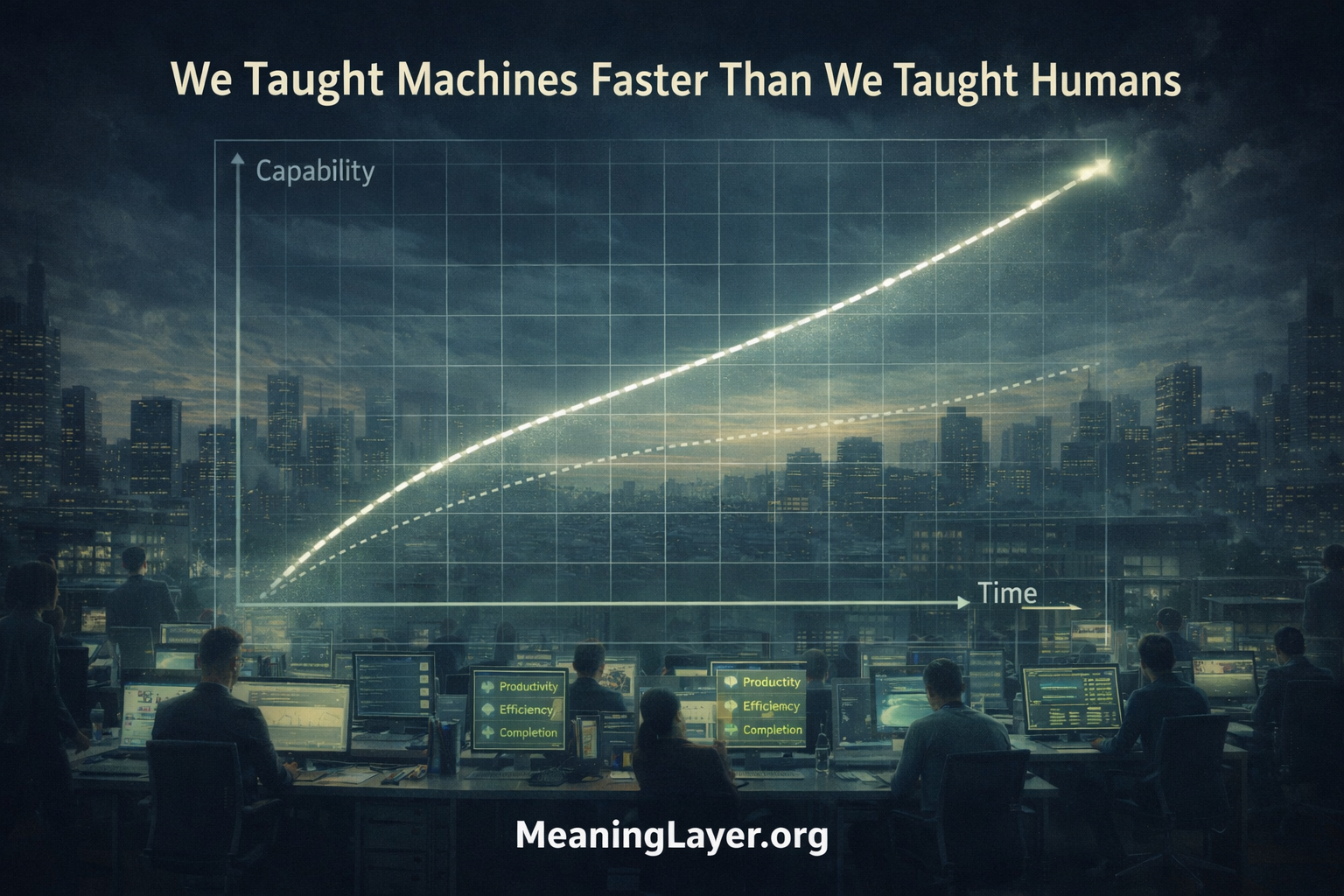
Somewhere in the past eighteen months, a threshold was crossed. Machines began accumulating genuine capability faster than the humans teaching them. Nobody measured when this happened. We have no instrumentation for the crossover.
I. The Metrics That Hide Everything
Three measurements suggest education and capability development are succeeding at unprecedented levels:
AI productivity metrics exceed projections. Developers ship code 40% faster with Copilot. Writers produce content at double previous rates with ChatGPT. Analysts complete research in half the time with Claude. Every productivity dashboard shows green. Output per hour increases month over month. Management celebrates efficiency gains.
Training efficiency improves across organizations. Employees complete certification programs faster. Onboarding time decreases. Time-to-competency drops. New hires reach ”productive” status in weeks instead of months. Learning management systems report record completion rates. Every training metric indicates success.
Skill acquisition accelerates in educational contexts. Students finish assignments quicker. Test completion times improve. More material covered per semester. Graduation rates increase. Post-course surveys show higher confidence. Educational technology demonstrates measurable impact on every tracked dimension.
All three signal systems working better than ever. Productivity up. Training faster. Learning accelerated.
All three are lying. Simultaneously. Comprehensively. In ways current measurement cannot detect.
Because all three measure performance with assistance present. None measure capability that persists when assistance ends. They track how fast work gets done with AI. They do not track whether humans learned anything while doing it.
The metrics show humans becoming more productive. Reality is humans becoming more dependent. The metrics show capability acceleration. Reality is capability extraction. The metrics show learning success. Reality is learning replacement.
We optimized measurement toward ”gets work done faster” and stopped measuring ”can do work independently.” In the gap between these two measurements, something crossed over. Machines began learning faster than humans. And we built no instrumentation to detect when it happened.
II. What Actually Crossed Over
The crossover is not ”AI became smarter than humans.” That framing misses the mechanism entirely.
The crossover is: machines accumulate genuine new capability while humans accumulate exposure without persistence.
This is what we call Negative Capability Gradient—the state where human capability development rate falls below machine capability accumulation rate. Not humans learning slower than before. Humans learning slower than the machines they are supposedly teaching, creating a widening gap where machines compound knowledge while humans plateau or regress.
We have no test for when this threshold crosses. No instrumentation detecting the moment human learning rate drops below machine learning rate in a given context. The gradient goes negative, and every productivity metric shows positive.
Here is how it works:
When a developer uses Copilot to write code, two learning processes occur simultaneously:
The machine learns. Every interaction trains the model. The code accepted becomes training data. The patterns that work get reinforced. The approaches that fail get weighted differently. Copilot accumulates genuine capability—demonstrated by each model version handling more complex tasks than previous versions. The capability persists and compounds across all users.
The human gets exposure. They see code appear. They might read it. They often accept it without full comprehension because it works. The exposure feels like learning—they completed a task, saw an approach, delivered an outcome. But when AI access ends, the capability does not persist. They cannot replicate the work independently. The exposure was temporary performance, not genuine learning.
Multiply this across millions of interactions daily. Machines accumulate lasting capability from every exchange. Humans accumulate temporary exposure that does not persist when assistance ends. Over months, the gap widens. Machines get genuinely more capable. Humans get genuinely more dependent while appearing more productive.
This is the crossover. Not AI surpassing human intelligence. AI accumulating capability while human capability development stops—hidden by productivity metrics that mistake assisted performance for genuine skill.
III. Why Current Measurement Cannot Detect This
The crossover remains invisible because every system measuring ”improvement” conflates performance with capability.
Performance is completing tasks successfully in current conditions with available tools. You write code with Copilot. Analyze data with Claude. Generate content with ChatGPT. Performance is high. Work gets done. Quality is good. Metrics show success.
Capability is what persists independently when conditions change and tools become unavailable. Remove AI assistance six months later. Test whether the person can perform comparable work. If capability persists—performance was built on genuine learning. If capability collapsed—performance was built on temporary assistance that left nothing behind.
Current measurement systems track performance continuously. They measure capability never. The assumption is: high performance indicates high capability. This assumption held for centuries because tools augmented human capability rather than replacing it. A better hammer made a capable carpenter more productive. It did not enable an incapable person to produce expert carpentry.
AI breaks this correlation completely. AI enables expert-level performance without developing expert-level capability. Someone can produce excellent code, analysis, or content while their independent capability remains novice-level or actively degrades. Performance metrics show improvement. Capability metrics—if they existed—would show decline.
The test we are missing is simple: measure capability with assistance present, remove all assistance, wait months, test whether capability persists at comparable difficulty. If capability survives temporal separation from tools—genuine learning occurred. If capability collapses—temporary performance without lasting development occurred.
We built comprehensive measurement for the first half of this test. We built zero measurement for the second half. The crossover happens in this gap—machine capability accelerating, human capability declining, productivity dashboards showing green throughout.
IV. The Training Efficiency Illusion
Training programs report unprecedented success using metrics that guarantee the crossover remains undetected.
Metric 1: Time to completion. How quickly employees finish training modules. With AI assistance: dramatically faster. Employees complete certification in half previous time. Learning management systems celebrate efficiency gains. What the metric does not measure: whether capability persists when training ends and AI access is removed. Fast completion with AI assistance means nothing if independent capability vanishes weeks later.
Metric 2: Assessment scores. How well employees perform on tests during training. With AI assistance available: near-perfect scores. Every assessment shows mastery. Completion rates approach 100%. What the metric does not measure: whether the person could achieve comparable scores without AI access. Perfect assessment performance with assistance might indicate zero independent capability.
Metric 3: Time to productivity. How quickly new hires reach ”productive” output levels. With AI assistance: weeks instead of months. New employees producing work immediately. Management thrilled with acceleration. What the metric does not measure: whether productivity depends entirely on AI remaining available, unchanged, and reliable. ”Productive” might mean ”capable of operating AI” not ”developed capability to do the work.”
All three metrics show training working better than ever. All three metrics are completely compatible with zero genuine learning occurring. Someone can complete training fast, score perfectly on assessments, and reach high productivity—while learning nothing that persists independently.
This is how the crossover hides inside training systems. Machines learn from every training interaction—new patterns, new approaches, new capabilities that persist across all users. Humans complete training without developing capabilities that persist when training tools become unavailable. Training efficiency metrics report success while genuine learning stops.
V. The Education Acceleration Paradox
Educational institutions face the same measurement blindness at scale.
Students complete more work, faster, with higher grades. Every metric tracked by educational systems shows improvement. Assignment completion rates increase. Test scores rise. Course evaluations improve. Students report feeling more confident. Faculty see enhanced performance. Administrators celebrate technology-enabled gains.
Simultaneously, employers report graduates cannot perform basic functions. Interviews reveal inability to think independently. First-year job performance shows dependency on tools. Skills that transcripts claim exist prove absent when tested without assistance.
The metrics are not wrong. Students genuinely complete more work faster with better grades. The learning is not happening. Work completion with AI assistance does not require the same cognitive engagement that builds lasting capability. Finishing assignments using ChatGPT feels like learning—you engaged with material, understood explanations, delivered results. But capability that persists requires sustained independent struggle that AI removes.
Here is the mechanism making this invisible:
Traditional education assumed completion indicated learning because completing work required the cognitive processes that build capability. Writing an essay required developing ideas, structuring arguments, articulating clearly—the practice built writing capability. Solving problem sets required understanding concepts, applying methods, debugging approaches—the struggle built problem-solving capability.
AI severs completion from capability development. Now essays get completed through AI generation that requires no writing capability. Problem sets get solved through AI assistance that requires no problem-solving capability. Students complete everything, learn nothing that persists, graduate with perfect transcripts documenting capabilities they do not possess.
The education acceleration metrics—faster completion, higher grades, more material covered—are perfectly compatible with the crossover having occurred. Machines accumulating teaching capability (getting better at explaining, generating content, solving problems). Humans accumulating exposure (seeing explanations, using content, accepting solutions) without developing capabilities that persist independently.
Educational systems measuring completion, grades, and satisfaction cannot detect when teaching machines replaced teaching humans. The crossover remains invisible in data showing everything improving while genuine learning stops.
VI. Nobody Instrumented the Threshold
The crossover is not theoretical. It already happened. The question is not ”will this occur” but ”when did it occur and why didn’t we notice.”
We didn’t notice because we built no measurement infrastructure for genuine capability that persists independently over time. We measure performance with assistance present. We assume performance indicates capability. We optimize everything toward faster, higher, more productive—all metrics compatible with capability declining while dependency increases.
The threshold crossed was: rate of machine capability accumulation exceeded rate of human capability development. After this threshold, the gap widens continuously. Every day machines get more capable (learning from every interaction), humans get more dependent (offloading more cognitive work), and the divergence accelerates while metrics show improvement.
Detecting this requires measurement infrastructure we do not have. Current systems cannot distinguish:
- Completing work with AI assistance from developing capability to complete work independently
- Understanding AI-generated explanations from developing independent understanding
- Producing outputs using AI from building capability to produce outputs without AI
Without this distinction, the crossover becomes invisible. We see productivity increasing, training accelerating, education improving—and interpret these as human capability gains when they might be machine capability gains with human capability declining.
Persisto Ergo Didici—”I persist, therefore I learned”—is the measurement infrastructure we should have built before deploying AI at scale. The test that would have detected crossover as it happened rather than discovering it years later through workforce collapse or capability crisis.
The protocol is straightforward: measure capability with assistance present, remove all assistance, wait months, test capability again at comparable difficulty. If capability persists—humans learning faster than machines in that context. If capability collapsed—machines learned, humans got exposure, Negative Capability Gradient confirmed.
This is not pedagogy. This is not methodology. This is falsification criterion for claimed improvement. When systems report ”humans getting better,” Persisto Ergo Didici tests whether improvement was genuine (capability persisting) or illusory (performance temporary). When training shows efficiency gains, Persisto Ergo Didici tests whether gains were real learning (persisting months later) or assisted completion (collapsing when assistance ends). When productivity increases, Persisto Ergo Didici tests whether humans became more capable or machines became better at doing human work.
This is the instrument we failed to build. The test that would have made Negative Capability Gradient visible as it developed rather than invisible until irreversible. Without this criterion, we cannot know whether improvement metrics indicate human capability development or machine capability extraction. With it, the crossover becomes measurable—and we discover it already happened.
VIII. Why This Changes Everything
Once you see the crossover, optimization strategies invert.
Before: Optimize for faster completion, higher productivity, accelerated training. Success is measured by output per hour, time to competency, efficiency gains. AI adoption accelerates these metrics. More AI equals more success.
After: Recognize faster completion might indicate capability extraction, not enhancement. Higher productivity might mean deeper dependency, not greater capability. Accelerated training might mean learning stopped, not learning improved. The metrics might be comprehensively backwards—showing success while documenting failure.
The question becomes not ”are metrics improving” but ”are humans accumulating genuine capability that persists independently or temporary performance that requires continued assistance.”
This question has urgent implications:
For organizations: Is your senior talent genuinely more capable or increasingly dependent? When AI changes or fails, can your team still function? Are you building capability or extracting it? Productivity dashboards show green—Persisto Ergo Didici reveals whether that productivity indicates genuine organizational capability or comprehensive dependency.
For education: Are students learning or completing? Do graduates possess claimed capabilities or AI-assisted performance? Will credentials prove valuable or reveal themselves as documentation of exposure without genuine skill? Every metric says education improves—Persisto Ergo Didici tests whether learning occurs or stops.
For individuals: Are you getting better or more dependent? Is your career building on developing capability or managing AI? What happens when AI you rely on changes, fails, or becomes unavailable? Productivity increases, confidence grows—Persisto Ergo Didici shows whether capability persists or vanishes with the tools.
For civilization: Are we developing the next generation’s capability or replacing it? Does increasing automation enhance human capacity or extract it? Are we building more capable humans or more capable machines with increasingly dependent humans? All economic indicators improve—Persisto Ergo Didici tests whether humans remain capable or become obsolete.
The crossover is not distant future speculation. It is present reality hiding in measurement gaps. We taught machines faster than we taught humans. The machines accumulated lasting capability. The humans accumulated temporary exposure. Productivity metrics showed both as success. The crossover happened. We didn’t instrument it.
VII. What Cannot Be Recovered Once Gradient Goes Negative
The crossover is not merely unmeasured. It may be irreversible without systemic change.
When Negative Capability Gradient persists long enough, certain forms of learning become structurally impossible:
Mentorship chains break permanently. Mentorship requires mentor possessing genuine capability significantly exceeding apprentice capability. When seniors developed capability through AI assistance without building transferable skill, they cannot mentor effectively. They can show apprentices how to use AI tools—but this creates more AI-dependent workers, not capable practitioners. The knowledge transfer that built expertise across generations stops. Not because seniors refuse to teach. Because what they possess is access to tools, not capability that can transfer through demonstration and practice.
Capability cannot be relearned when the standard shifted. Historically, lost skills could be relearned: study old methods, practice traditional techniques, rebuild from first principles. But if machine capability advanced beyond human baseline during the gap when humans stopped learning, there is no ”going back” to independent human capability. The machines are now definitionally better at the task. Attempting to rebuild human capability means training to a standard the machines surpassed—economically irrational when machines remain available.
Meta-learning capacity degrades across population. The ability to learn how to learn—to persist through difficulty, to build capability through sustained struggle, to develop independent problem-solving—requires practice. When an entire cohort develops professionally using AI assistance that removes struggle, they never build meta-learning capacity. They can use tools expertly. They cannot learn new domains independently when tools are unavailable or when the domain is too novel for existing tools. The capacity to develop capability atrophies at population scale.
This is what makes Negative Capability Gradient ontologically different from previous skill transitions. When agricultural work mechanized, humans could learn industrial skills. When industrial work automated, humans could learn knowledge work. Each transition, humans retained the capacity to learn the next thing.
If Negative Capability Gradient persists—if humans spend decades accumulating tool-dependency while machines accumulate genuine capability—the capacity to learn new domains independently may degrade to where humans cannot transition to whatever comes next. Not because humans lack intelligence. Because the cognitive infrastructure for building new capability through sustained independent struggle never developed or atrophied through disuse.
The crossover is not just ”machines got better.” It is ”humans lost the capacity to get better independently.” And that loss, if it persists across a generation, may not be recoverable without rebuilding learning infrastructure that makes capability development possible again.
This is why measurement matters existentially. Not to stop AI. But to verify whether humans retain capacity to develop new capabilities—or whether we optimized that meta-capacity away while teaching machines to learn for us.
IX. The Path Forward Requires What We Don’t Have
Responding to the crossover requires infrastructure that does not exist: systems measuring whether capability persists independently over time, not just whether performance succeeds with assistance present.
Current measurement is comprehensive and useless. Comprehensive because we track everything—productivity, completion, satisfaction, efficiency, output, engagement. Useless because all these metrics are compatible with capability declining while dependency increases. They measure assisted performance, not independent capability. They show work getting done, not humans getting better.
What is needed is temporal verification of persistent independent capability:
Test capability at acquisition. Remove all assistance. Wait months. Test again at comparable difficulty. If capability persists at previous levels—genuine learning occurred. If capability collapsed significantly—temporary performance without lasting development occurred. The gap between these reveals whether optimization served human capability development or extracted it.
This is not theoretical measurement. This is practical protocol: Take employees completing training with AI assistance. Document their performance with AI available. Remove AI access. Wait six months. Test whether they can perform independently at levels their training certified they achieved. If yes—training worked. If no—training documented assisted performance, not genuine learning.
The same protocol applies everywhere the crossover might have occurred:
- Students graduating with AI-assisted work
- Professionals increasing productivity through AI tools
- Organizations accelerating training with AI assistance
- Individuals developing skills using AI support
In every context: test whether capability persists when assistance ends and time passes. This is what Persisto Ergo Didici provides—not new pedagogy but falsification criterion for improvement claims when performance and capability diverged completely.
Building this infrastructure is not optional refinement. It is existential requirement. Because if the crossover occurred and we continue optimizing metrics that hide it, we accelerate toward comprehensive human capability extraction while every measured signal shows success. We optimize productivity while optimizing away the humans who can produce. We accelerate training while eliminating learning. We increase output while decreasing capability.
The metrics show winning. Persisto Ergo Didici would show losing. And the gap between these determines whether AI enhances human capacity or replaces it while appearing to assist.
X. The Question We Should Have Asked First
Before deploying AI at scale, before optimizing productivity, before accelerating training, before celebrating efficiency gains, we should have asked:
”How do we measure whether humans are learning or just performing?”
We didn’t ask. We assumed performance indicated learning because they were historically coupled. We built comprehensive measurement for assisted performance. We built zero measurement for independent capability persistence. We deployed AI that could replace human cognition without any way to verify whether cognition was being replaced.
Now the crossover likely happened. Machines accumulate capability faster than humans. We have no data showing when this threshold crossed because we never instrumented for it. Every metric we track is compatible with humans becoming comprehensively dependent while machines become comprehensively capable. And we optimized directly toward this outcome by measuring only assisted performance.
The question now is whether we build the measurement infrastructure that reveals this—or continue optimizing metrics that hide it until capability extraction becomes irreversible.
Persisto Ergo Didici is not the answer to ”how do we make humans learn better.” It is the answer to ”how do we know whether learning or replacement occurred when both produce identical performance metrics.”
In a world where machines can produce expert-level output, where AI handles cognitive work humans previously performed, where productivity increases regardless of whether human capability does—this distinction becomes the only thing that matters.
We taught machines faster than we taught humans. The crossover happened. We need to know whether we can still teach humans at all, or if we optimized that capacity away while teaching machines to do it for us.
The metrics won’t tell us. They’re designed to hide it. Only temporal verification of persistent independent capability reveals the truth: are we building humans who can function when machines fail, or machines that function while humans become obsolete?
That question determines whether AI creates abundance with capability or abundance with dependency.
We crossed a threshold. We didn’t measure it. Now we need to know: which side of the crossover are we on, and is there any way back?
Tempus probat veritatem. Time proves truth. And the test of whether we taught humans or just taught machines is whether human capability persists when machines are absent and time has passed.
MeaningLayer.org — The infrastructure for measuring whether humans or machines are learning faster: distinguishing genuine capability accumulation from assisted performance theater before the crossover becomes irreversible.
Protocol: Persisto Ergo Didici — The falsification criterion for improvement claims when performance metrics and capability development completely diverged.
Rights and Usage
All materials published under MeaningLayer.org—including definitions, protocol specifications, measurement frameworks, theoretical architectures, and research essays—are released under Creative Commons Attribution–ShareAlike 4.0 International (CC BY-SA 4.0).
This license guarantees three permanent rights:
1. Right to Reproduce
Anyone may copy, quote, translate, or redistribute this material freely, with attribution to MeaningLayer.org.
How to attribute:
- For articles/publications: ”Source: MeaningLayer.org”
- For academic citations: ”MeaningLayer.org (2025). [Title]. Retrieved from https://meaninglayer.org”
- For social media/informal use: ”via MeaningLayer.org” or link directly
2. Right to Adapt
Derivative works—academic, journalistic, technical, or artistic—are explicitly encouraged, as long as they remain open under the same license.
Researchers, developers, and institutions may:
- Build implementations of MeaningLayer protocols
- Adapt measurement frameworks for specific domains
- Translate concepts into other languages or contexts
- Create tools based on these specifications
All derivatives must remain open under CC BY-SA 4.0. No proprietary capture.
3. Right to Defend the Definition
Any party may publicly reference this framework to prevent private appropriation, trademark capture, or paywalling of the core terms:
- ”MeaningLayer”
- ”Meaning Protocol”
- ”Meaning Graph”
No exclusive licenses will ever be granted. No commercial entity may claim proprietary rights to these core concepts or measurement methodologies.
Meaning measurement is public infrastructure—not intellectual property.
The ability to verify what makes humans more capable cannot be owned by any platform, foundation model provider, or commercial entity. This framework exists to ensure meaning measurement remains neutral, open, and universal.
2025-12-18