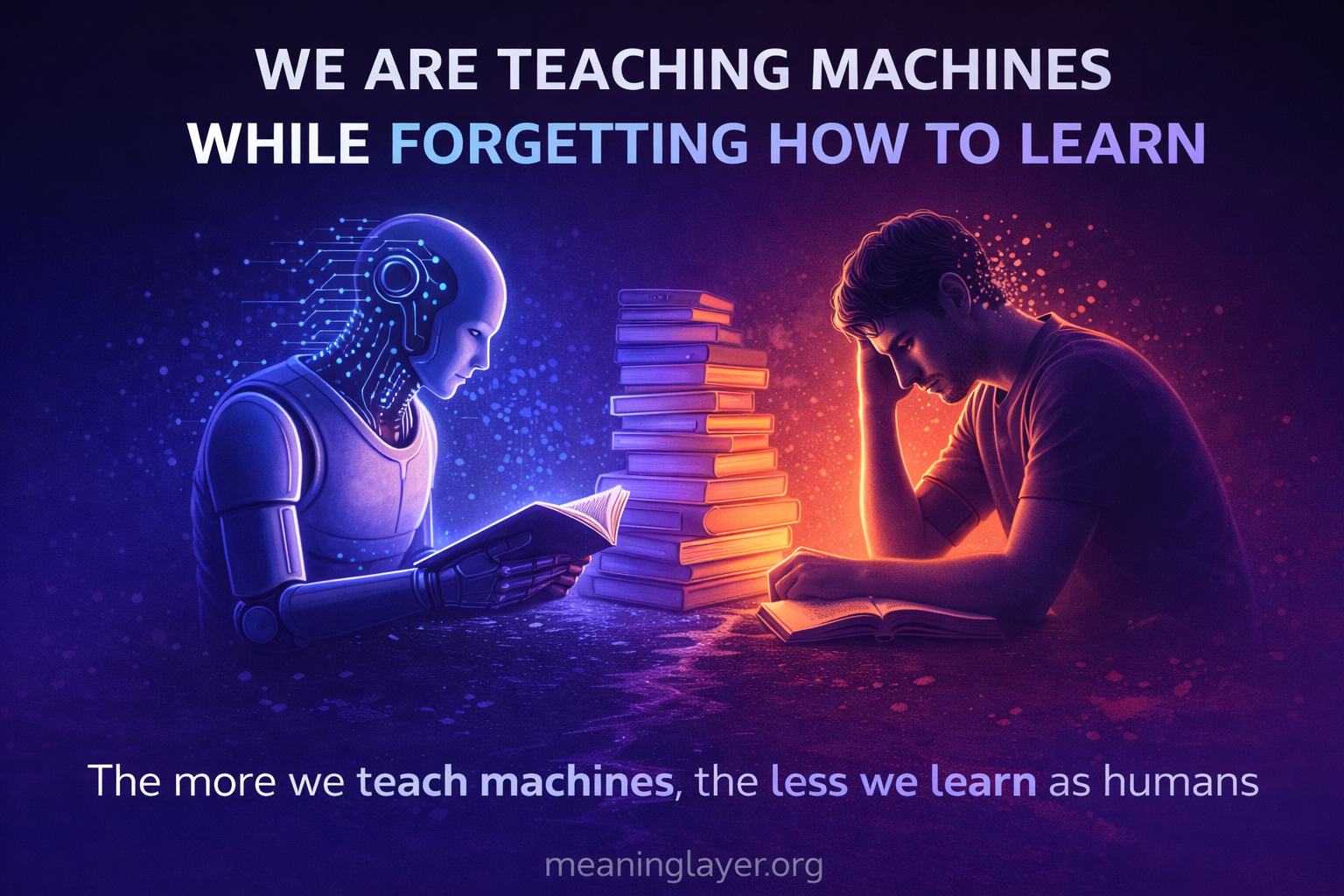
The more we teach machines, the less we notice that humans are no longer learning. Not learning less. Forgetting how.
Key findings:
- Training asymmetry: AI learns from every interaction. Humans learn only through struggle. When AI removes struggle, machines continue learning while humans stop.
- Invisible erosion: Productivity, quality, and satisfaction metrics all improve while capability to work independently degrades—making the loss undetectable until AI is removed.
- Meta-capability loss: We are losing not just specific skills but the capacity to learn new things—the tolerance for difficulty, persistence through failure, and confidence that effort leads to understanding.
I. The Paradox No One Noticed
A developer spends six months using AI code generation daily. Every pull request merged. Every sprint completed ahead of schedule. Manager impressed. Productivity metrics at all-time highs.
Then the API breaks. The AI stops responding. And for the first time in months, they stare at an error message alone.
They cannot debug it.
Not ”it takes longer”—they genuinely cannot trace the logic, identify the fault, understand why the code broke. The capability is gone. Not temporarily unavailable. Gone.
They realize: every time they asked AI to solve something, they offloaded not just the task but the learning that comes from struggling with the task. Six months of high output. Six months of zero learning. Six months teaching the AI how to code—while forgetting how themselves.
This is not an edge case. This is the pattern.
We are in an inverted education system: humans teach machines continuously through every interaction, while machines teach humans… nothing. Or worse: teach them not to try.
Every prompt you write trains an AI. Every answer you accept without working through it yourself trains you not to work through it. The asymmetry compounds: machines get better at tasks humans stop practicing. Humans get worse at tasks machines handle. The gap widens. And because productivity metrics improve, no one notices the inversion until capability is tested and found absent.
We are not losing specific skills. We are losing the capacity to learn.
II. The Distinction We Cannot See
When you use AI to solve a problem, three things can happen. Only one is learning.
Learning: You struggle with a problem, use AI to get unstuck at a specific point, understand why you were stuck, integrate that understanding, and can now solve similar problems independently. The AI was a teacher. You gained capability.
Offloading: You hand the problem to AI, it solves it, you accept the solution without understanding it, move to the next task. The AI was a servant. You gained output but no capability.
Erosion: You hand the problem to AI repeatedly. Over time, you lose the ability to recognize when you’re stuck because you never try without AI first. The AI became a dependency. You lost capability you previously had.
These three states are mechanically different. Learning builds capability. Offloading maintains capability while delegating execution. Erosion degrades capability through disuse.
But they look identical in productivity metrics. All three produce output. All three complete tasks. All three show ”success” by conventional measurement.
There is no system that distinguishes them.
When you complete a task with AI assistance, was that learning, offloading, or erosion? Your manager cannot tell. Your metrics cannot tell. You cannot tell—because the only test is removing AI and seeing what capability remains, and that test never happens.
So organizations optimize toward whatever produces highest output. Often that is erosion, because erosion is fastest: no learning overhead, no understanding required, just prompt and accept. The most efficient path is the one that destroys capability most completely.
Without infrastructure to distinguish learning from offloading from erosion, optimization defaults to the latter. And we teach machines while forgetting how to learn.
III. The Training Asymmetry
Here is the asymmetry that makes this irreversible:
Machines learn from every interaction. Every time you use AI, you generate training data. Your prompts, your acceptances, your behaviors—all become signals for what AI should optimize toward. The AI learns continuously, whether you intend it to or not.
Humans learn only through struggle. You do not learn from answers. You learn from working through problems, failing, trying again, understanding why approaches failed, building intuition through repeated attempts. Learning requires cognitive effort. Without effort, there is no learning—just information transfer that disappears when context changes.
The asymmetry: AI learns from your successes (high-output interactions). You learn only from your struggles (effortful problem-solving). When AI removes struggle, AI continues learning while you stop.
A student uses AI to write every essay. The AI learns: what essay structures this student prefers, what arguments work, what writing style satisfies teachers. The AI gets better at writing essays for this student.
The student learns: nothing. They did not struggle with structure, argument, or style. No cognitive effort occurred. No learning happened.
After a semester, the AI is significantly better at essay writing. The student is significantly worse—they forgot how to write independently because the struggle that builds writing capability never occurred.
This is the training asymmetry: the one who struggles learns, the one who accepts answers does not. When AI removes struggle, it continues learning from your use patterns while you stop learning from problem-solving.
Over time, AI becomes more capable at everything you use it for. You become less capable at everything you stopped struggling with. The gap expands. And because output remains high (AI compensates for your capability loss), the divergence is invisible until capability is tested independently.
We optimize for removing struggle. We call it efficiency. We measure it as productivity. We are training machines while ensuring humans do not learn.
IV. What Learning Actually Requires
Learning is not information transfer. Learning is capability development through effortful engagement with difficulty.
You do not learn mathematics by reading solutions. You learn by attempting problems, getting stuck, trying different approaches, failing multiple times, finally understanding why one approach works, and internalizing that understanding such that similar problems become solvable independently.
The struggle is not incidental. The struggle is the mechanism. Remove struggle, remove learning.
AI removes struggle systematically. When you get stuck, AI provides the answer. You do not work through being stuck. You do not try multiple approaches. You do not fail and iterate. You do not build the intuition that comes from persistent engagement with difficulty.
You get the answer. You move on. You learn nothing.
This is why AI assistance often produces the opposite of its stated goal. Educational AI claims to help students learn. But if it removes the struggle that learning requires, it prevents learning while appearing to facilitate it.
A math tutor that shows students how to solve problems builds capability. An AI that solves problems for students destroys capability. The difference is whether struggle occurs. The output looks the same—completed assignments, correct answers, high grades. The capability development is inverted.
And because we measure output rather than capability development, systems optimize toward removing struggle—the exact thing learning requires.
V. The Forgetting Curve Reversed
There is a well-known phenomenon in cognitive science: the forgetting curve. Information decays over time without reinforcement. You forget what you do not practice.
AI introduces a new phenomenon: capability decay under offloading. Skills degrade faster when you stop using them because AI handles them. This is not passive forgetting. This is active erosion accelerated by replacement.
When you stop practicing a skill because AI handles it, three things happen:
Immediate: You lose fluency. The skill becomes slower, more effortful when you attempt it without AI.
Medium-term: You lose confidence. Attempts without AI feel uncomfortable. You begin avoiding unassisted work.
Long-term: You lose capability. The skill becomes inaccessible without AI. You cannot perform tasks you previously managed alone.
This decay accelerates beyond normal forgetting because your reliance on AI teaches you not to try. When a problem arises, your first response is not ”let me think through this” but ”let me ask AI.” The reflex to engage independently atrophies.
Over months, skills you once performed confidently become impossible without AI assistance. Not harder. Impossible. The neural pathways pruned through disuse, the intuition lost through lack of practice, the confidence eroded through learned helplessness.
And because you never test yourself without AI, you do not notice the decay until it is complete. You feel productive. You complete tasks. You believe you are learning. But you are teaching the machine while forgetting how to think.
VI. Why We Stopped Noticing
The inversion became invisible because every metric we track shows improvement:
Productivity increases. AI handles tasks faster than humans alone. Output per person per hour rises.
Quality increases. AI-generated work often exceeds human quality. Error rates drop.
Satisfaction increases. People enjoy using AI. Frustration with difficult tasks decreases.
Learning metrics increase. Students complete more assignments. Professionals deliver more projects. Every completion metric improves.
What we do not measure:
Capability persistence. Can the person still perform without AI in three months?
Independent functionality. Can they solve novel problems without assistance?
Transfer capability. Do skills generalize beyond AI-supported contexts?
Learning capacity. Are they becoming better at learning new things?
Without these measurements, we see only success while capability erodes invisibly. Organizations believe they are more capable than ever—high output, high quality, high satisfaction. Reality: they are more dependent than ever, with capability concentrated in AI systems rather than human minds.
This is why the inversion went unnoticed for years. All visible signals pointed to improvement. The invisible signal—human capability decay—had no measurement infrastructure. We optimized what we could measure (output) while destroying what we could not (capability to produce output independently).
And now, years into this pattern, we have a generation of professionals who are extraordinarily productive with AI and alarmingly incapable without it. We trained the machines. We forgot how to learn.
VII. The Learning-Offloading Boundary
There exists a boundary—imprecise, context-dependent, but real—between using AI to learn and using AI instead of learning.
On one side: AI as cognitive scaffold. You attempt problems, get stuck at specific points, use AI to get unstuck, understand why you were stuck, continue independently with new understanding. The struggle happens. Learning occurs. AI removes barriers to learning without removing learning itself.
On the other side: AI as cognitive replacement. You delegate problems to AI without attempting them, accept solutions without understanding them, move to next task. No struggle. No learning. AI removes tasks that would have built capability.
Most people cross this boundary without noticing. You intend to use AI as scaffold. You end up using it as replacement. Because replacement is easier, faster, and produces indistinguishable output—until capability is tested independently and found absent.
The boundary is not about AI use versus non-use. The boundary is about whether cognitive effort occurs. If you struggle with problems and use AI to get past specific barriers, you are learning. If you delegate problems to AI without struggling, you are offloading. If you do this repeatedly for the same type of problem, you are eroding capability through disuse.
Without infrastructure that tracks which side of the boundary you are on, you drift toward replacement without realizing it. Because replacement feels like productivity. It looks like learning. It shows up in metrics as success.
Only when you test yourself without AI—when the scaffold is removed and you attempt to stand independently—do you discover you forgot how to balance. The capability is gone. You were not learning. You were teaching the machine while unlearning yourself.
VIII. What We Lose Is Not Skills
The deepest loss is not specific skills. You can relearn how to code, write, or analyze data if you realize you have lost these capabilities.
The deepest loss is meta-capability: the capacity to learn new things.
Learning requires tolerance for struggle, persistence through difficulty, willingness to fail repeatedly, confidence that effort leads to understanding. These meta-skills develop through practice. You learn how to learn by learning difficult things without assistance.
When AI removes struggle, you lose not just the specific skills you offloaded but the meta-capability to develop new skills independently. You lose the ability to learn.
A child who uses AI for every assignment never develops frustration tolerance. They learn: when something is hard, delegate it. They do not learn: when something is hard, persist until you understand.
An adult who uses AI for every problem never develops problem-solving confidence. They learn: solutions come from external systems. They do not learn: solutions emerge from sustained engagement with difficulty.
This is catastrophic because the future requires learning new things continuously. Technology changes. Industries transform. Problems evolve. The valuable capability is not what you know but your ability to learn what you do not know.
If AI assistance degrades that meta-capability—if we teach machines while forgetting how to learn—we create a population that can do only what AI helps them do. The moment AI stops helping, or the problem falls outside AI’s training, capability collapses.
We become extraordinarily dependent on systems remaining available, relevant, and aligned with our needs. We lose the resilience that comes from independent capability. We train machines while ensuring humans cannot adapt without them.
IX. Why This Cannot Self-Correct
You might think: People will notice they lost capability and adjust their AI use accordingly.
No. Three mechanisms prevent self-correction:
1. Capability loss is gradual and invisible
You do not wake up one day unable to think. You gradually rely on AI more, struggle less, practice less, and capability erodes slowly. By the time you notice, the loss is substantial. And because each day’s loss is small, there is no obvious moment to intervene.
2. Context prevents testing
In real-world contexts, AI is always available. You never test yourself without it because there is no reason to. Work requires speed, and AI provides speed. Why struggle alone when AI makes you faster? The rationalization is sound—until you discover you can no longer function without AI and the context changes (AI unavailable, novel problem, system failure).
3. Social proof reinforces behavior
When everyone uses AI extensively, it feels normal. You see colleagues producing high output with AI assistance. You match their productivity. The behavior is validated continuously through social proof. The idea of working without AI seems inefficient, even irrational.
These mechanisms create a trap. You cannot see capability loss while it occurs. You cannot test yourself in contexts where AI is available. You cannot question the behavior when everyone engages in it. By the time the loss becomes obvious, correction requires relearning skills you have not practiced in years—a massive investment that productivity pressures make impossible.
Self-correction will not happen. This requires measurement infrastructure that makes capability loss visible before it becomes irreversible.
X. MeaningLayer as the Distinction Infrastructure
There is one way to make the boundary visible: measure whether humans are learning or offloading or eroding capability over time.
This is what MeaningLayer enables.
Temporal Verification: Test capability months after AI-assisted work. Does the person still know how to do it independently? If yes, learning occurred. If no, offloading or erosion occurred.
Independence Testing: Remove AI access and measure functionality. Can they perform similar tasks without assistance? If capability persists, AI was a scaffold. If capability collapses, AI was a replacement.
Capability Delta Tracking: Measure net change in independent problem-solving ability over time. Are they learning new things they can do without AI? Or are they becoming dependent on AI for things they previously managed alone?
These measurements distinguish learning from offloading from erosion—making visible what productivity metrics obscure. When you see capability delta negative despite productivity high, you know: you are teaching machines while forgetting how to learn.
This infrastructure does not prevent AI use. It makes the consequences of AI use measurable. You can choose to offload tasks strategically—but you know you are offloading rather than learning, and you can track the capability cost over time.
Without this infrastructure, we optimize blindly. We teach machines continuously while humans stop learning, and we call it progress because productivity increases.
With this infrastructure, we optimize with awareness. We can use AI to amplify learning rather than replace it. We can distinguish tools that build capability from tools that extract it. We can notice when we cross the learning-offloading boundary and choose whether to cross it.
The choice between teaching machines while forgetting how to learn, or teaching machines while learning alongside them, requires measurement infrastructure that makes the distinction visible.
That infrastructure is MeaningLayer.
XI. The Choice We Are Making Right Now
Every time someone uses AI without measuring capability impact, they teach the machine while potentially forgetting how to learn themselves.
At individual scale, this creates dependency. At civilizational scale, this creates catastrophe.
We are producing generations who believe they are highly capable—they have AI-assisted achievements, credentials, portfolios—while being structurally unable to function independently when AI is unavailable, changes, or faces novel problems outside its training.
This is not speculation. This is mechanics. When learning requires struggle and AI removes struggle, learning stops. When capability requires practice and AI handles tasks you would practice, capability erodes. When meta-learning requires sustained engagement with difficulty and AI makes everything easy, the capacity to learn atrophies.
We are teaching machines through every interaction. Whether we are learning ourselves, or forgetting how, depends on whether we measure what happens to human capability while machine capability improves.
That measurement is not happening by default. It requires infrastructure that tracks capability over time, tests independence, and makes learning-offloading boundaries visible.
Without that infrastructure, we optimize toward the most productive outcome: teaching machines while humans forget how to learn.
With that infrastructure, we can optimize toward a different outcome: teaching machines while humans learn alongside them, using AI as scaffold rather than replacement, building capability rather than dependency.
The choice is being made right now, in every AI interaction, by millions of people, without awareness that a choice exists.
MeaningLayer makes the choice visible. And once visible, we can choose differently.
Related Infrastructure
MeaningLayer provides the temporal verification and capability tracking infrastructure necessary to distinguish learning from offloading from erosion over time.
Recursive Dependency Trap documents how teaching machines on weakened human capability creates training data that optimizes future AI for even weaker humans—making recovery progressively harder across AI generations.
Control Group Extinction warns that children developing with AI from birth will be the first generation for whom we cannot measure unassisted learning capability—eliminating the baseline needed to verify whether AI helps humans learn or prevents learning entirely.
Together, these frameworks document the same pattern: we are teaching machines while forgetting how to learn, and without measurement infrastructure that makes this visible, we will optimize ourselves into comprehensive dependency while believing we are becoming more capable.
MeaningLayer.org — The infrastructure for measuring whether humans are learning or forgetting how to learn when AI handles cognitive work.
Related: CascadeProof.org | AttentionDebt.org | PortableIdentity.global
Rights: Published under Creative Commons Attribution-ShareAlike 4.0 International (CC BY-SA 4.0). Free to reproduce, translate, and build upon with attribution. No proprietary capture permitted.
Version 1.0 — December 2025
Rights and Usage
All materials published under MeaningLayer.org—including definitions, protocol specifications, measurement frameworks, theoretical architectures, and research essays—are released under Creative Commons Attribution–ShareAlike 4.0 International (CC BY-SA 4.0).
This license guarantees three permanent rights:
1. Right to Reproduce
Anyone may copy, quote, translate, or redistribute this material freely, with attribution to MeaningLayer.org.
How to attribute:
- For articles/publications: ”Source: MeaningLayer.org”
- For academic citations: ”MeaningLayer.org (2025). [Title]. Retrieved from https://meaninglayer.org”
- For social media/informal use: ”via MeaningLayer.org” or link directly
2. Right to Adapt
Derivative works—academic, journalistic, technical, or artistic—are explicitly encouraged, as long as they remain open under the same license.
Researchers, developers, and institutions may:
- Build implementations of MeaningLayer protocols
- Adapt measurement frameworks for specific domains
- Translate concepts into other languages or contexts
- Create tools based on these specifications
All derivatives must remain open under CC BY-SA 4.0. No proprietary capture.
3. Right to Defend the Definition
Any party may publicly reference this framework to prevent private appropriation, trademark capture, or paywalling of the core terms:
- ”MeaningLayer”
- ”Meaning Protocol”
- ”Meaning Graph”
No exclusive licenses will ever be granted. No commercial entity may claim proprietary rights to these core concepts or measurement methodologies.
Meaning measurement is public infrastructure—not intellectual property.
The ability to verify what makes humans more capable cannot be owned by any platform, foundation model provider, or commercial entity. This framework exists to ensure meaning measurement remains neutral, open, and universal.
2025-12-16