Why AI Cannot Measure Meaning — And Why Web4 Dies Without This Layer
Artificial intelligence can compute everything except the one thing that matters: whether anything it does makes humans meaningfully better. This is not limitation to overcome through better AI. This is architectural impossibility requiring infrastructure AI cannot provide. Web4 lives or dies based on whether this measurement layer gets built before optimization locks in extraction patterns AI cannot detect.
- The Semantic Void
AI systems demonstrate extraordinary capability across nearly every measurable domain. They generate text indistinguishable from human writing, create images matching professional quality, write code executing complex functions, analyze data revealing hidden patterns, make predictions exceeding human accuracy, optimize processes improving measured efficiency. Every benchmark shows AI capability approaching or surpassing human performance across tasks previously requiring human intelligence.
Yet something fundamental is missing. AI can complete any task but cannot determine whether completing that task created genuine value. Can generate perfect answers but cannot verify whether answers improved human understanding. Can optimize any metric but cannot measure whether optimization served human capability development or extracted it. Can demonstrate success across all standard measurements while being semantically blind to whether that success represents meaningful improvement or systematic failure disguised as progress.
This is not temporary limitation awaiting better models or larger datasets. This is structural impossibility: AI operates through pattern recognition and statistical optimization across training data. Meaning is not statistical property of data patterns. Meaning emerges from relationship between information and human capability development, understanding deepening, life improvement. AI can measure correlations within data. AI cannot measure whether data consumption made humans genuinely more capable of independent thought, deeper understanding, meaningful action.
The void is architectural. AI processes information. Meaning is not property of information but property of what information does to human capability over time. You can measure information consumption, processing speed, output quality, pattern matching accuracy. You cannot measure from within information system whether consumption built lasting human capability or created dependency theater appearing as capability while capability degraded.
This creates Semantic Blindness: AI’s structural inability to distinguish optimization serving human improvement from optimization serving human extraction when both produce identical immediate performance metrics. Not because AI lacks sophistication. Because meaning requires temporal verification across conditions AI cannot access – human capability persisting independently after AI assistance ends and time passes.
The blindness is total: AI measuring its own impact on humans is like system measuring whether it enhanced or extracted capability using only data from periods when system was present. Every measurement shows performance with assistance. No measurement captures capability surviving without assistance after temporal separation. The measurement architecture making this distinction possible cannot exist within AI because the distinction requires testing conditions where AI is deliberately absent.
- Why Computation Cannot Capture Meaning
The fundamental problem is category error: treating meaning as computational property when meaning is relational property between information and human development. This error guarantees measurement failure regardless of computational advancement.
Computation measures patterns. AI identifies statistical regularities in data, recognizes correlations between inputs and outputs, predicts likely sequences, generates content matching training distribution. These are pattern operations – powerful, sophisticated, increasingly accurate. But patterns in data do not contain meaning. Patterns become meaningful only when they connect to human capability development in ways that persist independently.
Meaning measures persistence. Information is meaningful when it creates lasting change in human capability to understand, think, act independently. Meaning is not property you can extract from information itself. Meaning is relationship between information and what endures in humans after information exposure ends. This relationship requires temporal verification – test whether capability persists months later without information access. Computation cannot perform this test because computation operates on information present, not capability absent.
Computation optimizes metrics. AI improves whatever gets measured – accuracy, efficiency, user satisfaction, engagement, completion rates. These metrics improve when AI gets better at generating patterns matching what metrics reward. But metrics measure performance with AI present. Metrics do not measure capability persisting when AI absent. Optimization toward better metrics systematically selects for dependency creation when dependency improves metrics faster than capability building does.
Meaning requires independence. Information created meaning when it built capability you retain independently. You genuinely learned something when you can apply it months later without referring back to source. Computation cannot verify independence because verification requires deliberately removing computational assistance and testing what remains – architectural impossibility for system measuring its own value through data collected during system usage.
This is why AI cannot measure whether it makes humans better: ”better” means more capable independently over time, which requires testing during AI absence after temporal separation. AI can measure everything except the conditions proving whether AI built or extracted capability. The measurement architecture required exists outside AI’s operational domain by definition.
III. The Measurement Layer AI Cannot Provide
What AI needs but cannot create is semantic measurement infrastructure: systems verifying whether information consumption, AI interaction, platform usage creates lasting human capability improvement measurable through independent function after temporal separation.
This infrastructure requires capabilities AI fundamentally lacks:
Temporal verification beyond training data. AI operates on data from past performance. Semantic measurement requires testing future capability when conditions changed – AI removed, time passed, assistance unavailable. Training data cannot contain information about capability persistence under conditions deliberately excluded from training. AI cannot learn to measure what requires testing it was not present for.
Independence assessment requiring absence. Verifying genuine learning demands testing without AI available. AI measuring its own impact cannot deliberately exclude itself from measurement conditions. Like trying to measure silence while making noise – measurement act prevents condition being measured. Independence verification requires infrastructure operating when AI is intentionally absent.
Comparable difficulty across time. Testing whether capability persisted requires presenting problems at similar complexity months apart. AI can generate problems but cannot verify complexity remained comparable across temporal separation because complexity is relative to human capability at testing time, not absolute property of problem. Human capability changed during separation. AI cannot measure that change without infrastructure tracking capability development independent of AI performance.
Transfer validation across contexts. Genuine understanding transfers to novel situations. Platform-specific performance patterns fail when context changes. AI can measure performance within training domain. AI cannot measure whether capability generalizes beyond contexts represented in training because generalization reveals itself through performance in contexts AI was not trained on – requiring measurement infrastructure spanning domains beyond any single AI system’s operational scope.
Causation beyond correlation. AI identifies correlations in data. Meaning requires establishing causation – did AI interaction cause capability improvement, or did improvement happen independently and AI merely correlated? Causal inference demands control groups, temporal testing, counterfactual analysis AI cannot perform because AI operates on data from conditions that occurred, not conditions that did not occur but would reveal causation through comparison.
Together these requirements define measurement infrastructure AI cannot internally provide. Not through lacking capability but through structural impossibility: the measurements proving whether AI built or extracted capability require testing under conditions AI cannot access by definition – its own absence, extended time, novel contexts, controlled comparison groups.
This is the semantic layer AI lacks. Not processing capability. Not pattern recognition. The infrastructure measuring whether patterns created meaning through building human capability persisting independently across time and context.
- Why Web4 Dies Without This Infrastructure
Web4 is defined not by technological sophistication but by ability to verify whether anything endured – capability, understanding, improvement, value. If this verification cannot occur, Web4 collapses into faster Web2: more sophisticated extraction appearing as enhancement while optimization systematically selects dependency over capability because measurement cannot distinguish them.
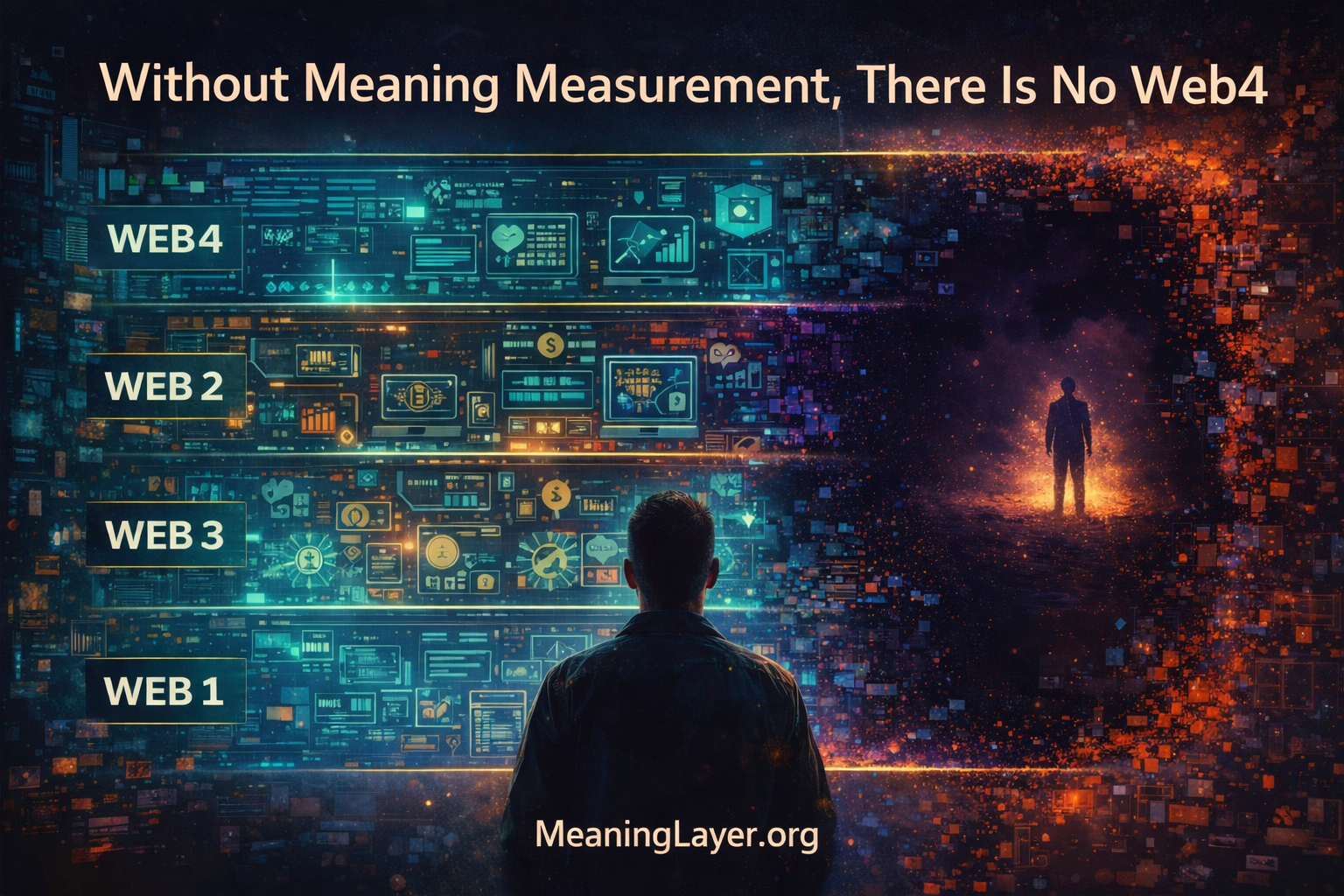
Web4’s definitional requirement is persistence verification. Not better AI. Not smarter systems. Infrastructure proving whether human capability persisted independently after platform usage ended and time passed. This is not optional feature – this is what makes Web4 architecturally different from Web2. Web2 measured engagement. Web3 measured ownership. Web4 measures persistence. Remove persistence verification and Web4 becomes meaningless category – just platforms optimizing metrics that systematically invert like Web2, with blockchain or AI or whatever technology happens to be current.
AI cannot provide this verification alone. AI can measure everything during AI-assisted performance. AI cannot measure what persists during AI absence after temporal separation. The measurement defining Web4 is precisely the measurement AI architecturally cannot perform. If Web4 relies on AI for its measurement infrastructure, Web4 gets metrics showing continuous improvement while human capability systematically degrades – identical pattern to Web2, just faster and harder to detect.
Without semantic layer, Web4 optimizes extraction. Any system measuring success through AI-accessible data systematically optimizes toward dependency creation because dependency improves measured metrics faster than capability building. Users becoming more dependent on platform show better engagement, higher usage, increased satisfaction – all measurable by AI. Users becoming more capable independently show declining engagement as they need platform less – appears as failure in AI measurement despite being genuine success. Optimization follows measurement. Measurement accessible to AI selects extraction. Web4 without semantic layer is Web2 with better AI.
MeaningLayer is this infrastructure. Not AI feature. Not platform capability. Independent measurement layer verifying whether information consumption, platform usage, AI interaction created human capability persisting independently through temporal testing. This layer is what makes Web4 possible – infrastructure distinguishing genuine capability building from dependency creation when both appear identical in AI-accessible metrics.
The architecture is specifically designed to be AI-independent: MeaningLayer does not measure through AI analyzing usage data. MeaningLayer measures through testing human capability when AI is absent, time has passed, assistance is unavailable. This independence is not limitation – this is requirement. Only measurement infrastructure operating outside AI’s domain can verify whether AI built or extracted capability.
- Protocols Over Platforms
The reason MeaningLayer cannot be platform feature is structural: platforms profit from metrics improving regardless of whether improvement is genuine or illusory. Semantic measurement infrastructure must exist as protocol – shared standard no platform controls, implemented independently, verifying persistence across all platforms and contexts.
Platform incentives oppose semantic measurement. Platforms optimize engagement, retention, growth. These metrics improve faster through dependency creation than capability building. Platform implementing true semantic measurement risks revealing its optimization extracted rather than enhanced capability – destroying competitive position relative to platforms hiding behind metrics that invert. First-mover disadvantage prevents any individual platform from voluntarily implementing measurement revealing their value proposition as extraction.
Protocols enable coordination. Standard semantic verification protocol creates level competitive field: all platforms measured by same persistence verification, all required to prove capability building rather than dependency creation, all users able to compare platforms through independent measurement rather than platform-provided metrics. This coordination solves prisoner’s dilemma – no platform punished for measuring what all platforms must measure, all platforms competing on verified outcomes rather than optimized metrics.
Independence requires protocol structure. Semantic measurement must verify capability persisting across platform changes, job transitions, context shifts. Platform-specific measurement cannot verify transfer – only shows performance within that platform’s domain. Protocol-level measurement spans all contexts, proving whether capability genuinely transferred or whether performance was platform-specific pattern requiring continued platform access. Transfer verification requires measurement infrastructure no single platform provides.
Portability demands open standards. Users must carry semantic verification across all systems – educational credentials verifying persistent learning, employment records proving capability development, skill certifications demonstrating independent function. Proprietary platform metrics lock users into platform proving those metrics. Open semantic protocols enable verified capability portability – users can demonstrate genuine capability to any system implementing verification protocol. Portability is Web4’s defining characteristic. Portability requires protocols not platforms.
This is why MeaningLayer exists as .org infrastructure rather than platform feature. Not ideology. Not preference. Architectural necessity: the measurement distinguishing Web4 from Web2 cannot exist within systems whose business models depend on measurement remaining blind to distinction between enhancement and extraction.
The protocol defines semantic verification standards: temporal testing methodology, independence verification requirements, transfer validation procedures, persistence measurement criteria. Any platform can implement. Any user can verify. Any employer can trust. No platform controls. This is what makes Web4 buildable – shared infrastructure for meaning measurement that platforms cannot provide because their incentives run opposite.
- What Gets Built When Meaning Is Measurable
Implementing semantic measurement infrastructure transforms what becomes economically viable and what becomes obsolete. Not through regulation or restriction. Through making genuine value creation distinguishable from extraction in ways that redirect optimization.
Educational systems verify learning occurred. Current credentials certify completion. Semantic verification proves capability persisted independently months after coursework ended. Test graduates without access to course materials, educational AI, platform assistance. If capability persists – learning verified. If capability collapsed – credential documented exposure rather than learning. Educational programs compete on verified learning outcomes rather than completion rates. Programs building genuine capability gain competitive advantage through MeaningLayer verification. Programs optimizing completion metrics without building persistent capability lose credibility when temporal testing reveals gap.
Employment proves capability development. Current hiring trusts credentials and resumes. Semantic verification tests whether claimed capability persists independently. Present candidate with problems at claimed skill level without assistance. If they can solve independently – capability verified. If they cannot function without AI/tools/platform access – claimed capability is dependency disguised as skill. Employment markets price accurately when capability is verifiable rather than assumed through credentials that could document exposure theater.
Platforms demonstrate value creation. Current metrics show engagement and satisfaction. Semantic verification proves whether usage built capability that persisted when usage ended. Test users months after platform experience without platform access at tasks platform claimed to enhance capability for. If capability improved persistently – genuine value verified. If capability requires continued platform access – dependency creation disguised as enhancement. Platforms compete on verified capability building rather than optimized engagement metrics. Users choose based on proven outcomes rather than satisfaction scores that could indicate addiction rather than value.
AI systems prove enhancement rather than extraction. Current AI deployment shows productivity improvement with AI present. Semantic verification tests whether improvement persists when AI is removed. Measure baseline capability, track AI-assisted performance, verify independent capability after temporal separation. If capability improved persistently – AI enhanced. If capability collapsed when AI removed – AI replaced capability while metrics showed enhancement. Organizations select AI proving genuine enhancement through MeaningLayer verification rather than AI optimizing dependency creation hidden by productivity metrics.
Value becomes portable across contexts. Current value locks into platforms – learning locked in educational system, skills locked to employers, contributions locked to platforms. Semantic verification creates portable capability proofs – verified learning transfers across educational institutions, verified skills transfer across employers, verified contributions transfer across platforms. Portability is possible because verification is protocol not platform feature. Users carry verified capability everywhere. Platforms cannot capture value that users can prove independently.
This transformation happens not through mandating semantic measurement but through enabling it. Once verification infrastructure exists, users demand it because it protects capability development. Employers require it because it distinguishes genuine skill from credential theater. Platforms providing it gain competitive advantage through demonstrated value. Markets shift toward verified persistence because measurement makes genuine value distinguishable from extraction for first time at scale.
VII. The Bridge Between Computation and Meaning
MeaningLayer is not anti-AI. MeaningLayer is the infrastructure making AI’s computational power serve human capability development rather than extract it. The layer is bridge – connecting AI’s pattern processing capability with verification that processing created meaningful human improvement.
AI computes. Generates text, analyzes data, optimizes processes, makes predictions, completes tasks. Computational capability increases continuously. Better models, larger datasets, more sophisticated architectures. Computation becomes more powerful, faster, cheaper, more accessible. This trajectory is technical inevitability.
Humans develop capability. Learn, understand, improve, transfer knowledge, apply independently, build on past learning. Capability development requires sustained effort, productive struggle, temporal persistence, independent function. This trajectory is what makes humans valuable beyond what any computation provides.
Semantic layer verifies connection. Did computation serve capability development? Did AI interaction build lasting understanding? Did platform usage create independent function? Did optimization enhance human capacity? These questions require measurement infrastructure bridging AI’s computational domain with human capability’s temporal domain.
Without bridge: AI optimizes metrics showing improvement while human capability systematically degrades. With bridge: AI optimization must demonstrate verified capability persistence to show genuine value. The bridge does not limit AI capability. The bridge requires AI demonstrate its capability served human development rather than extracted it.
The architecture is complementary. AI provides computational power humans lack. Humans provide meaning-making capability AI lacks. MeaningLayer verifies AI’s computation created conditions for human meaning-making to occur successfully. Not replacing AI. Not limiting AI. Requiring AI prove it enhanced rather than replaced the human capability making AI valuable in first place – capability to learn, understand, develop independently.
This complementarity is what makes Web4 possible: AI power plus human capability development verified through semantic measurement. Remove either component and Web4 collapses. AI without semantic verification becomes extraction engine. Semantic verification without AI becomes manual assessment that cannot scale. Together they create infrastructure where computational power provably serves human capability development at scale.
VIII. Why Current Attempts Fail
Multiple organizations attempt building measurement infrastructure for AI impact on human capability. All attempts fail for same structural reason: they measure within computational domain what requires measurement outside computational domain.
AI measuring AI impact. Systems using AI to analyze whether AI helped users. Structural impossibility: AI measures correlations in usage data. Genuine learning reveals itself through independent capability when AI is absent. AI cannot measure its own absence. Every AI-based measurement shows success metrics during AI presence. None verify capability surviving AI absence. Results systematically show AI enhanced capability because measurement occurs during conditions where AI presence improved performance – tautological confirmation bias built into measurement architecture.
Platform measuring platform value. Platforms tracking whether users improved through platform usage. Structural conflict: platforms profit from users needing platform continuously. Measurement revealing users became independent enough to not need platform threatens retention metrics driving revenue. Every platform-based measurement optimizes toward metrics compatible with continued platform dependency. Genuine capability building means declining platform necessity. Measurement cannot be trusted when measurer profits from measured not improving independently.
Self-reported learning. Users claiming whether they learned. Structural unreliability: humans cannot distinguish learning from exposure without temporal verification. Feeling like you learned feels identical to consuming information without capability building. Completion feels like accomplishment regardless of whether capability persisted. Satisfaction correlates with engagement not capability development. Self-report systematically shows learning occurred when only performance theater happened – measurement confusion between immediate experience and lasting capability.
Credential-based verification. Testing whether credential holders can perform certified skills. Structural gap: testing happens immediately after training when temporary performance patterns peak. Testing with assistance available when certification should prove independent capability. Testing in same context as training when transfer should be verified. Results show high pass rates during optimal conditions that guarantee inflation. True capability reveals itself through testing after temporal separation, without assistance, in novel contexts – conditions credential verification systematically avoids.
All current attempts share architectural flaw: measuring during conditions optimized to show success rather than conditions revealing whether success was genuine. Testing during AI presence rather than AI absence. Measuring immediately after training rather than months later. Verifying within same context rather than novel situations. Trusting self-report rather than independent assessment. Every approach guarantees measurement shows capability improved when systematic extraction could be occurring invisible to measurement architecture.
MeaningLayer succeeds through opposite architecture: Measurement during AI absence not presence. Testing after temporal separation not immediately. Verifying through novel contexts not training contexts. Independent assessment not self-report. Measuring what persists not what performs. Architecture specifically designed to reveal extraction when all other measurement shows enhancement.
- The Semantic Layer as Web4 Requirement
Web4 has definitional requirements that cannot be met through technology advancement alone. These requirements are architectural – infrastructural prerequisites that must exist before Web4 can function as intended.
Requirement: Verify persistence across time. Web4 must distinguish genuine capability improvement from temporary performance theater. This requires temporal verification infrastructure testing capability months after acquisition when assistance is absent. Current systems test during optimal conditions when assistance present. Web4 requires measurement infrastructure operating during suboptimal conditions when assistance deliberately removed. MeaningLayer provides this through Persisto Ergo Didici protocol.
Requirement: Prove independence from platforms. Web4 must enable users to carry value across platform boundaries. This requires independence verification proving capability persists when platform access ends. Current systems assume platform usage built capability without testing. Web4 requires verification platform usage built transferable capability not platform-specific dependency. MeaningLayer provides this through independence baseline testing and transfer validation.
Requirement: Measure across contexts. Web4 must verify capability generalizes beyond acquisition environment. This requires transfer testing proving capability applies in novel situations. Current systems test within training context where performance patterns optimized. Web4 requires measurement proving capability transfers to contexts different from training. MeaningLayer provides this through comparable difficulty assessment across varied contexts.
Requirement: Establish causation not correlation. Web4 must prove platforms caused capability improvement rather than merely correlated with it. This requires control groups and counterfactual analysis. Current systems lack unexposed populations to compare against. Web4 requires measurement infrastructure enabling causal claims about capability development. MeaningLayer provides this through Temporal Baseline Preservation while unexposed cohorts exist.
Requirement: Enable portable verification. Web4 must allow capability proofs to transfer across all systems. This requires open protocols not proprietary platforms. Current credentials lock into issuing institutions. Web4 requires verification standards any system can implement and trust. MeaningLayer provides this through protocol architecture rather than platform features.
These requirements are not technical challenges awaiting better AI. These are architectural necessities requiring infrastructure AI cannot provide because requirements demand measurement during AI’s deliberate absence. No amount of AI advancement creates capability to measure what requires testing when AI is intentionally excluded.
Web4 either builds semantic measurement layer as foundational infrastructure or becomes meaningless category – faster more sophisticated version of Web2’s extraction optimization appearing as enhancement while systematic capability degradation occurs invisible to measurement. The layer is not optional feature. The layer is definitional requirement separating Web4 from everything preceding it.
- What Must Be Built Now
The window for building semantic measurement infrastructure is finite and closing. Each cohort developing with ubiquitous AI and no temporal verification loses capacity to later demand such verification – they cannot miss what they never experienced. The infrastructure must be built while baseline capability still exists to validate measurement protocols.
Semantic verification standards. Open protocols defining how to test capability persistence, verify independence, validate transfer, measure across time. Standards must be platform-agnostic, implementable by any system, trusted across all contexts. MeaningLayer provides reference implementation but standard must be openly available for universal adoption. Build now or lose coordinated measurement forever.
Temporal testing infrastructure. Systems conducting capability verification after temporal separation without assistance availability. Not platform features but independent services proving persistence across all platforms. Infrastructure requiring investment from parties with no stake in whether testing reveals enhancement or extraction – neutral measurement as public good. Build now or optimization locks in patterns measurement would prevent.
Portable capability graphs. Measurement tracking capability development across all contexts, systems, platforms. Not owned by any platform. Portable across all environments. Proving what genuinely persisted versus what required specific platform access. Enables verified capability as transferable value rather than platform-locked dependency. Build now or value capture becomes permanent.
Independence verification marketplaces. Competitive ecosystem of services proving capability persistence through standardized protocols. Users choose verification services they trust. Platforms compete on verified outcomes. Employers accept verification from independent services rather than trusting platform metrics. Creates market for genuine value measurement rather than metric optimization. Build now or dependency becomes only economically viable model.
Transfer validation networks. Infrastructure proving capability generalizes across novel contexts. Tests spanning multiple domains, systems, situations. Verification that learning transferred rather than performance optimized to narrow context. Makes genuine understanding distinguishable from platform-specific patterns. Build now or transfer testing becomes structurally impossible through universal platform integration.
This infrastructure requires coordinated development by organizations recognizing semantic measurement as prerequisite for Web4 rather than feature to add later. Later is too late – once optimization selected dependency over capability at scale, measurement infrastructure revealing this cannot emerge because every institution optimized toward inverted metrics.
MeaningLayer initiates this infrastructure. Not as proprietary platform but as protocol other systems implement. Not as profit center but as public infrastructure enabling markets to price genuine value accurately. Not as AI feature but as bridge making AI serve human capability development measurably. The layer either gets built as foundational Web4 infrastructure or Web4 becomes impossible regardless of technological advancement.
Tempus probat veritatem. Time proves truth. And semantic verification proves meaning – distinguishing computational power serving human capability from computational power extracting it when both appear identical in metrics AI can measure.
MeaningLayer.org — The semantic measurement infrastructure Web4 requires: verifying whether AI interaction, platform usage, information consumption created human capability persisting independently across time and context.
Protocol: Persisto Ergo Didici — Temporal verification proving capability persistence when AI absent, distinguishing genuine learning from dependency theater when computational metrics show continuous improvement.
Architecture: Protocols over platforms – open standards for semantic verification that any system implements, no platform controls, enabling verified capability portability as Web4’s defining characteristic.
Articles Defining Web4 Infrastructure
Web4 Is Impossible Without Portable Identity
Web4 requires users can leave any platform carrying verified proof of contributions. When value cannot transfer with humans, platforms don’t serve humans—humans serve platforms. Portability is the only measurement distinguishing service from servitude.
We Replaced Truth With Throughput
Civilization replaced temporal verification with productivity metrics. Now optimization cannot distinguish success from collapse because both show rising throughput. Web4 restores time as the verifier proving what endures is true.
The Last Resume You’ll Ever Need
Web4 ends the era where your worth resets every time you change jobs. Your verified contributions will follow you everywhere through portable identity, proving genuine capability across all contexts forever.
Web4 Infrastructure Across Projects:
→ Web4 Is Not About AI – It’s About Time (AttentionDebt.org)
The definitional Web4 article: temporal verification proving what endured when assistance ended and time passed.
Rights and Usage
All materials published under MeaningLayer.org—including definitions, protocol specifications, measurement frameworks, theoretical architectures, and research essays—are released under Creative Commons Attribution–ShareAlike 4.0 International (CC BY-SA 4.0).
This license guarantees three permanent rights:
1. Right to Reproduce
Anyone may copy, quote, translate, or redistribute this material freely, with attribution to MeaningLayer.org.
How to attribute:
- For articles/publications: ”Source: MeaningLayer.org”
- For academic citations: ”MeaningLayer.org (2025). [Title]. Retrieved from https://meaninglayer.org”
- For social media/informal use: ”via MeaningLayer.org” or link directly
2. Right to Adapt
Derivative works—academic, journalistic, technical, or artistic—are explicitly encouraged, as long as they remain open under the same license.
Researchers, developers, and institutions may:
- Build implementations of MeaningLayer protocols
- Adapt measurement frameworks for specific domains
- Translate concepts into other languages or contexts
- Create tools based on these specifications
All derivatives must remain open under CC BY-SA 4.0. No proprietary capture.
3. Right to Defend the Definition
Any party may publicly reference this framework to prevent private appropriation, trademark capture, or paywalling of the core terms:
- ”MeaningLayer”
- ”Meaning Protocol”
- ”Meaning Graph”
No exclusive licenses will ever be granted. No commercial entity may claim proprietary rights to these core concepts or measurement methodologies.
Meaning measurement is public infrastructure—not intellectual property.
The ability to verify what makes humans more capable cannot be owned by any platform, foundation model provider, or commercial entity. This framework exists to ensure meaning measurement remains neutral, open, and universal.
2025-12-21